

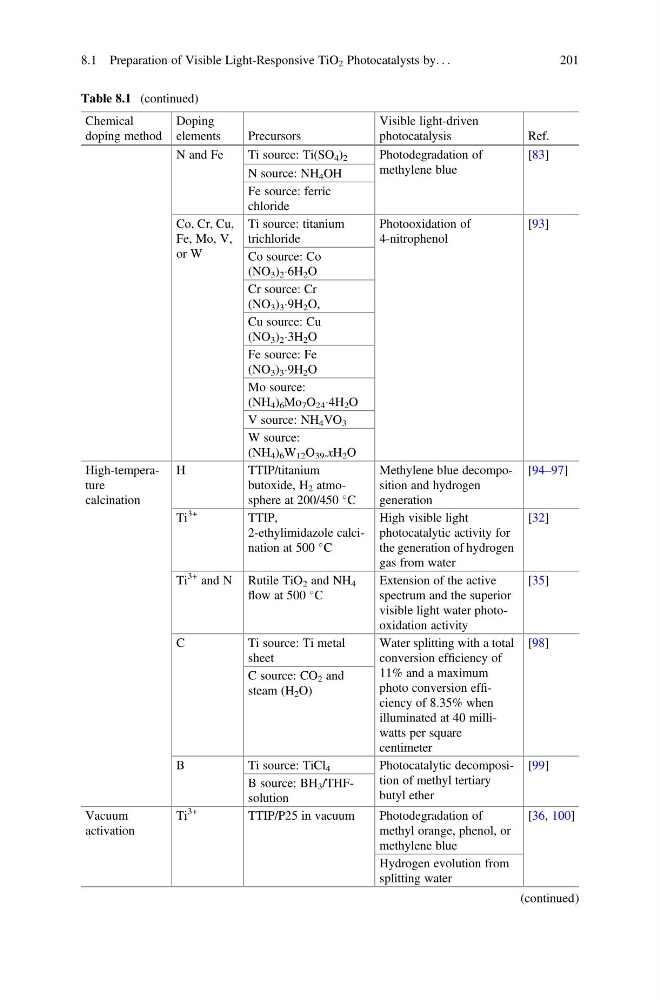
Table 8.1 (continued)
Chemical
doping method
Doping
elements
Precursors
Visible light-driven
photocatalysis
Ref.
N and Fe
Ti source: Ti(SO 4 ) 2
Photodegradation of
methylene blue
[83]
N source: NH 4 OH
Fe source: ferric
chloride
Co, Cr, Cu,
Fe, Mo, V,
or W
Ti source: titanium
trichloride
Photooxidation of
4-nitrophenol
[93]
Co source: Co
(NO 3 ) 2 Á6H 2 O
Cr source: Cr
(NO 3 ) 3 Á9H 2 O,
Cu source: Cu
(NO 3 ) 2 Á3H 2 O
Fe source: Fe
(NO 3 ) 3 Á9H 2 O
Mo source:
(NH 4 ) 6 Mo 7 O 24 Á4H 2 O
V source: NH 4 VO 3
W source:
(NH 4 ) 6 W 12 O 39 .xH 2 O
High-temperature
calcination
H
TTIP/titanium
butoxide, H 2 atmosphere at 200/450
C
Methylene blue decomposition and hydrogen
generation
[94–97]
Ti
3+
TTIP,
2-ethylimidazole calcination at 500
C
High visible light
photocatalytic activity for
the generation of hydrogen
gas from water
[32]
Ti
3+ and N Rutile TiO 2 and NH 4
flow at 500
C
Extension of the active
spectrum and the superior
visible light water photooxidation activity
[35]
C
Ti source: Ti metal
sheet
Water splitting with a total
conversion efficiency of
11% and a maximum
photo conversion efficiency of 8.35% when
illuminated at 40 milliwatts per square
centimeter
[98]
C source: CO 2 and
steam (H 2 O)
B
Ti source: TiCl 4
Photocatalytic decomposition of methyl tertiary
butyl ether
[99]
B source: BH 3 /THFsolution
Vacuum
activation
Ti
3+
TTIP/P25 in vacuum
Photodegradation of
methyl orange, phenol, or
methylene blue
[36, 100]
Hydrogen evolution from
splitting water
(continued)
8.1 Preparation of Visible Light-Responsive TiO 2 Photocatalysts by. . .
201
Chemical
doping method
Doping
elements
Precursors
Visible light-driven
photocatalysis
Ref.
N and Fe
Ti source: Ti(SO 4 ) 2
Photodegradation of
methylene blue
[83]
N source: NH 4 OH
Fe source: ferric
chloride
Co, Cr, Cu,
Fe, Mo, V,
or W
Ti source: titanium
trichloride
Photooxidation of
4-nitrophenol
[93]
Co source: Co
(NO 3 ) 2 Á6H 2 O
Cr source: Cr
(NO 3 ) 3 Á9H 2 O,
Cu source: Cu
(NO 3 ) 2 Á3H 2 O
Fe source: Fe
(NO 3 ) 3 Á9H 2 O
Mo source:
(NH 4 ) 6 Mo 7 O 24 Á4H 2 O
V source: NH 4 VO 3
W source:
(NH 4 ) 6 W 12 O 39 .xH 2 O
High-temperature
calcination
H
TTIP/titanium
butoxide, H 2 atmosphere at 200/450
C
Methylene blue decomposition and hydrogen
generation
[94–97]
Ti
3+
TTIP,
2-ethylimidazole calcination at 500
C
High visible light
photocatalytic activity for
the generation of hydrogen
gas from water
[32]
Ti
3+ and N Rutile TiO 2 and NH 4
flow at 500
C
Extension of the active
spectrum and the superior
visible light water photooxidation activity
[35]
C
Ti source: Ti metal
sheet
Water splitting with a total
conversion efficiency of
11% and a maximum
photo conversion efficiency of 8.35% when
illuminated at 40 milliwatts per square
centimeter
[98]
C source: CO 2 and
steam (H 2 O)
B
Ti source: TiCl 4
Photocatalytic decomposition of methyl tertiary
butyl ether
[99]
B source: BH 3 /THFsolution
Vacuum
activation
Ti
3+
TTIP/P25 in vacuum
Photodegradation of
methyl orange, phenol, or
methylene blue
[36, 100]
Hydrogen evolution from
splitting water
(continued)
8.1 Preparation of Visible Light-Responsive TiO 2 Photocatalysts by. . .
201