

be adjusted by tuning the treatment temperature in the synthesis process of the
composite catalyst, and the g-C 3 N 4 /TiO 2 nanocomposite prepared at 450
C
exhibited the best photocatalytic performance, which was much higher than the
pure TiO 2 . In addition to the preparation temperature, the mass ratio between g-C 3 N 4
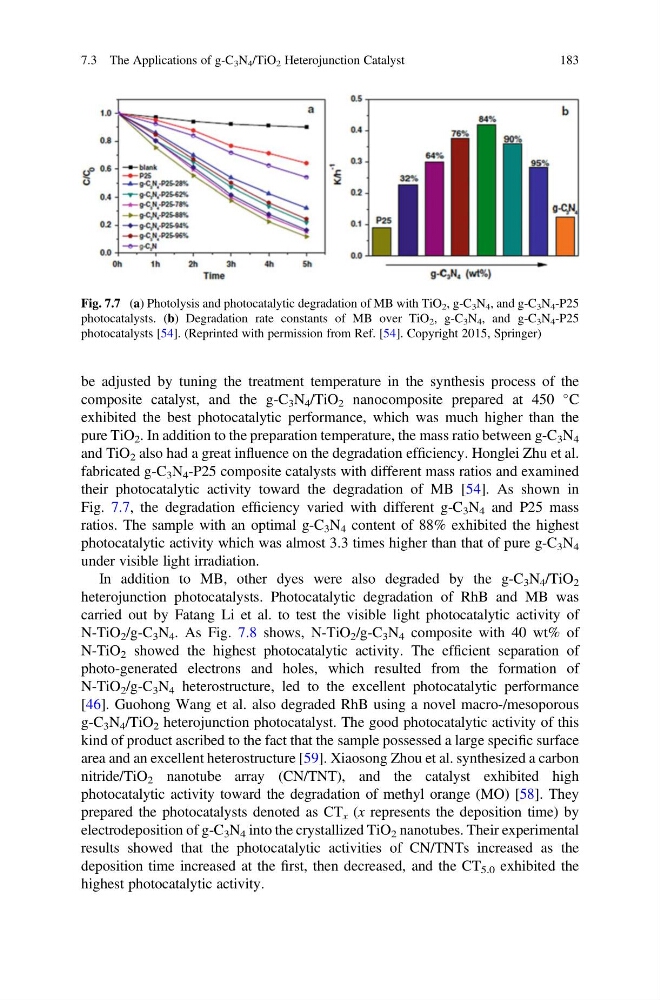
and TiO 2 also had a great influence on the degradation efficiency. Honglei Zhu et al.
fabricated g-C 3 N 4 -P25 composite catalysts with different mass ratios and examined
their photocatalytic activity toward the degradation of MB [54]. As shown in
Fig. 7.7, the degradation efficiency varied with different g-C 3 N 4 and P25 mass
ratios. The sample with an optimal g-C 3 N 4 content of 88% exhibited the highest
photocatalytic activity which was almost 3.3 times higher than that of pure g-C 3 N 4
under visible light irradiation.
In addition to MB, other dyes were also degraded by the g-C 3 N 4 /TiO 2
heterojunction photocatalysts. Photocatalytic degradation of RhB and MB was
carried out by Fatang Li et al. to test the visible light photocatalytic activity of
N-TiO 2 /g-C 3 N 4 . As Fig. 7.8 shows, N-TiO 2 /g-C 3 N 4 composite with 40 wt% of
N-TiO 2 showed the highest photocatalytic activity. The efficient separation of
photo-generated electrons and holes, which resulted from the formation of
N-TiO 2 /g-C 3 N 4 heterostructure, led to the excellent photocatalytic performance
[46]. Guohong Wang et al. also degraded RhB using a novel macro-/mesoporous
g-C 3 N 4 /TiO 2 heterojunction photocatalyst. The good photocatalytic activity of this
kind of product ascribed to the fact that the sample possessed a large specific surface
area and an excellent heterostructure [59]. Xiaosong Zhou et al. synthesized a carbon
nitride/TiO 2 nanotube array (CN/TNT), and the catalyst exhibited high
photocatalytic activity toward the degradation of methyl orange (MO) [58]. They
prepared the photocatalysts denoted as CT x (x represents the deposition time) by
electrodeposition of g-C 3 N 4 into the crystallized TiO 2 nanotubes. Their experimental
results showed that the photocatalytic activities of CN/TNTs increased as the
deposition time increased at the first, then decreased, and the CT 5.0 exhibited the
highest photocatalytic activity.
Fig. 7.7 (a) Photolysis and photocatalytic degradation of MB with TiO 2 , g-C 3 N 4 , and g-C 3 N 4 -P25
photocatalysts. (b) Degradation rate constants of MB over TiO 2 , g-C 3 N 4 , and g-C 3 N 4 -P25
photocatalysts [54]. (Reprinted with permission from Ref. [54]. Copyright 2015, Springer)
7.3 The Applications of g-C 3 N 4 /TiO 2 Heterojunction Catalyst
183
composite catalyst, and the g-C 3 N 4 /TiO 2 nanocomposite prepared at 450
C
exhibited the best photocatalytic performance, which was much higher than the
pure TiO 2 . In addition to the preparation temperature, the mass ratio between g-C 3 N 4
and TiO 2 also had a great influence on the degradation efficiency. Honglei Zhu et al.
fabricated g-C 3 N 4 -P25 composite catalysts with different mass ratios and examined
their photocatalytic activity toward the degradation of MB [54]. As shown in
Fig. 7.7, the degradation efficiency varied with different g-C 3 N 4 and P25 mass
ratios. The sample with an optimal g-C 3 N 4 content of 88% exhibited the highest
photocatalytic activity which was almost 3.3 times higher than that of pure g-C 3 N 4
under visible light irradiation.
In addition to MB, other dyes were also degraded by the g-C 3 N 4 /TiO 2
heterojunction photocatalysts. Photocatalytic degradation of RhB and MB was
carried out by Fatang Li et al. to test the visible light photocatalytic activity of
N-TiO 2 /g-C 3 N 4 . As Fig. 7.8 shows, N-TiO 2 /g-C 3 N 4 composite with 40 wt% of
N-TiO 2 showed the highest photocatalytic activity. The efficient separation of
photo-generated electrons and holes, which resulted from the formation of
N-TiO 2 /g-C 3 N 4 heterostructure, led to the excellent photocatalytic performance
[46]. Guohong Wang et al. also degraded RhB using a novel macro-/mesoporous
g-C 3 N 4 /TiO 2 heterojunction photocatalyst. The good photocatalytic activity of this
kind of product ascribed to the fact that the sample possessed a large specific surface
area and an excellent heterostructure [59]. Xiaosong Zhou et al. synthesized a carbon
nitride/TiO 2 nanotube array (CN/TNT), and the catalyst exhibited high
photocatalytic activity toward the degradation of methyl orange (MO) [58]. They
prepared the photocatalysts denoted as CT x (x represents the deposition time) by
electrodeposition of g-C 3 N 4 into the crystallized TiO 2 nanotubes. Their experimental
results showed that the photocatalytic activities of CN/TNTs increased as the
deposition time increased at the first, then decreased, and the CT 5.0 exhibited the
highest photocatalytic activity.
Fig. 7.7 (a) Photolysis and photocatalytic degradation of MB with TiO 2 , g-C 3 N 4 , and g-C 3 N 4 -P25
photocatalysts. (b) Degradation rate constants of MB over TiO 2 , g-C 3 N 4 , and g-C 3 N 4 -P25
photocatalysts [54]. (Reprinted with permission from Ref. [54]. Copyright 2015, Springer)
7.3 The Applications of g-C 3 N 4 /TiO 2 Heterojunction Catalyst
183