

determining factors for the photocatalytic activity of mixed-phase crystal TiO 2
contain grain size, structural forms (core–shell structure, cladding structure, random
composite, etc.), phase composition, and so on. These factors cause the emergence
of bending band, trapping sites, and other phenomena in the mixed-phase TiO 2 .
Therefore, the obtained mixed-phase TiO 2 differ in photocatalytic mechanism on
different experimental conditions, so further research is still required.
6.6 Conclusion and Outlook
In the field of photocatalysis, since it was discovered that TiO 2 nanomaterials could
be used for photocatalytic water splitting and degradation of organic pollutants in the
1970s, the synthetic methods and applications of mixed-phase TiO 2 have achieved
great progress. The superior photocatalytic performance of mixed-phase TiO 2 to
single-phase TiO 2 has been well recognized, and the mechanism of the improved
photocatalytic activities of the mixed-phase TiO 2 photocatalysts has also been
widely studied. However, there are still many problems remaining to be resolved.
For instance, (1) particulate mixed-phase TiO 2 nanomaterials are easy to agglomerate, which will greatly inhibit the photocatalytic activity and impede the further
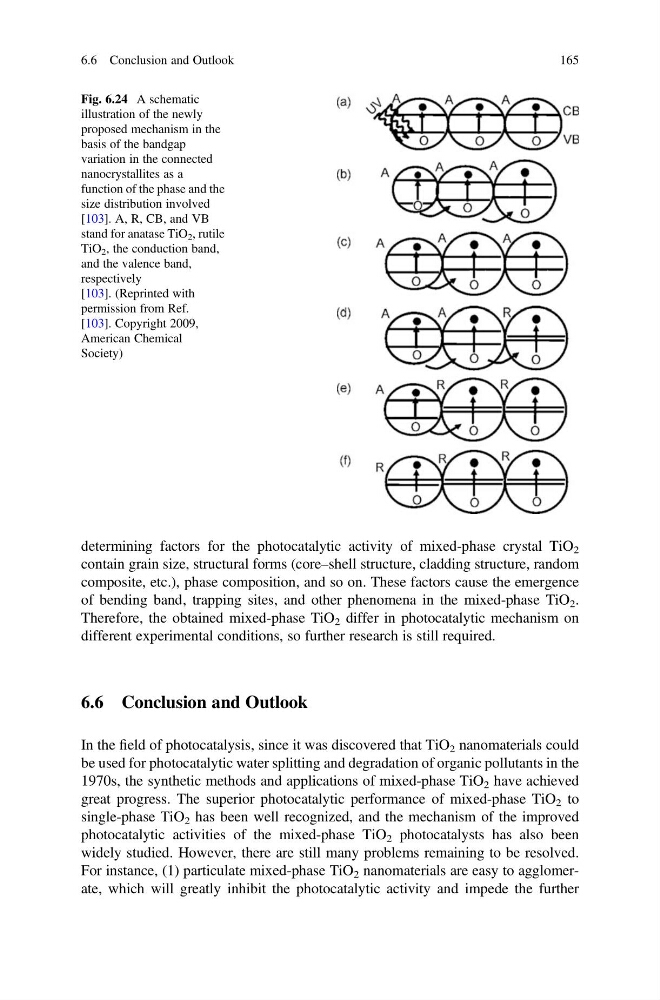
Fig. 6.24 A schematic
illustration of the newly
proposed mechanism in the
basis of the bandgap
variation in the connected
nanocrystallites as a
function of the phase and the
size distribution involved
[103]. A, R, CB, and VB
stand for anatase TiO 2 , rutile
TiO 2 , the conduction band,
and the valence band,
respectively
[103]. (Reprinted with
permission from Ref.
[103]. Copyright 2009,
American Chemical
Society)
6.6 Conclusion and Outlook
165
contain grain size, structural forms (core–shell structure, cladding structure, random
composite, etc.), phase composition, and so on. These factors cause the emergence
of bending band, trapping sites, and other phenomena in the mixed-phase TiO 2 .
Therefore, the obtained mixed-phase TiO 2 differ in photocatalytic mechanism on
different experimental conditions, so further research is still required.
6.6 Conclusion and Outlook
In the field of photocatalysis, since it was discovered that TiO 2 nanomaterials could
be used for photocatalytic water splitting and degradation of organic pollutants in the
1970s, the synthetic methods and applications of mixed-phase TiO 2 have achieved
great progress. The superior photocatalytic performance of mixed-phase TiO 2 to
single-phase TiO 2 has been well recognized, and the mechanism of the improved
photocatalytic activities of the mixed-phase TiO 2 photocatalysts has also been
widely studied. However, there are still many problems remaining to be resolved.
For instance, (1) particulate mixed-phase TiO 2 nanomaterials are easy to agglomerate, which will greatly inhibit the photocatalytic activity and impede the further
Fig. 6.24 A schematic
illustration of the newly
proposed mechanism in the
basis of the bandgap
variation in the connected
nanocrystallites as a
function of the phase and the
size distribution involved
[103]. A, R, CB, and VB
stand for anatase TiO 2 , rutile
TiO 2 , the conduction band,
and the valence band,
respectively
[103]. (Reprinted with
permission from Ref.
[103]. Copyright 2009,
American Chemical
Society)
6.6 Conclusion and Outlook
165