

(•OH) (i.e., surface-trapped h
+
) or directly via h
+ attached on the metal surfaces,
before it is trapped within the particle or at its surface.
h
þ
þ H 2 O ads ÀÀÀ À!
• OH ads þ h
þ
ð1:3Þ
h
þ
þ HO
À
ads ÀÀÀ À!
• OH ads
ð1:4Þ
h
þ
þ M
nþ
ads ÀÀÀÀ! M ads
nþ1
ð
Þþ
ð1:5Þ
These produced surface hydroxyl radicals contain enormous power to oxide the
pollutants and hence mineralize them completely. Scheme 1.1 shows the formation
of different oxide species by the reactions of electrons and holes through various
pathways.
On the other hand, the electrons from the photoexcitation must also react to avoid
accumulation of excess charges within the catalyst particles. Therefore, the efficient
removal of the electrons can enhance the photocatalytic oxidation of the pollutants.
Oxygen is commonly employed as electron scavenger if the overall reaction target is
oxidation of dyes or organic compounds as it is very cost-effective and can be able to
dissolve in aqueous and other solutions. After the attack of the electron on the
oxygen, it can be reduced to the different oxygen activated species given by the
following equations:
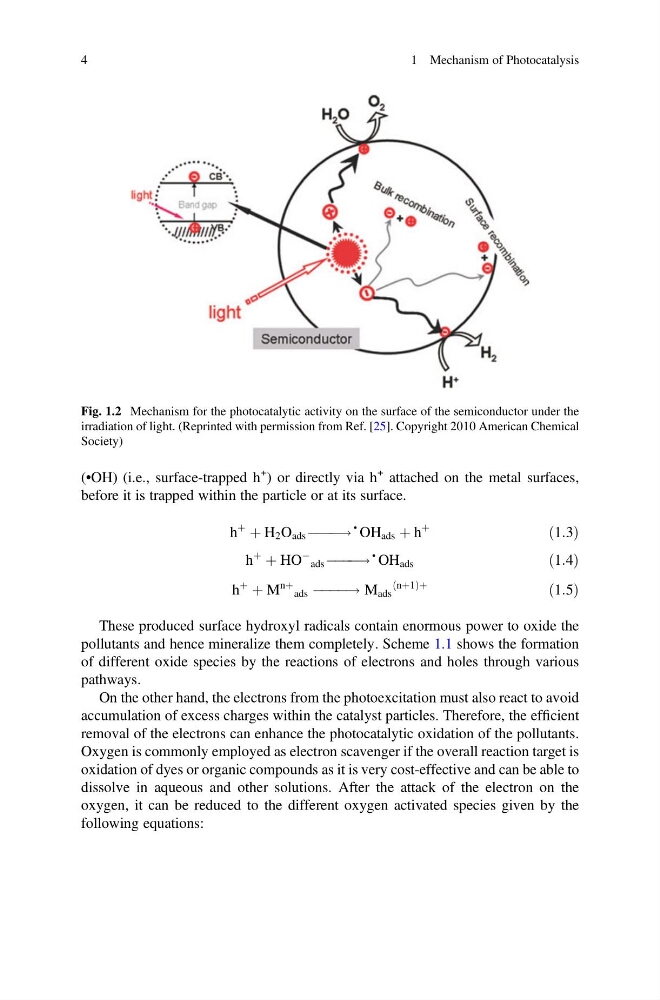
Fig. 1.2 Mechanism for the photocatalytic activity on the surface of the semiconductor under the
irradiation of light. (Reprinted with permission from Ref. [25]. Copyright 2010 American Chemical
Society)
4
1 Mechanism of Photocatalysis
+
) or directly via h
+ attached on the metal surfaces,
before it is trapped within the particle or at its surface.
h
þ
þ H 2 O ads ÀÀÀ À!
• OH ads þ h
þ
ð1:3Þ
h
þ
þ HO
À
ads ÀÀÀ À!
• OH ads
ð1:4Þ
h
þ
þ M
nþ
ads ÀÀÀÀ! M ads
nþ1
ð
Þþ
ð1:5Þ
These produced surface hydroxyl radicals contain enormous power to oxide the
pollutants and hence mineralize them completely. Scheme 1.1 shows the formation
of different oxide species by the reactions of electrons and holes through various
pathways.
On the other hand, the electrons from the photoexcitation must also react to avoid
accumulation of excess charges within the catalyst particles. Therefore, the efficient
removal of the electrons can enhance the photocatalytic oxidation of the pollutants.
Oxygen is commonly employed as electron scavenger if the overall reaction target is
oxidation of dyes or organic compounds as it is very cost-effective and can be able to
dissolve in aqueous and other solutions. After the attack of the electron on the
oxygen, it can be reduced to the different oxygen activated species given by the
following equations:
Fig. 1.2 Mechanism for the photocatalytic activity on the surface of the semiconductor under the
irradiation of light. (Reprinted with permission from Ref. [25]. Copyright 2010 American Chemical
Society)
4
1 Mechanism of Photocatalysis