

TiO 2 þ hν ÀÀÀÀ! e
À
þ h
þ
ð1:1Þ
These photo-generated electrons and holes can possibly recombine by releasing
the heat between 10 nanoseconds and 100 nanoseconds as mentioned by Hofmann
et al. by the measurement with the laser flash photolysis at room temperature
[3]. This recombination of the electrons and holes causes the low quantum efficiency
of the photocatalyst.
e
À
þ h
þ
ÀÀÀÀ! heat
ð1:2Þ
The reports on the mechanism of the photocatalysis indicate that the recombination of photo-generated electrons and holes mainly occurs in the bulk of the catalyst
samples. This recombination process of the electrons and holes can be reduced
significantly if these charge-carrier species are separated by the addition of suitable
scavenger or incorporation of some of the trap sites on the surface as a result of
producing defects, surface adsorbents, or other sites.
If we provide sufficient time to the holes and electrons before they recombine,
then these produced charge carriers migrate to the surface of the catalyst and can
undergo the charge transfer to initiate the redox reactions with the pollutants
adsorbed on its surface which is shown in Fig. 1.2.
A valence band hole, h
+
, contains a strong oxidation power by having a redox
potential ranging from +1.0 to +3.5 V (measured vs normal hydrogen electrode
(NHE) at room temperature), depending on the semiconductor and pH. Thus, the
presence of the hole plays an important role in the photocatalytic degradation of the
pollutant present on the surface of the catalyst. The oxidation can take place either
due to the indirect oxidation via reaction with the surface-bound hydroxyl radical
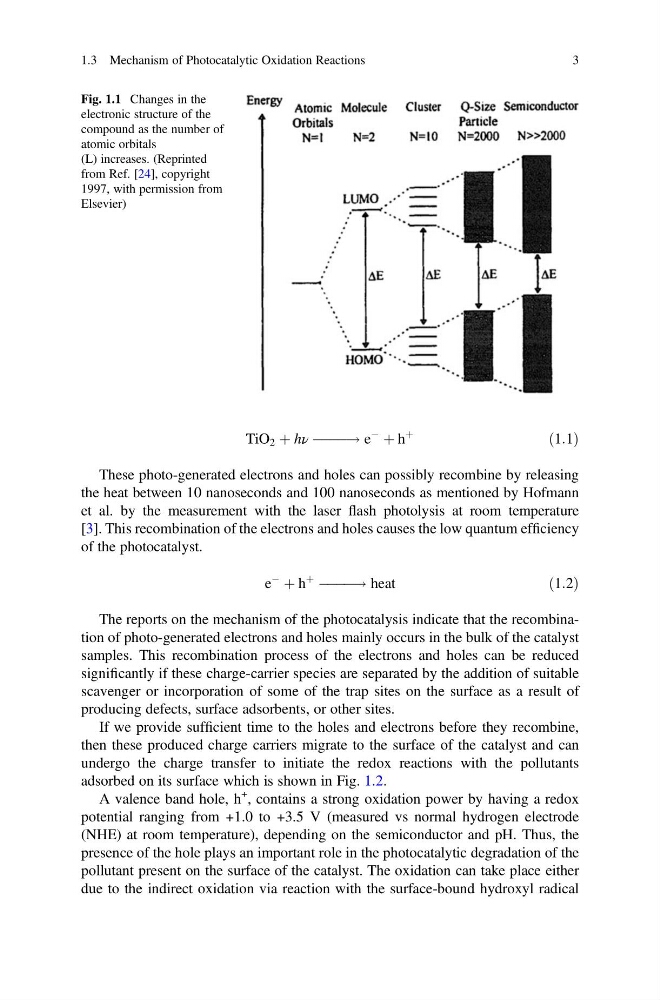
Fig. 1.1 Changes in the
electronic structure of the
compound as the number of
atomic orbitals
(L) increases. (Reprinted
from Ref. [24], copyright
1997, with permission from
Elsevier)
1.3 Mechanism of Photocatalytic Oxidation Reactions
3
À
þ h
þ
ð1:1Þ
These photo-generated electrons and holes can possibly recombine by releasing
the heat between 10 nanoseconds and 100 nanoseconds as mentioned by Hofmann
et al. by the measurement with the laser flash photolysis at room temperature
[3]. This recombination of the electrons and holes causes the low quantum efficiency
of the photocatalyst.
e
À
þ h
þ
ÀÀÀÀ! heat
ð1:2Þ
The reports on the mechanism of the photocatalysis indicate that the recombination of photo-generated electrons and holes mainly occurs in the bulk of the catalyst
samples. This recombination process of the electrons and holes can be reduced
significantly if these charge-carrier species are separated by the addition of suitable
scavenger or incorporation of some of the trap sites on the surface as a result of
producing defects, surface adsorbents, or other sites.
If we provide sufficient time to the holes and electrons before they recombine,
then these produced charge carriers migrate to the surface of the catalyst and can
undergo the charge transfer to initiate the redox reactions with the pollutants
adsorbed on its surface which is shown in Fig. 1.2.
A valence band hole, h
+
, contains a strong oxidation power by having a redox
potential ranging from +1.0 to +3.5 V (measured vs normal hydrogen electrode
(NHE) at room temperature), depending on the semiconductor and pH. Thus, the
presence of the hole plays an important role in the photocatalytic degradation of the
pollutant present on the surface of the catalyst. The oxidation can take place either
due to the indirect oxidation via reaction with the surface-bound hydroxyl radical
Fig. 1.1 Changes in the
electronic structure of the
compound as the number of
atomic orbitals
(L) increases. (Reprinted
from Ref. [24], copyright
1997, with permission from
Elsevier)
1.3 Mechanism of Photocatalytic Oxidation Reactions
3