

decrease of the condensation reaction rate of TiO 6 octahedra to form rutile TiO 2 with
better thermodynamically stability (Fig. 6.7d, e).
Mixed-phase TiO 2 crystals with small particles and high purity can be obtained
by the sol–gel method, but the experimental procedure usually requires longtime
aging, and the agglomeration of particles is easy to occur after high-temperature
calcination, which may cause significant decrease of the photocatalytic activity.
6.3.4 Solvent Mixing and Calcination Method
The solvent mixing and calcination method (SMC method) means to mix TiO 2 with
different phases in a certain solvent at first and then to evaporate the solvent
completely, finally followed by calcinations at high temperature in order to make a
close contact among different crystal phases. Zachariah et al. [103] prepared anatase/
rutile mixed-phase TiO 2 by the SMC method wherein anhydrous isopropanol was
used as the solvent. According to the Scherrer equation, the crystalline calculated
size of pure anatase was 10 nm, and the grain size of pure rutile was 40 nm. In the
resultant mixed-phase TiO 2 containing 40% rutile, the size of anatase was 29 nm and
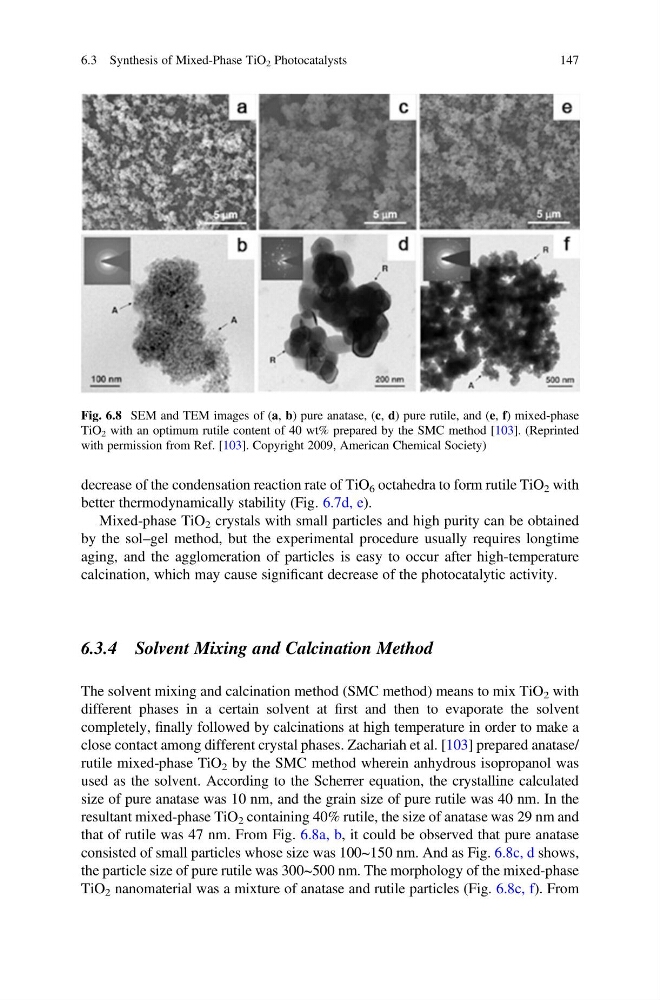
that of rutile was 47 nm. From Fig. 6.8a, b, it could be observed that pure anatase
consisted of small particles whose size was 100~150 nm. And as Fig. 6.8c, d shows,
the particle size of pure rutile was 300~500 nm. The morphology of the mixed-phase
TiO 2 nanomaterial was a mixture of anatase and rutile particles (Fig. 6.8c, f). From
Fig. 6.8 SEM and TEM images of (a, b) pure anatase, (c, d) pure rutile, and (e, f) mixed-phase
TiO 2 with an optimum rutile content of 40 wt% prepared by the SMC method [103]. (Reprinted
with permission from Ref. [103]. Copyright 2009, American Chemical Society)
6.3 Synthesis of Mixed-Phase TiO 2 Photocatalysts
147
better thermodynamically stability (Fig. 6.7d, e).
Mixed-phase TiO 2 crystals with small particles and high purity can be obtained
by the sol–gel method, but the experimental procedure usually requires longtime
aging, and the agglomeration of particles is easy to occur after high-temperature
calcination, which may cause significant decrease of the photocatalytic activity.
6.3.4 Solvent Mixing and Calcination Method
The solvent mixing and calcination method (SMC method) means to mix TiO 2 with
different phases in a certain solvent at first and then to evaporate the solvent
completely, finally followed by calcinations at high temperature in order to make a
close contact among different crystal phases. Zachariah et al. [103] prepared anatase/
rutile mixed-phase TiO 2 by the SMC method wherein anhydrous isopropanol was
used as the solvent. According to the Scherrer equation, the crystalline calculated
size of pure anatase was 10 nm, and the grain size of pure rutile was 40 nm. In the
resultant mixed-phase TiO 2 containing 40% rutile, the size of anatase was 29 nm and
that of rutile was 47 nm. From Fig. 6.8a, b, it could be observed that pure anatase
consisted of small particles whose size was 100~150 nm. And as Fig. 6.8c, d shows,
the particle size of pure rutile was 300~500 nm. The morphology of the mixed-phase
TiO 2 nanomaterial was a mixture of anatase and rutile particles (Fig. 6.8c, f). From
Fig. 6.8 SEM and TEM images of (a, b) pure anatase, (c, d) pure rutile, and (e, f) mixed-phase
TiO 2 with an optimum rutile content of 40 wt% prepared by the SMC method [103]. (Reprinted
with permission from Ref. [103]. Copyright 2009, American Chemical Society)
6.3 Synthesis of Mixed-Phase TiO 2 Photocatalysts
147