

in the sol–gel reaction system. Firstly, the hydrolysis of titanium precursor forms a
sol. After aging the sol for a certain time, a three-dimensional cross-linked gel is
obtained, and amorphous white powder is obtained by grinding the gel. Finally,
crystallized TiO 2 is obtained by the treatment of the calcination at a certain high
temperature.
Scotti et al. [52] prepared anatase/rutile mixed-phase TiO 2 crystal by a sol–gel
method and studied the effects of HCl/Ti and H 2 O/Ti molar ratio on the phase type of
TiO 2 crystal. At first, TiCl 4 and triblock copolymer were dissolved in ethanol. Then
water and HCl were added to adjust the pH of the solution, obtaining a sol. After
aging the sol for 3–13 days, a gel was formed. After drying and calcination, mixedphase TiO 2 crystals consisting of anatase and rutile in different content were
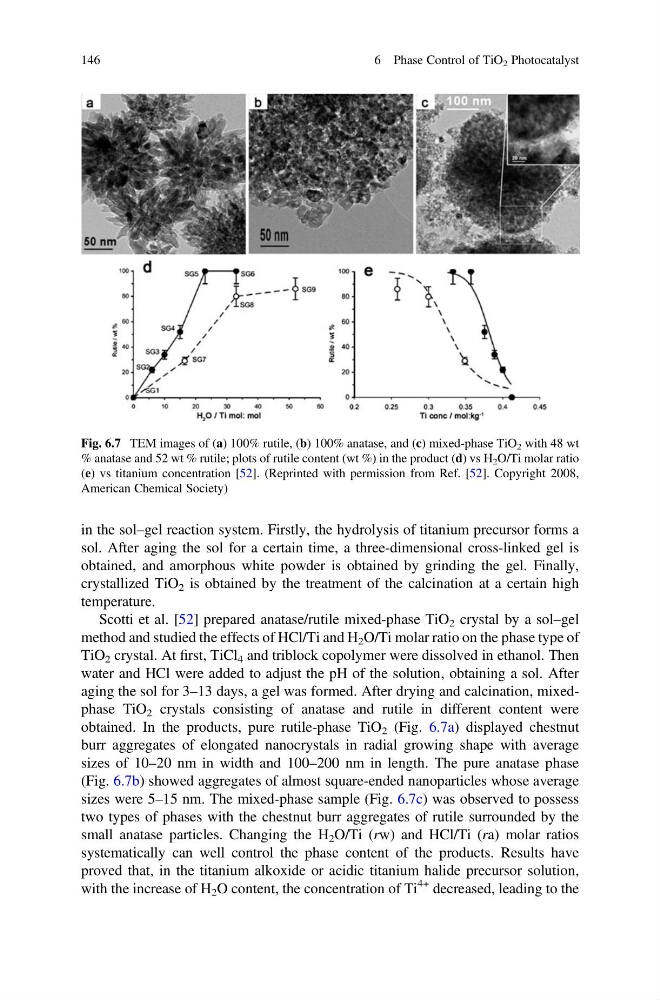
obtained. In the products, pure rutile-phase TiO 2 (Fig. 6.7a) displayed chestnut
burr aggregates of elongated nanocrystals in radial growing shape with average
sizes of 10–20 nm in width and 100–200 nm in length. The pure anatase phase
(Fig. 6.7b) showed aggregates of almost square-ended nanoparticles whose average
sizes were 5–15 nm. The mixed-phase sample (Fig. 6.7c) was observed to possess
two types of phases with the chestnut burr aggregates of rutile surrounded by the
small anatase particles. Changing the H 2 O/Ti (rw) and HCl/Ti (ra) molar ratios
systematically can well control the phase content of the products. Results have
proved that, in the titanium alkoxide or acidic titanium halide precursor solution,
with the increase of H 2 O content, the concentration of Ti
4+ decreased, leading to the
Fig. 6.7 TEM images of (a) 100% rutile, (b) 100% anatase, and (c) mixed-phase TiO 2 with 48 wt
% anatase and 52 wt % rutile; plots of rutile content (wt %) in the product (d) vs H 2 O/Ti molar ratio
(e) vs titanium concentration [52]. (Reprinted with permission from Ref. [52]. Copyright 2008,
American Chemical Society)
146
6 Phase Control of TiO 2 Photocatalyst
sol. After aging the sol for a certain time, a three-dimensional cross-linked gel is
obtained, and amorphous white powder is obtained by grinding the gel. Finally,
crystallized TiO 2 is obtained by the treatment of the calcination at a certain high
temperature.
Scotti et al. [52] prepared anatase/rutile mixed-phase TiO 2 crystal by a sol–gel
method and studied the effects of HCl/Ti and H 2 O/Ti molar ratio on the phase type of
TiO 2 crystal. At first, TiCl 4 and triblock copolymer were dissolved in ethanol. Then
water and HCl were added to adjust the pH of the solution, obtaining a sol. After
aging the sol for 3–13 days, a gel was formed. After drying and calcination, mixedphase TiO 2 crystals consisting of anatase and rutile in different content were
obtained. In the products, pure rutile-phase TiO 2 (Fig. 6.7a) displayed chestnut
burr aggregates of elongated nanocrystals in radial growing shape with average
sizes of 10–20 nm in width and 100–200 nm in length. The pure anatase phase
(Fig. 6.7b) showed aggregates of almost square-ended nanoparticles whose average
sizes were 5–15 nm. The mixed-phase sample (Fig. 6.7c) was observed to possess
two types of phases with the chestnut burr aggregates of rutile surrounded by the
small anatase particles. Changing the H 2 O/Ti (rw) and HCl/Ti (ra) molar ratios
systematically can well control the phase content of the products. Results have
proved that, in the titanium alkoxide or acidic titanium halide precursor solution,
with the increase of H 2 O content, the concentration of Ti
4+ decreased, leading to the
Fig. 6.7 TEM images of (a) 100% rutile, (b) 100% anatase, and (c) mixed-phase TiO 2 with 48 wt
% anatase and 52 wt % rutile; plots of rutile content (wt %) in the product (d) vs H 2 O/Ti molar ratio
(e) vs titanium concentration [52]. (Reprinted with permission from Ref. [52]. Copyright 2008,
American Chemical Society)
146
6 Phase Control of TiO 2 Photocatalyst