

aqueous phase. Then the aqueous phase was added dropwise to the oil phase to form
a clear microemulsion. After that, the obtained solution was solvothermally treated
below 120
C for 13 h to produce the mixed-phase TiO 2 . The surface area of the
resultant product is about 86~169 m
2 /g. Besides grain size of anatase is 15 nm and
that of rutile is about 10 nm. Their results showed that the adjustment of SO 4
2À
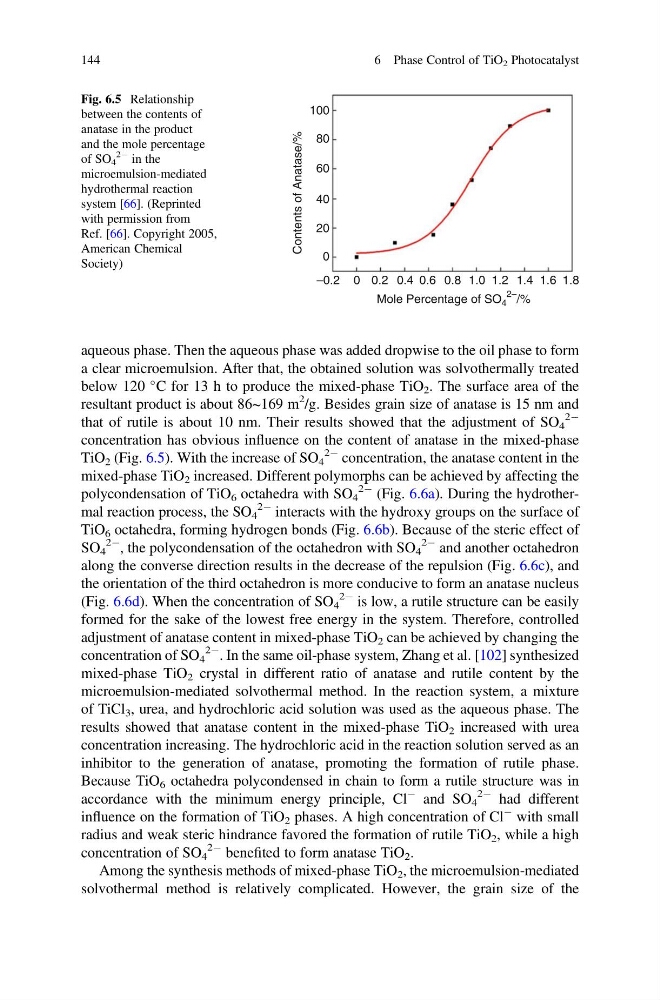
concentration has obvious influence on the content of anatase in the mixed-phase
TiO 2 (Fig. 6.5). With the increase of SO 4
2À concentration, the anatase content in the
mixed-phase TiO 2 increased. Different polymorphs can be achieved by affecting the
polycondensation of TiO 6 octahedra with SO 4
2À (Fig. 6.6a). During the hydrothermal reaction process, the SO 4
2À interacts with the hydroxy groups on the surface of
TiO 6 octahedra, forming hydrogen bonds (Fig. 6.6b). Because of the steric effect of
SO 4
2À
, the polycondensation of the octahedron with SO 4
2À and another octahedron
along the converse direction results in the decrease of the repulsion (Fig. 6.6c), and
the orientation of the third octahedron is more conducive to form an anatase nucleus
(Fig. 6.6d). When the concentration of SO 4
2À is low, a rutile structure can be easily
formed for the sake of the lowest free energy in the system. Therefore, controlled
adjustment of anatase content in mixed-phase TiO 2 can be achieved by changing the
concentration of SO 4
2À . In the same oil-phase system, Zhang et al. [102] synthesized
mixed-phase TiO 2 crystal in different ratio of anatase and rutile content by the
microemulsion-mediated solvothermal method. In the reaction system, a mixture
of TiCl 3 , urea, and hydrochloric acid solution was used as the aqueous phase. The
results showed that anatase content in the mixed-phase TiO 2 increased with urea
concentration increasing. The hydrochloric acid in the reaction solution served as an
inhibitor to the generation of anatase, promoting the formation of rutile phase.
Because TiO 6 octahedra polycondensed in chain to form a rutile structure was in
accordance with the minimum energy principle, Cl
À and SO 4
2À had different
influence on the formation of TiO 2 phases. A high concentration of Cl
À with small
radius and weak steric hindrance favored the formation of rutile TiO 2 , while a high
concentration of SO 4
2À benefited to form anatase TiO 2 .
Among the synthesis methods of mixed-phase TiO 2 , the microemulsion-mediated
solvothermal method is relatively complicated. However, the grain size of the
100
80
60
40
20
Contents of Anatase/%
0
–0.2 0 0.2 0.4 0.6 0.8 1.0 1.2 1.4 1.6 1.8
Mole Percentage of SO 4
2–
/%
Fig. 6.5 Relationship
between the contents of
anatase in the product
and the mole percentage
of SO 4
2À in the
microemulsion-mediated
hydrothermal reaction
system [66]. (Reprinted
with permission from
Ref. [66]. Copyright 2005,
American Chemical
Society)
144
6 Phase Control of TiO 2 Photocatalyst
a clear microemulsion. After that, the obtained solution was solvothermally treated
below 120
C for 13 h to produce the mixed-phase TiO 2 . The surface area of the
resultant product is about 86~169 m
2 /g. Besides grain size of anatase is 15 nm and
that of rutile is about 10 nm. Their results showed that the adjustment of SO 4
2À
concentration has obvious influence on the content of anatase in the mixed-phase
TiO 2 (Fig. 6.5). With the increase of SO 4
2À concentration, the anatase content in the
mixed-phase TiO 2 increased. Different polymorphs can be achieved by affecting the
polycondensation of TiO 6 octahedra with SO 4
2À (Fig. 6.6a). During the hydrothermal reaction process, the SO 4
2À interacts with the hydroxy groups on the surface of
TiO 6 octahedra, forming hydrogen bonds (Fig. 6.6b). Because of the steric effect of
SO 4
2À
, the polycondensation of the octahedron with SO 4
2À and another octahedron
along the converse direction results in the decrease of the repulsion (Fig. 6.6c), and
the orientation of the third octahedron is more conducive to form an anatase nucleus
(Fig. 6.6d). When the concentration of SO 4
2À is low, a rutile structure can be easily
formed for the sake of the lowest free energy in the system. Therefore, controlled
adjustment of anatase content in mixed-phase TiO 2 can be achieved by changing the
concentration of SO 4
2À . In the same oil-phase system, Zhang et al. [102] synthesized
mixed-phase TiO 2 crystal in different ratio of anatase and rutile content by the
microemulsion-mediated solvothermal method. In the reaction system, a mixture
of TiCl 3 , urea, and hydrochloric acid solution was used as the aqueous phase. The
results showed that anatase content in the mixed-phase TiO 2 increased with urea
concentration increasing. The hydrochloric acid in the reaction solution served as an
inhibitor to the generation of anatase, promoting the formation of rutile phase.
Because TiO 6 octahedra polycondensed in chain to form a rutile structure was in
accordance with the minimum energy principle, Cl
À and SO 4
2À had different
influence on the formation of TiO 2 phases. A high concentration of Cl
À with small
radius and weak steric hindrance favored the formation of rutile TiO 2 , while a high
concentration of SO 4
2À benefited to form anatase TiO 2 .
Among the synthesis methods of mixed-phase TiO 2 , the microemulsion-mediated
solvothermal method is relatively complicated. However, the grain size of the
100
80
60
40
20
Contents of Anatase/%
0
–0.2 0 0.2 0.4 0.6 0.8 1.0 1.2 1.4 1.6 1.8
Mole Percentage of SO 4
2–
/%
Fig. 6.5 Relationship
between the contents of
anatase in the product
and the mole percentage
of SO 4
2À in the
microemulsion-mediated
hydrothermal reaction
system [66]. (Reprinted
with permission from
Ref. [66]. Copyright 2005,
American Chemical
Society)
144
6 Phase Control of TiO 2 Photocatalyst