

to monitor the real time of the hydrothermal and solvothermal process, and the
reaction usually proceeds without stirring, sometimes leading to the incomplete
reaction and irregularly arranged product. Due to the fact that a variety of organic
solvents can be used in the solvothermal method, it is easier to control the crystalline
and morphology of the products than the hydrothermal method. Therefore, we can
foresee that the solvothermal method has better application prospects.
6.3.2 Microemulsion-Mediated Solvothermal Method
The method of microemulsion usually contains two processes. Firstly, two immiscible solvents divided into many micro-reactors (microbubbles) with the help of the
surfactants form emulsion, in which nanomaterials are obtained through nucleation,
coalescence, agglomeration, and heat treatment process in the oil-in-water or waterin-oil microbubbles. The reactants of immiscible solvents are well dispersed, and a
uniform nucleation limited in the micro-reactors occurs. Therefore, the particle size
and stability of the nanomaterials can be well controlled. Compared with other
traditional synthesis methods, the microemulsion method has shown obvious advantages in terms of the preparation of nanomaterials with perfect monodispersity and
interfacial properties. Moreover, this method is a very versatile technique which
allows the synthesis of a great variety of nanomaterials by combining with other
techniques. Recently, the microemulsion-mediated solvothermal method, which is
named for the combination of the microemulsion method with solvothermal method,
has been used to the preparation of the mixed-phase TiO 2 nanomaterials [66, 101,
102].
Yan et al. [66] fabricated anatase/rutile mixed-phase TiO 2 crystal through the
combination of microemulsion and solvothermal method, using tertoctylphenoxypolyethoxyethanol (Triton X-100) as the surfactant, n-hexanol as the
co-surfactant, and cyclohexane as the continuous oil phase. Tetrabutyl titanate and
(NH 4 ) 2 SO 4 were completely dissolved in the hydrochloric acid to serve as the
100
80
60
40
20
0
0
0.2
0.4
0.6
0.8
1.0
Volume Ratio of Ethanol/%
Contents of Anatase/%
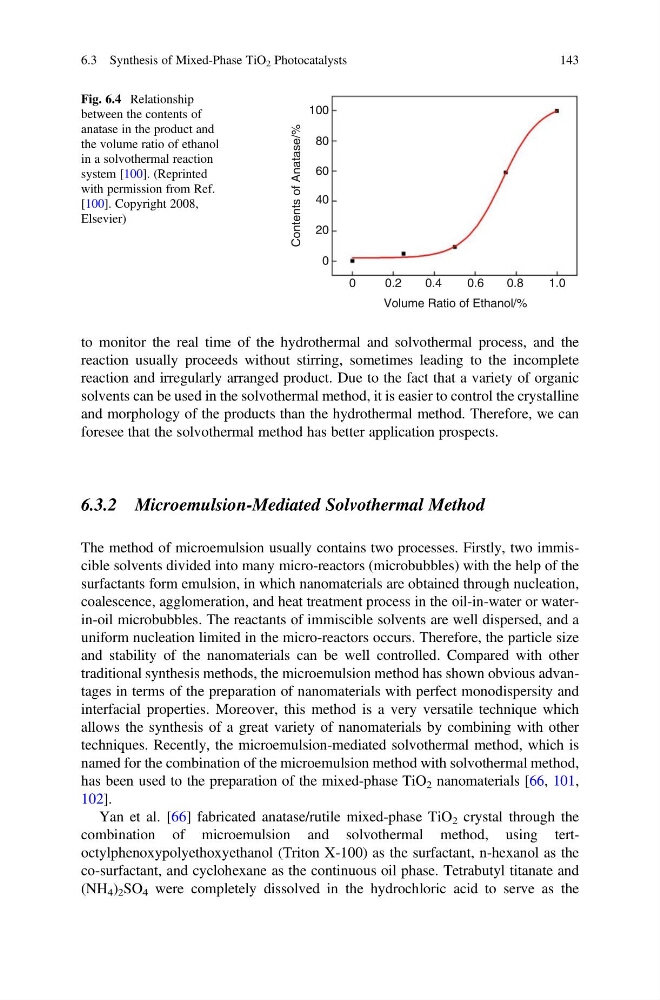
Fig. 6.4 Relationship
between the contents of
anatase in the product and
the volume ratio of ethanol
in a solvothermal reaction
system [100]. (Reprinted
with permission from Ref.
[100]. Copyright 2008,
Elsevier)
6.3 Synthesis of Mixed-Phase TiO 2 Photocatalysts
143
reaction usually proceeds without stirring, sometimes leading to the incomplete
reaction and irregularly arranged product. Due to the fact that a variety of organic
solvents can be used in the solvothermal method, it is easier to control the crystalline
and morphology of the products than the hydrothermal method. Therefore, we can
foresee that the solvothermal method has better application prospects.
6.3.2 Microemulsion-Mediated Solvothermal Method
The method of microemulsion usually contains two processes. Firstly, two immiscible solvents divided into many micro-reactors (microbubbles) with the help of the
surfactants form emulsion, in which nanomaterials are obtained through nucleation,
coalescence, agglomeration, and heat treatment process in the oil-in-water or waterin-oil microbubbles. The reactants of immiscible solvents are well dispersed, and a
uniform nucleation limited in the micro-reactors occurs. Therefore, the particle size
and stability of the nanomaterials can be well controlled. Compared with other
traditional synthesis methods, the microemulsion method has shown obvious advantages in terms of the preparation of nanomaterials with perfect monodispersity and
interfacial properties. Moreover, this method is a very versatile technique which
allows the synthesis of a great variety of nanomaterials by combining with other
techniques. Recently, the microemulsion-mediated solvothermal method, which is
named for the combination of the microemulsion method with solvothermal method,
has been used to the preparation of the mixed-phase TiO 2 nanomaterials [66, 101,
102].
Yan et al. [66] fabricated anatase/rutile mixed-phase TiO 2 crystal through the
combination of microemulsion and solvothermal method, using tertoctylphenoxypolyethoxyethanol (Triton X-100) as the surfactant, n-hexanol as the
co-surfactant, and cyclohexane as the continuous oil phase. Tetrabutyl titanate and
(NH 4 ) 2 SO 4 were completely dissolved in the hydrochloric acid to serve as the
100
80
60
40
20
0
0
0.2
0.4
0.6
0.8
1.0
Volume Ratio of Ethanol/%
Contents of Anatase/%
Fig. 6.4 Relationship
between the contents of
anatase in the product and
the volume ratio of ethanol
in a solvothermal reaction
system [100]. (Reprinted
with permission from Ref.
[100]. Copyright 2008,
Elsevier)
6.3 Synthesis of Mixed-Phase TiO 2 Photocatalysts
143