

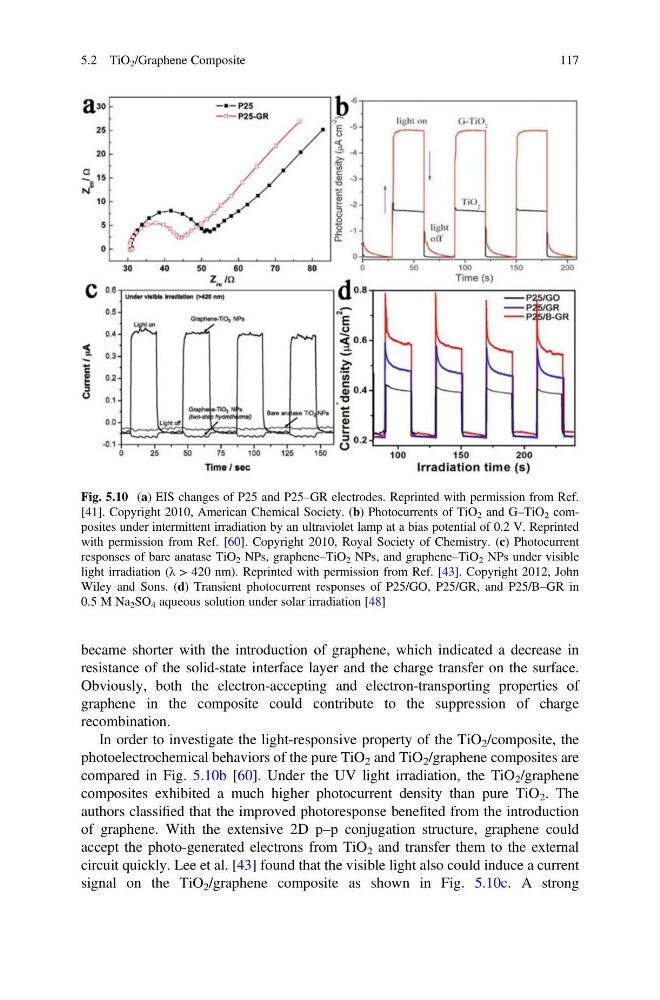
became shorter with the introduction of graphene, which indicated a decrease in
resistance of the solid-state interface layer and the charge transfer on the surface.
Obviously, both the electron-accepting and electron-transporting properties of
graphene in the composite could contribute to the suppression of charge
recombination.
In order to investigate the light-responsive property of the TiO 2 /composite, the
photoelectrochemical behaviors of the pure TiO 2 and TiO 2 /graphene composites are
compared in Fig. 5.10b [60]. Under the UV light irradiation, the TiO 2 /graphene
composites exhibited a much higher photocurrent density than pure TiO 2 . The
authors classified that the improved photoresponse benefited from the introduction
of graphene. With the extensive 2D p–p conjugation structure, graphene could
accept the photo-generated electrons from TiO 2 and transfer them to the external
circuit quickly. Lee et al. [43] found that the visible light also could induce a current
signal on the TiO 2 /graphene composite as shown in Fig. 5.10c. A strong
Fig. 5.10 (a) EIS changes of P25 and P25–GR electrodes. Reprinted with permission from Ref.
[41]. Copyright 2010, American Chemical Society. (b) Photocurrents of TiO 2 and G–TiO 2 composites under intermittent irradiation by an ultraviolet lamp at a bias potential of 0.2 V. Reprinted
with permission from Ref. [60]. Copyright 2010, Royal Society of Chemistry. (c) Photocurrent
responses of bare anatase TiO 2 NPs, graphene–TiO 2 NPs, and graphene–TiO 2 NPs under visible
light irradiation (λ > 420 nm). Reprinted with permission from Ref. [43]. Copyright 2012, John
Wiley and Sons. (d) Transient photocurrent responses of P25/GO, P25/GR, and P25/B–GR in
0.5 M Na 2 SO 4 aqueous solution under solar irradiation [48]
5.2 TiO 2 /Graphene Composite
117
resistance of the solid-state interface layer and the charge transfer on the surface.
Obviously, both the electron-accepting and electron-transporting properties of
graphene in the composite could contribute to the suppression of charge
recombination.
In order to investigate the light-responsive property of the TiO 2 /composite, the
photoelectrochemical behaviors of the pure TiO 2 and TiO 2 /graphene composites are
compared in Fig. 5.10b [60]. Under the UV light irradiation, the TiO 2 /graphene
composites exhibited a much higher photocurrent density than pure TiO 2 . The
authors classified that the improved photoresponse benefited from the introduction
of graphene. With the extensive 2D p–p conjugation structure, graphene could
accept the photo-generated electrons from TiO 2 and transfer them to the external
circuit quickly. Lee et al. [43] found that the visible light also could induce a current
signal on the TiO 2 /graphene composite as shown in Fig. 5.10c. A strong
Fig. 5.10 (a) EIS changes of P25 and P25–GR electrodes. Reprinted with permission from Ref.
[41]. Copyright 2010, American Chemical Society. (b) Photocurrents of TiO 2 and G–TiO 2 composites under intermittent irradiation by an ultraviolet lamp at a bias potential of 0.2 V. Reprinted
with permission from Ref. [60]. Copyright 2010, Royal Society of Chemistry. (c) Photocurrent
responses of bare anatase TiO 2 NPs, graphene–TiO 2 NPs, and graphene–TiO 2 NPs under visible
light irradiation (λ > 420 nm). Reprinted with permission from Ref. [43]. Copyright 2012, John
Wiley and Sons. (d) Transient photocurrent responses of P25/GO, P25/GR, and P25/B–GR in
0.5 M Na 2 SO 4 aqueous solution under solar irradiation [48]
5.2 TiO 2 /Graphene Composite
117