

process of g-C 3 N 4 /TiO 2–x composites [96]. Due to its excellent visible light response
promoted by Ti
3+ and g-C 3 N 4 , and efficient electron-hole separation and transportation, g-C 3 N 4 /TiO 2–x photocatalyst shows great performance of photodegradation
of organic pollution and Cr(VI) reduction [160]. Other composite materials such as
N-doped TiO 2–x /MoS 2 [161], 3D mesoporous TiO 2–x /MoS 2 /TiO 2–x nanosheets [23],
and Pd-MgNi x nanospheres/TiO 2–x composite films [103] were also reported.
4.5.5 TiO 2–x with Ordered Morphology
TiO 2–x photocatalysts with ordered morphology were synthesized, such as hollow
porous structure [116], mesoporous [162], core shell [163], yolk shell [164],
nanocage [165], inverse opals [166, 167], etc. Hu et al. fabricated mesoporous
TiO 2–x hollow spheres to enhance the solar light utilization by extended absorption
edge by Ti
3+ doping and multi-refraction of solar light within the hollow structure
[15]. The unique hollow structure also allows better charge separation and transfer
properties of TiO 2–x . Wang et al. demonstrated that the increased conductivity of
TiO 2–x and its hollow porous structure were beneficial for lithium-ion electron
diffusion while using TiO 2–x hollow porous sphere as the anode materials in LIBs
[116]. Besides, yolk-shell structure of TiO 2–x contributes to the multiple reflection of
solar light in the chamber and provides high surface area of the catalysts [164] and
thus makes the TiO 2–x catalyst superior photocatalytic activities under visible light
irradiation.
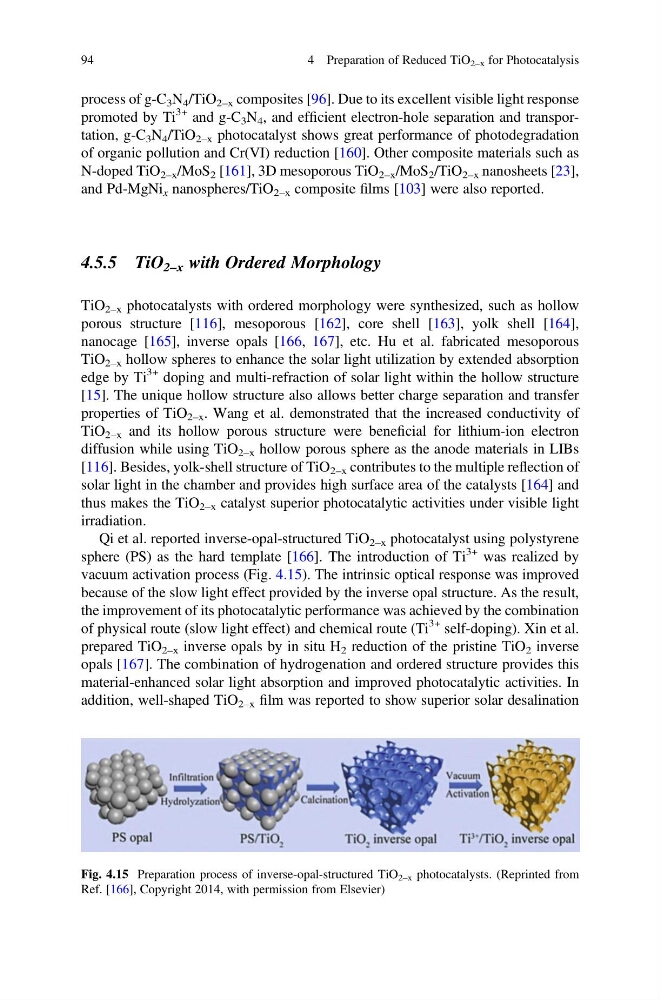
Qi et al. reported inverse-opal-structured TiO 2–x photocatalyst using polystyrene
sphere (PS) as the hard template [166]. The introduction of Ti
3+ was realized by
vacuum activation process (Fig. 4.15). The intrinsic optical response was improved
because of the slow light effect provided by the inverse opal structure. As the result,
the improvement of its photocatalytic performance was achieved by the combination
of physical route (slow light effect) and chemical route (Ti
3+ self-doping). Xin et al.
prepared TiO 2–x inverse opals by in situ H 2 reduction of the pristine TiO 2 inverse
opals [167]. The combination of hydrogenation and ordered structure provides this
material-enhanced solar light absorption and improved photocatalytic activities. In
addition, well-shaped TiO 2–x film was reported to show superior solar desalination
Fig. 4.15 Preparation process of inverse-opal-structured TiO 2–x photocatalysts. (Reprinted from
Ref. [166], Copyright 2014, with permission from Elsevier)
94
4 Preparation of Reduced TiO 2–x for Photocatalysis
promoted by Ti
3+ and g-C 3 N 4 , and efficient electron-hole separation and transportation, g-C 3 N 4 /TiO 2–x photocatalyst shows great performance of photodegradation
of organic pollution and Cr(VI) reduction [160]. Other composite materials such as
N-doped TiO 2–x /MoS 2 [161], 3D mesoporous TiO 2–x /MoS 2 /TiO 2–x nanosheets [23],
and Pd-MgNi x nanospheres/TiO 2–x composite films [103] were also reported.
4.5.5 TiO 2–x with Ordered Morphology
TiO 2–x photocatalysts with ordered morphology were synthesized, such as hollow
porous structure [116], mesoporous [162], core shell [163], yolk shell [164],
nanocage [165], inverse opals [166, 167], etc. Hu et al. fabricated mesoporous
TiO 2–x hollow spheres to enhance the solar light utilization by extended absorption
edge by Ti
3+ doping and multi-refraction of solar light within the hollow structure
[15]. The unique hollow structure also allows better charge separation and transfer
properties of TiO 2–x . Wang et al. demonstrated that the increased conductivity of
TiO 2–x and its hollow porous structure were beneficial for lithium-ion electron
diffusion while using TiO 2–x hollow porous sphere as the anode materials in LIBs
[116]. Besides, yolk-shell structure of TiO 2–x contributes to the multiple reflection of
solar light in the chamber and provides high surface area of the catalysts [164] and
thus makes the TiO 2–x catalyst superior photocatalytic activities under visible light
irradiation.
Qi et al. reported inverse-opal-structured TiO 2–x photocatalyst using polystyrene
sphere (PS) as the hard template [166]. The introduction of Ti
3+ was realized by
vacuum activation process (Fig. 4.15). The intrinsic optical response was improved
because of the slow light effect provided by the inverse opal structure. As the result,
the improvement of its photocatalytic performance was achieved by the combination
of physical route (slow light effect) and chemical route (Ti
3+ self-doping). Xin et al.
prepared TiO 2–x inverse opals by in situ H 2 reduction of the pristine TiO 2 inverse
opals [167]. The combination of hydrogenation and ordered structure provides this
material-enhanced solar light absorption and improved photocatalytic activities. In
addition, well-shaped TiO 2–x film was reported to show superior solar desalination
Fig. 4.15 Preparation process of inverse-opal-structured TiO 2–x photocatalysts. (Reprinted from
Ref. [166], Copyright 2014, with permission from Elsevier)
94
4 Preparation of Reduced TiO 2–x for Photocatalysis