

its high photodegradation activity of organic compounds and enhanced hydrogen
evolution performance from water splitting under visible light irradiation.
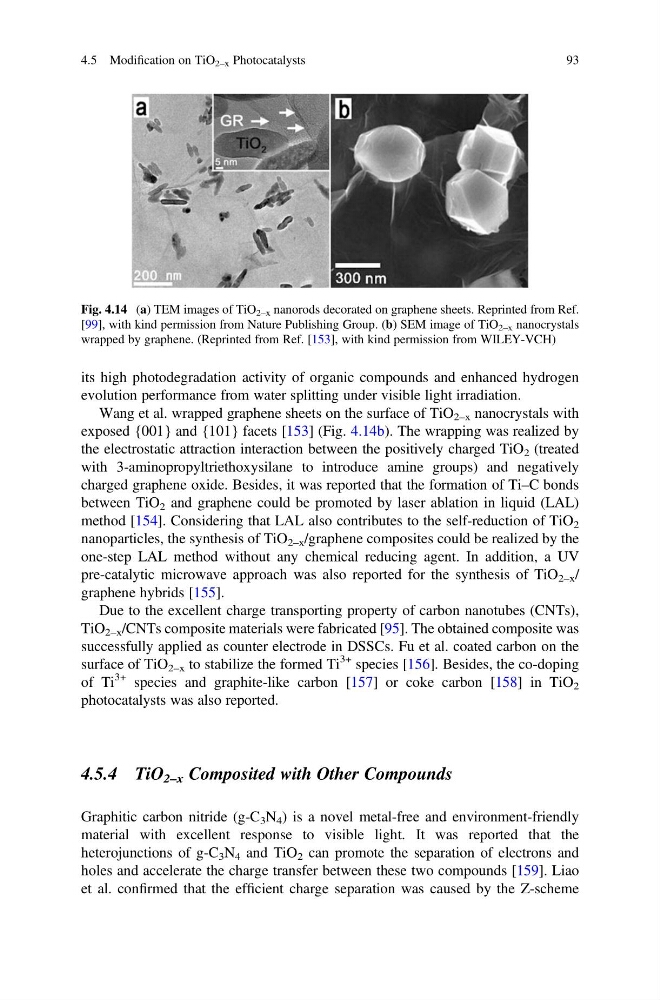
Wang et al. wrapped graphene sheets on the surface of TiO 2–x nanocrystals with
exposed {001} and {101} facets [153] (Fig. 4.14b). The wrapping was realized by
the electrostatic attraction interaction between the positively charged TiO 2 (treated
with 3-aminopropyltriethoxysilane to introduce amine groups) and negatively
charged graphene oxide. Besides, it was reported that the formation of Ti–C bonds
between TiO 2 and graphene could be promoted by laser ablation in liquid (LAL)
method [154]. Considering that LAL also contributes to the self-reduction of TiO 2
nanoparticles, the synthesis of TiO 2–x /graphene composites could be realized by the
one-step LAL method without any chemical reducing agent. In addition, a UV
pre-catalytic microwave approach was also reported for the synthesis of TiO 2–x /
graphene hybrids [155].
Due to the excellent charge transporting property of carbon nanotubes (CNTs),
TiO 2–x /CNTs composite materials were fabricated [95]. The obtained composite was
successfully applied as counter electrode in DSSCs. Fu et al. coated carbon on the
surface of TiO 2–x to stabilize the formed Ti
3+ species [156]. Besides, the co-doping
of Ti
3+ species and graphite-like carbon [157] or coke carbon [158] in TiO 2
photocatalysts was also reported.
4.5.4 TiO 2–x Composited with Other Compounds
Graphitic carbon nitride (g-C 3 N 4 ) is a novel metal-free and environment-friendly
material with excellent response to visible light. It was reported that the
heterojunctions of g-C 3 N 4 and TiO 2 can promote the separation of electrons and
holes and accelerate the charge transfer between these two compounds [159]. Liao
et al. confirmed that the efficient charge separation was caused by the Z-scheme
Fig. 4.14 (a) TEM images of TiO 2–x nanorods decorated on graphene sheets. Reprinted from Ref.
[99], with kind permission from Nature Publishing Group. (b) SEM image of TiO 2–x nanocrystals
wrapped by graphene. (Reprinted from Ref. [153], with kind permission from WILEY-VCH)
4.5 Modification on TiO 2–x Photocatalysts
93
evolution performance from water splitting under visible light irradiation.
Wang et al. wrapped graphene sheets on the surface of TiO 2–x nanocrystals with
exposed {001} and {101} facets [153] (Fig. 4.14b). The wrapping was realized by
the electrostatic attraction interaction between the positively charged TiO 2 (treated
with 3-aminopropyltriethoxysilane to introduce amine groups) and negatively
charged graphene oxide. Besides, it was reported that the formation of Ti–C bonds
between TiO 2 and graphene could be promoted by laser ablation in liquid (LAL)
method [154]. Considering that LAL also contributes to the self-reduction of TiO 2
nanoparticles, the synthesis of TiO 2–x /graphene composites could be realized by the
one-step LAL method without any chemical reducing agent. In addition, a UV
pre-catalytic microwave approach was also reported for the synthesis of TiO 2–x /
graphene hybrids [155].
Due to the excellent charge transporting property of carbon nanotubes (CNTs),
TiO 2–x /CNTs composite materials were fabricated [95]. The obtained composite was
successfully applied as counter electrode in DSSCs. Fu et al. coated carbon on the
surface of TiO 2–x to stabilize the formed Ti
3+ species [156]. Besides, the co-doping
of Ti
3+ species and graphite-like carbon [157] or coke carbon [158] in TiO 2
photocatalysts was also reported.
4.5.4 TiO 2–x Composited with Other Compounds
Graphitic carbon nitride (g-C 3 N 4 ) is a novel metal-free and environment-friendly
material with excellent response to visible light. It was reported that the
heterojunctions of g-C 3 N 4 and TiO 2 can promote the separation of electrons and
holes and accelerate the charge transfer between these two compounds [159]. Liao
et al. confirmed that the efficient charge separation was caused by the Z-scheme
Fig. 4.14 (a) TEM images of TiO 2–x nanorods decorated on graphene sheets. Reprinted from Ref.
[99], with kind permission from Nature Publishing Group. (b) SEM image of TiO 2–x nanocrystals
wrapped by graphene. (Reprinted from Ref. [153], with kind permission from WILEY-VCH)
4.5 Modification on TiO 2–x Photocatalysts
93