

In Eqs. (5.2.7) and (5.2.8) the mean dipole
2 -quadrupole polarizabilities
B and
the mean polarizabilities a are written as
B
A
¼
2
5
B
A
zzzz þ 2
B
A
xzxz
À
Á ;
ð5:2:9Þ
B
B
¼
2
15
B
B
zzzz þ
B
B
xxzz þ 4
B
B
xzxz þ 4
B
B
xxxx
À
Á ;
ð5:2:10Þ
a
B
¼
1
3
2a
B
xx þ a
B
zz
À
Á ; and a
A
¼ a
A
zz :
ð5:2:11Þ
Equations (5.2.7) and (5.2.8) show, that after averaging, only Ba interactions
(*R
−4 ) give contributions to
b xxx and
b xyy ¼
b xzz . As expected, the Eqs. (5.2.7) and
(5.2.8) lead immediately to the expressions of the first polarizabilities for two
different interacting spherically symmetric atoms A and B [13].
As a result, for free oriented interacting molecules CH 4 and N 2 the invariants A
2
and B
2 (see Eqs. (5.2.3) and (5.2.4)) can be rewritten as a function of R (with
accuracy up to the terms *R
−6 ) [49]
A
2
ðRÞ ¼
8 90 a
B
ð Þ
2 þ 7 D a
B
ð
Þ
2
h
i
b
A
xyz
2
25R 6
ð5:2:12Þ
and
B
2
ðRÞ ¼ 8 b
A
xyz
2 þ
8 720 a
B
ð Þ
2 þ 191 D a
B
ð
Þ
2
h
i
b
A
xyz
2
75R 6
þ
288 a
A a
B
b
A
xyz
2
R 6
þ
49C 6 d xyzzz b
A
xyz
5 a A R 6
þ
91C 6 c
B
b
A
xyz
2
135 a A a B R 6
ð5:2:13Þ
Here, the anisotropy polarizability D a
B and the mean second hyperpolarizability
c
B are written in the form
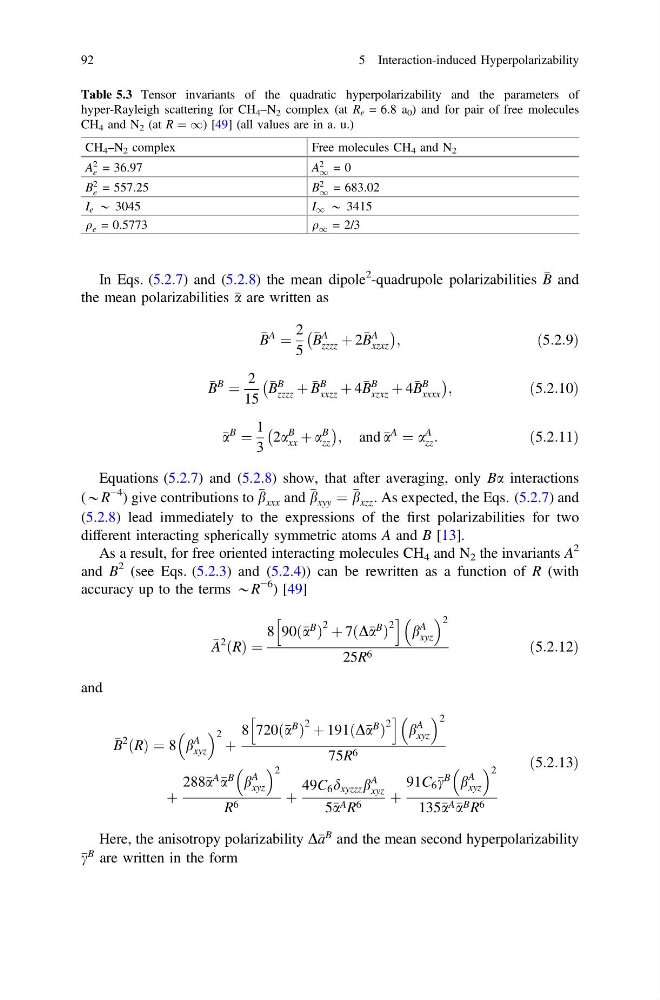
Table 5.3 Tensor invariants of the quadratic hyperpolarizability and the parameters of
hyper-Rayleigh scattering for CH 4 –N 2 complex (at R e = 6.8 a 0 ) and for pair of free molecules
CH 4 and N 2 (at R ¼ 1) [49] (all values are in a. u.)
CH 4 –N 2 complex
Free molecules CH 4 and N 2
A
2
e = 36.97
A
2
1 = 0
B
2
e = 557.25
B
2
1 = 683.02
I e * 3045
I 1 * 3415
q e = 0.5773
q 1 = 2/3
92
5 Interaction-induced Hyperpolarizability
2 -quadrupole polarizabilities
B and
the mean polarizabilities a are written as
B
A
¼
2
5
B
A
zzzz þ 2
B
A
xzxz
À
Á ;
ð5:2:9Þ
B
B
¼
2
15
B
B
zzzz þ
B
B
xxzz þ 4
B
B
xzxz þ 4
B
B
xxxx
À
Á ;
ð5:2:10Þ
a
B
¼
1
3
2a
B
xx þ a
B
zz
À
Á ; and a
A
¼ a
A
zz :
ð5:2:11Þ
Equations (5.2.7) and (5.2.8) show, that after averaging, only Ba interactions
(*R
−4 ) give contributions to
b xxx and
b xyy ¼
b xzz . As expected, the Eqs. (5.2.7) and
(5.2.8) lead immediately to the expressions of the first polarizabilities for two
different interacting spherically symmetric atoms A and B [13].
As a result, for free oriented interacting molecules CH 4 and N 2 the invariants A
2
and B
2 (see Eqs. (5.2.3) and (5.2.4)) can be rewritten as a function of R (with
accuracy up to the terms *R
−6 ) [49]
A
2
ðRÞ ¼
8 90 a
B
ð Þ
2 þ 7 D a
B
ð
Þ
2
h
i
b
A
xyz
2
25R 6
ð5:2:12Þ
and
B
2
ðRÞ ¼ 8 b
A
xyz
2 þ
8 720 a
B
ð Þ
2 þ 191 D a
B
ð
Þ
2
h
i
b
A
xyz
2
75R 6
þ
288 a
A a
B
b
A
xyz
2
R 6
þ
49C 6 d xyzzz b
A
xyz
5 a A R 6
þ
91C 6 c
B
b
A
xyz
2
135 a A a B R 6
ð5:2:13Þ
Here, the anisotropy polarizability D a
B and the mean second hyperpolarizability
c
B are written in the form
Table 5.3 Tensor invariants of the quadratic hyperpolarizability and the parameters of
hyper-Rayleigh scattering for CH 4 –N 2 complex (at R e = 6.8 a 0 ) and for pair of free molecules
CH 4 and N 2 (at R ¼ 1) [49] (all values are in a. u.)
CH 4 –N 2 complex
Free molecules CH 4 and N 2
A
2
e = 36.97
A
2
1 = 0
B
2
e = 557.25
B
2
1 = 683.02
I e * 3045
I 1 * 3415
q e = 0.5773
q 1 = 2/3
92
5 Interaction-induced Hyperpolarizability