

D a
B
¼ a
B
zz À a
B
xx ;
ð5:2:14Þ
c
B
¼
1
15
3c
B
zzzz þ 12c
B
xxzz þ 8c
B
xxxx
À
Á :
ð5:2:15Þ
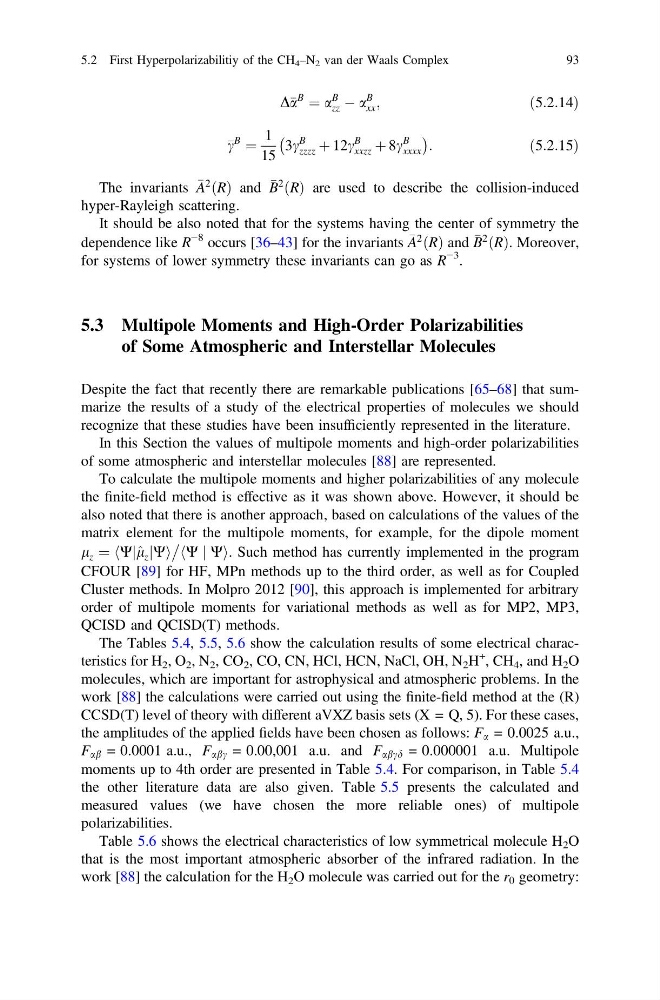
The invariants
A
2
ðRÞ and
B
2
ðRÞ are used to describe the collision-induced
hyper-Rayleigh scattering.
It should be also noted that for the systems having the center of symmetry the
dependence like R
−8 occurs [36–43] for the invariants
A
2
ðRÞ and
B
2
ðRÞ. Moreover,
for systems of lower symmetry these invariants can go as R
−3 .
5.3 Multipole Moments and High-Order Polarizabilities
of Some Atmospheric and Interstellar Molecules
Despite the fact that recently there are remarkable publications [65–68] that summarize the results of a study of the electrical properties of molecules we should
recognize that these studies have been insufficiently represented in the literature.
In this Section the values of multipole moments and high-order polarizabilities
of some atmospheric and interstellar molecules [88] are represented.
To calculate the multipole moments and higher polarizabilities of any molecule
the finite-field method is effective as it was shown above. However, it should be
also noted that there is another approach, based on calculations of the values of the
matrix element for the multipole moments, for example, for the dipole moment
l z ¼ W
h j^ l z W
j i
W j W
h
i. Such method has currently implemented in the program
CFOUR [89] for HF, MPn methods up to the third order, as well as for Coupled
Cluster methods. In Molpro 2012 [90], this approach is implemented for arbitrary
order of multipole moments for variational methods as well as for MP2, MP3,
QCISD and QCISD(T) methods.
The Tables 5.4, 5.5, 5.6 show the calculation results of some electrical characteristics for H 2 , O 2 , N 2 , CO 2 , CO, CN, HCl, HCN, NaCl, OH, N 2 H
+
, CH 4 , and H 2 O
molecules, which are important for astrophysical and atmospheric problems. In the
work [88] the calculations were carried out using the finite-field method at the (R)
CCSD(T) level of theory with different aVXZ basis sets (X = Q, 5). For these cases,
the amplitudes of the applied fields have been chosen as follows: F a = 0.0025 a.u.,
F ab = 0.0001 a.u., F abc = 0.00,001 a.u. and F abcd = 0.000001 a.u. Multipole
moments up to 4th order are presented in Table 5.4. For comparison, in Table 5.4
the other literature data are also given. Table 5.5 presents the calculated and
measured values (we have chosen the more reliable ones) of multipole
polarizabilities.
Table 5.6 shows the electrical characteristics of low symmetrical molecule H 2 O
that is the most important atmospheric absorber of the infrared radiation. In the
work [88] the calculation for the H 2 O molecule was carried out for the r 0 geometry:
5.2 First Hyperpolarizabilitiy of the CH 4 –N 2 van der Waals Complex
93
B
¼ a
B
zz À a
B
xx ;
ð5:2:14Þ
c
B
¼
1
15
3c
B
zzzz þ 12c
B
xxzz þ 8c
B
xxxx
À
Á :
ð5:2:15Þ
The invariants
A
2
ðRÞ and
B
2
ðRÞ are used to describe the collision-induced
hyper-Rayleigh scattering.
It should be also noted that for the systems having the center of symmetry the
dependence like R
−8 occurs [36–43] for the invariants
A
2
ðRÞ and
B
2
ðRÞ. Moreover,
for systems of lower symmetry these invariants can go as R
−3 .
5.3 Multipole Moments and High-Order Polarizabilities
of Some Atmospheric and Interstellar Molecules
Despite the fact that recently there are remarkable publications [65–68] that summarize the results of a study of the electrical properties of molecules we should
recognize that these studies have been insufficiently represented in the literature.
In this Section the values of multipole moments and high-order polarizabilities
of some atmospheric and interstellar molecules [88] are represented.
To calculate the multipole moments and higher polarizabilities of any molecule
the finite-field method is effective as it was shown above. However, it should be
also noted that there is another approach, based on calculations of the values of the
matrix element for the multipole moments, for example, for the dipole moment
l z ¼ W
h j^ l z W
j i
W j W
h
i. Such method has currently implemented in the program
CFOUR [89] for HF, MPn methods up to the third order, as well as for Coupled
Cluster methods. In Molpro 2012 [90], this approach is implemented for arbitrary
order of multipole moments for variational methods as well as for MP2, MP3,
QCISD and QCISD(T) methods.
The Tables 5.4, 5.5, 5.6 show the calculation results of some electrical characteristics for H 2 , O 2 , N 2 , CO 2 , CO, CN, HCl, HCN, NaCl, OH, N 2 H
+
, CH 4 , and H 2 O
molecules, which are important for astrophysical and atmospheric problems. In the
work [88] the calculations were carried out using the finite-field method at the (R)
CCSD(T) level of theory with different aVXZ basis sets (X = Q, 5). For these cases,
the amplitudes of the applied fields have been chosen as follows: F a = 0.0025 a.u.,
F ab = 0.0001 a.u., F abc = 0.00,001 a.u. and F abcd = 0.000001 a.u. Multipole
moments up to 4th order are presented in Table 5.4. For comparison, in Table 5.4
the other literature data are also given. Table 5.5 presents the calculated and
measured values (we have chosen the more reliable ones) of multipole
polarizabilities.
Table 5.6 shows the electrical characteristics of low symmetrical molecule H 2 O
that is the most important atmospheric absorber of the infrared radiation. In the
work [88] the calculation for the H 2 O molecule was carried out for the r 0 geometry:
5.2 First Hyperpolarizabilitiy of the CH 4 –N 2 van der Waals Complex
93