

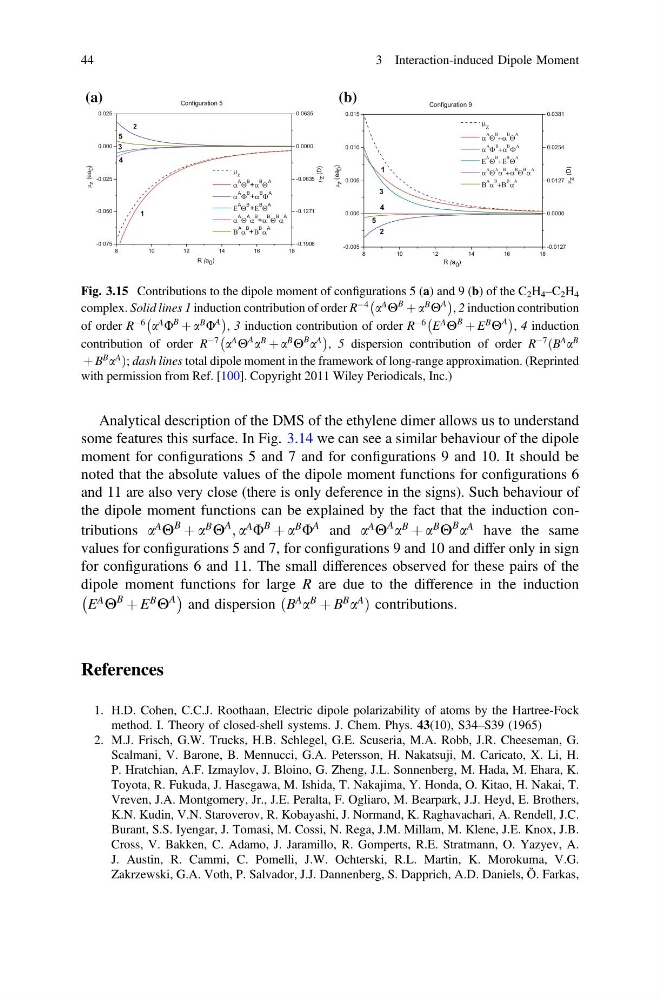
Analytical description of the DMS of the ethylene dimer allows us to understand
some features this surface. In Fig. 3.14 we can see a similar behaviour of the dipole
moment for configurations 5 and 7 and for configurations 9 and 10. It should be
noted that the absolute values of the dipole moment functions for configurations 6
and 11 are also very close (there is only deference in the signs). Such behaviour of
the dipole moment functions can be explained by the fact that the induction contributions a
A
H
B
þ a
B
H
A
; a
A
U
B
þ a
B
U
A and a
A
H
A a
B
þ a
B
H
B a
A have the same
values for configurations 5 and 7, for configurations 9 and 10 and differ only in sign
for configurations 6 and 11. The small differences observed for these pairs of the
dipole moment functions for large R are due to the difference in the induction
E
A
H
B
þ E
B
H
A
À
Á
and dispersion B
A a
B
þ B
B a
A
ð
Þcontributions.
References
1. H.D. Cohen, C.C.J. Roothaan, Electric dipole polarizability of atoms by the Hartree-Fock
method. I. Theory of closed-shell systems. J. Chem. Phys. 43(10), S34–S39 (1965)
2. M.J. Frisch, G.W. Trucks, H.B. Schlegel, G.E. Scuseria, M.A. Robb, J.R. Cheeseman, G.
Scalmani, V. Barone, B. Mennucci, G.A. Petersson, H. Nakatsuji, M. Caricato, X. Li, H.
P. Hratchian, A.F. Izmaylov, J. Bloino, G. Zheng, J.L. Sonnenberg, M. Hada, M. Ehara, K.
Toyota, R. Fukuda, J. Hasegawa, M. Ishida, T. Nakajima, Y. Honda, O. Kitao, H. Nakai, T.
Vreven, J.A. Montgomery, Jr., J.E. Peralta, F. Ogliaro, M. Bearpark, J.J. Heyd, E. Brothers,
K.N. Kudin, V.N. Staroverov, R. Kobayashi, J. Normand, K. Raghavachari, A. Rendell, J.C.
Burant, S.S. Iyengar, J. Tomasi, M. Cossi, N. Rega, J.M. Millam, M. Klene, J.E. Knox, J.B.
Cross, V. Bakken, C. Adamo, J. Jaramillo, R. Gomperts, R.E. Stratmann, O. Yazyev, A.
J. Austin, R. Cammi, C. Pomelli, J.W. Ochterski, R.L. Martin, K. Morokuma, V.G.
Zakrzewski, G.A. Voth, P. Salvador, J.J. Dannenberg, S. Dapprich, A.D. Daniels, Ö. Farkas,
8
1 0
1 2
1 4
1 6
1 8
-0.075
-0.050
-0.025
0.000
0.025
-0.1906
-0.1271
-0.0635
0.0000
0.0635
R (a 0 )
z (ea
0 )
z (D)
z
A B
+
B A
A B +
B A
A B +
B A
A A B
+
B B A
A B
+
B A
Configuration 5
1
2
3
4
5
8
1 0
1 2
1 4
1 6
1 8
-0.005
0.000
0.005
0.010
0.015
-0.0127
0.0000
0.0127
0.0254
0.0381
R (a 0 )
z (ea
0 )
z (D)
Z
Configuration 9
1
2
3
4
5
(a)
(b)
Fig. 3.15 Contributions to the dipole moment of configurations 5 (a) and 9 (b) of the C 2 H 4 –C 2 H 4
complex. Solid lines 1 induction contribution of order R
À4 a
A H
B þ a
B H
A
À
Á
, 2 induction contribution
of order R
À6 a
A U
B þ a
B U
A
À
Á
, 3 induction contribution of order R
À6 E
A H
B þ E
B H
A
À
Á
, 4 induction
contribution of order R
À7 a
A H
A a
B þ a
B H
B a
A
À
Á
, 5 dispersion contribution of order R
À7 B
A a
B
ð
þ B
B a
A Þ; dash lines total dipole moment in the framework of long-range approximation. (Reprinted
with permission from Ref. [100]. Copyright 2011 Wiley Periodicals, Inc.)
44
3 Interaction-induced Dipole Moment
some features this surface. In Fig. 3.14 we can see a similar behaviour of the dipole
moment for configurations 5 and 7 and for configurations 9 and 10. It should be
noted that the absolute values of the dipole moment functions for configurations 6
and 11 are also very close (there is only deference in the signs). Such behaviour of
the dipole moment functions can be explained by the fact that the induction contributions a
A
H
B
þ a
B
H
A
; a
A
U
B
þ a
B
U
A and a
A
H
A a
B
þ a
B
H
B a
A have the same
values for configurations 5 and 7, for configurations 9 and 10 and differ only in sign
for configurations 6 and 11. The small differences observed for these pairs of the
dipole moment functions for large R are due to the difference in the induction
E
A
H
B
þ E
B
H
A
À
Á
and dispersion B
A a
B
þ B
B a
A
ð
Þcontributions.
References
1. H.D. Cohen, C.C.J. Roothaan, Electric dipole polarizability of atoms by the Hartree-Fock
method. I. Theory of closed-shell systems. J. Chem. Phys. 43(10), S34–S39 (1965)
2. M.J. Frisch, G.W. Trucks, H.B. Schlegel, G.E. Scuseria, M.A. Robb, J.R. Cheeseman, G.
Scalmani, V. Barone, B. Mennucci, G.A. Petersson, H. Nakatsuji, M. Caricato, X. Li, H.
P. Hratchian, A.F. Izmaylov, J. Bloino, G. Zheng, J.L. Sonnenberg, M. Hada, M. Ehara, K.
Toyota, R. Fukuda, J. Hasegawa, M. Ishida, T. Nakajima, Y. Honda, O. Kitao, H. Nakai, T.
Vreven, J.A. Montgomery, Jr., J.E. Peralta, F. Ogliaro, M. Bearpark, J.J. Heyd, E. Brothers,
K.N. Kudin, V.N. Staroverov, R. Kobayashi, J. Normand, K. Raghavachari, A. Rendell, J.C.
Burant, S.S. Iyengar, J. Tomasi, M. Cossi, N. Rega, J.M. Millam, M. Klene, J.E. Knox, J.B.
Cross, V. Bakken, C. Adamo, J. Jaramillo, R. Gomperts, R.E. Stratmann, O. Yazyev, A.
J. Austin, R. Cammi, C. Pomelli, J.W. Ochterski, R.L. Martin, K. Morokuma, V.G.
Zakrzewski, G.A. Voth, P. Salvador, J.J. Dannenberg, S. Dapprich, A.D. Daniels, Ö. Farkas,
8
1 0
1 2
1 4
1 6
1 8
-0.075
-0.050
-0.025
0.000
0.025
-0.1906
-0.1271
-0.0635
0.0000
0.0635
R (a 0 )
z (ea
0 )
z (D)
z
A B
+
B A
A B +
B A
A B +
B A
A A B
+
B B A
A B
+
B A
Configuration 5
1
2
3
4
5
8
1 0
1 2
1 4
1 6
1 8
-0.005
0.000
0.005
0.010
0.015
-0.0127
0.0000
0.0127
0.0254
0.0381
R (a 0 )
z (ea
0 )
z (D)
Z
Configuration 9
1
2
3
4
5
(a)
(b)
Fig. 3.15 Contributions to the dipole moment of configurations 5 (a) and 9 (b) of the C 2 H 4 –C 2 H 4
complex. Solid lines 1 induction contribution of order R
À4 a
A H
B þ a
B H
A
À
Á
, 2 induction contribution
of order R
À6 a
A U
B þ a
B U
A
À
Á
, 3 induction contribution of order R
À6 E
A H
B þ E
B H
A
À
Á
, 4 induction
contribution of order R
À7 a
A H
A a
B þ a
B H
B a
A
À
Á
, 5 dispersion contribution of order R
À7 B
A a
B
ð
þ B
B a
A Þ; dash lines total dipole moment in the framework of long-range approximation. (Reprinted
with permission from Ref. [100]. Copyright 2011 Wiley Periodicals, Inc.)
44
3 Interaction-induced Dipole Moment