

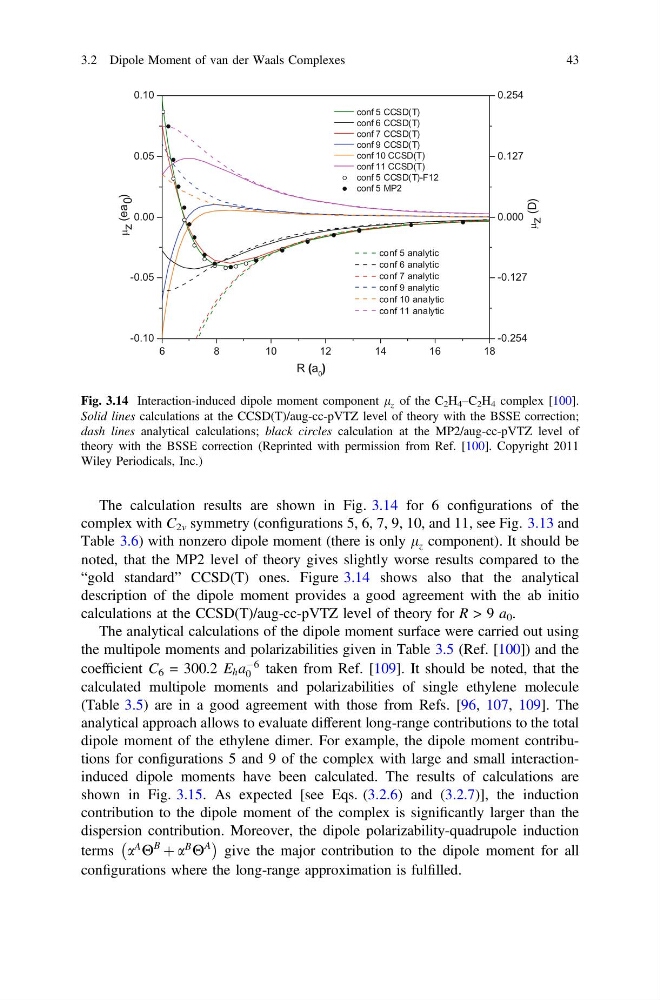
The calculation results are shown in Fig. 3.14 for 6 configurations of the
complex with C 2v symmetry (configurations 5, 6, 7, 9, 10, and 11, see Fig. 3.13 and
Table 3.6) with nonzero dipole moment (there is only l z component). It should be
noted, that the MP2 level of theory gives slightly worse results compared to the
“gold standard” CCSD(T) ones. Figure 3.14 shows also that the analytical
description of the dipole moment provides a good agreement with the ab initio
calculations at the CCSD(T)/aug-cc-pVTZ level of theory for R > 9 a 0 .
The analytical calculations of the dipole moment surface were carried out using
the multipole moments and polarizabilities given in Table 3.5 (Ref. [100]) and the
coefficient C 6 = 300.2 E h a
À6
0 taken from Ref. [109]. It should be noted, that the
calculated multipole moments and polarizabilities of single ethylene molecule
(Table 3.5) are in a good agreement with those from Refs. [96, 107, 109]. The
analytical approach allows to evaluate different long-range contributions to the total
dipole moment of the ethylene dimer. For example, the dipole moment contributions for configurations 5 and 9 of the complex with large and small interactioninduced dipole moments have been calculated. The results of calculations are
shown in Fig. 3.15. As expected [see Eqs. (3.2.6) and (3.2.7)], the induction
contribution to the dipole moment of the complex is significantly larger than the
dispersion contribution. Moreover, the dipole polarizability-quadrupole induction
terms a
A
H
B
þ a
B
H
A
À
Á
give the major contribution to the dipole moment for all
configurations where the long-range approximation is fulfilled.
6
8
10
12
14
16
18
-0.10
-0.05
0.00
0.05
0.10
-0.254
-0.127
0.000
0.127
0.254
conf 5 CCSD(T)
conf 6 CCSD(T)
conf 7 CCSD(T)
conf 9 CCSD(T)
conf 10 CCSD(T)
conf 11 CCSD(T)
conf 5 CCSD(T)-F12
conf 5 MP2
z (D)
z (ea
0 )
R (a 0 )
conf 5 analytic
conf 6 analytic
conf 7 analytic
conf 9 analytic
conf 10 analytic
conf 11 analytic
Fig. 3.14 Interaction-induced dipole moment component l z of the C 2 H 4 –C 2 H 4 complex [100].
Solid lines calculations at the CCSD(T)/aug-cc-pVTZ level of theory with the BSSE correction;
dash lines analytical calculations; black circles calculation at the MP2/aug-cc-pVTZ level of
theory with the BSSE correction (Reprinted with permission from Ref. [100]. Copyright 2011
Wiley Periodicals, Inc.)
3.2 Dipole Moment of van der Waals Complexes
43
complex with C 2v symmetry (configurations 5, 6, 7, 9, 10, and 11, see Fig. 3.13 and
Table 3.6) with nonzero dipole moment (there is only l z component). It should be
noted, that the MP2 level of theory gives slightly worse results compared to the
“gold standard” CCSD(T) ones. Figure 3.14 shows also that the analytical
description of the dipole moment provides a good agreement with the ab initio
calculations at the CCSD(T)/aug-cc-pVTZ level of theory for R > 9 a 0 .
The analytical calculations of the dipole moment surface were carried out using
the multipole moments and polarizabilities given in Table 3.5 (Ref. [100]) and the
coefficient C 6 = 300.2 E h a
À6
0 taken from Ref. [109]. It should be noted, that the
calculated multipole moments and polarizabilities of single ethylene molecule
(Table 3.5) are in a good agreement with those from Refs. [96, 107, 109]. The
analytical approach allows to evaluate different long-range contributions to the total
dipole moment of the ethylene dimer. For example, the dipole moment contributions for configurations 5 and 9 of the complex with large and small interactioninduced dipole moments have been calculated. The results of calculations are
shown in Fig. 3.15. As expected [see Eqs. (3.2.6) and (3.2.7)], the induction
contribution to the dipole moment of the complex is significantly larger than the
dispersion contribution. Moreover, the dipole polarizability-quadrupole induction
terms a
A
H
B
þ a
B
H
A
À
Á
give the major contribution to the dipole moment for all
configurations where the long-range approximation is fulfilled.
6
8
10
12
14
16
18
-0.10
-0.05
0.00
0.05
0.10
-0.254
-0.127
0.000
0.127
0.254
conf 5 CCSD(T)
conf 6 CCSD(T)
conf 7 CCSD(T)
conf 9 CCSD(T)
conf 10 CCSD(T)
conf 11 CCSD(T)
conf 5 CCSD(T)-F12
conf 5 MP2
z (D)
z (ea
0 )
R (a 0 )
conf 5 analytic
conf 6 analytic
conf 7 analytic
conf 9 analytic
conf 10 analytic
conf 11 analytic
Fig. 3.14 Interaction-induced dipole moment component l z of the C 2 H 4 –C 2 H 4 complex [100].
Solid lines calculations at the CCSD(T)/aug-cc-pVTZ level of theory with the BSSE correction;
dash lines analytical calculations; black circles calculation at the MP2/aug-cc-pVTZ level of
theory with the BSSE correction (Reprinted with permission from Ref. [100]. Copyright 2011
Wiley Periodicals, Inc.)
3.2 Dipole Moment of van der Waals Complexes
43