

The ab initio calculations were carried out at the CCSD(T) level of theory with
aug-cc-pVTZ basis set augmented by midbond functions (for more details, see Ref.
[31]). Then, the full 3D surface of each dipole moment component was represented
as a sum of spherical harmonics multiplied by corresponding expansion coefficients
and a cosine/sine function.
l x;z ¼
X
l;m
ðÀ1Þ
m a lm ðRÞP lm ðcosðhÞÞ cosðmuÞ;
l y ¼
X
l;m
ðÀ1Þ
m a lm ðRÞP lm ðcosðhÞÞ sinðmuÞ:
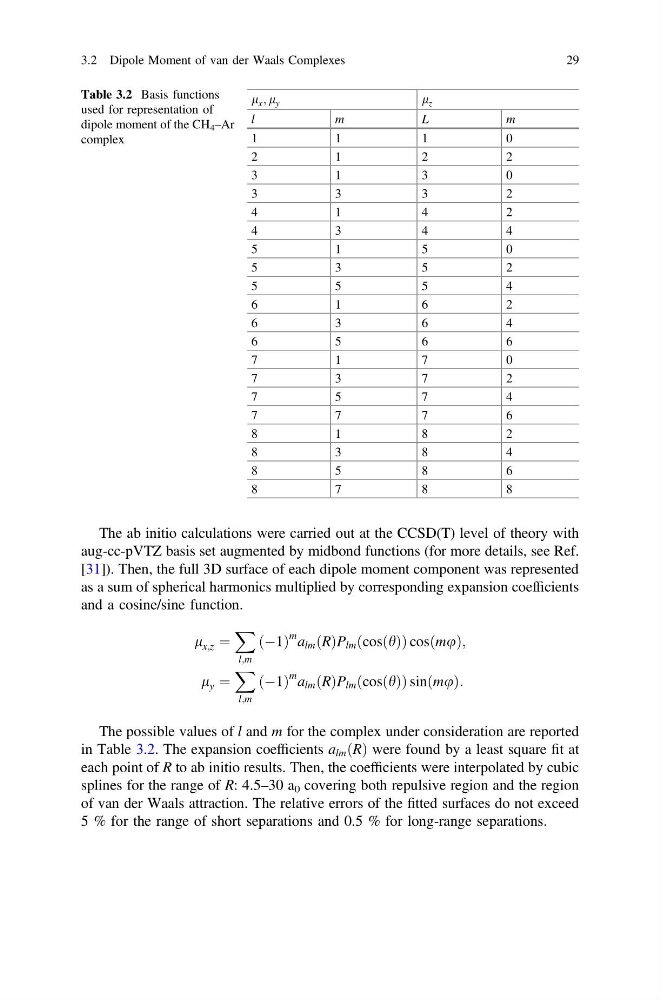
The possible values of l and m for the complex under consideration are reported
in Table 3.2. The expansion coefficients a lm ðRÞ were found by a least square fit at
each point of R to ab initio results. Then, the coefficients were interpolated by cubic
splines for the range of R: 4.5–30 a 0 covering both repulsive region and the region
of van der Waals attraction. The relative errors of the fitted surfaces do not exceed
5 % for the range of short separations and 0.5 % for long-range separations.
Table 3.2 Basis functions
used for representation of
dipole moment of the CH 4 –Ar
complex
l x ; l y
l z
l
m
L
m
1
1
1
0
2
1
2
2
3
1
3
0
3
3
3
2
4
1
4
2
4
3
4
4
5
1
5
0
5
3
5
2
5
5
5
4
6
1
6
2
6
3
6
4
6
5
6
6
7
1
7
0
7
3
7
2
7
5
7
4
7
7
7
6
8
1
8
2
8
3
8
4
8
5
8
6
8
7
8
8
3.2 Dipole Moment of van der Waals Complexes
29
aug-cc-pVTZ basis set augmented by midbond functions (for more details, see Ref.
[31]). Then, the full 3D surface of each dipole moment component was represented
as a sum of spherical harmonics multiplied by corresponding expansion coefficients
and a cosine/sine function.
l x;z ¼
X
l;m
ðÀ1Þ
m a lm ðRÞP lm ðcosðhÞÞ cosðmuÞ;
l y ¼
X
l;m
ðÀ1Þ
m a lm ðRÞP lm ðcosðhÞÞ sinðmuÞ:
The possible values of l and m for the complex under consideration are reported
in Table 3.2. The expansion coefficients a lm ðRÞ were found by a least square fit at
each point of R to ab initio results. Then, the coefficients were interpolated by cubic
splines for the range of R: 4.5–30 a 0 covering both repulsive region and the region
of van der Waals attraction. The relative errors of the fitted surfaces do not exceed
5 % for the range of short separations and 0.5 % for long-range separations.
Table 3.2 Basis functions
used for representation of
dipole moment of the CH 4 –Ar
complex
l x ; l y
l z
l
m
L
m
1
1
1
0
2
1
2
2
3
1
3
0
3
3
3
2
4
1
4
2
4
3
4
4
5
1
5
0
5
3
5
2
5
5
5
4
6
1
6
2
6
3
6
4
6
5
6
6
7
1
7
0
7
3
7
2
7
5
7
4
7
7
7
6
8
1
8
2
8
3
8
4
8
5
8
6
8
7
8
8
3.2 Dipole Moment of van der Waals Complexes
29