

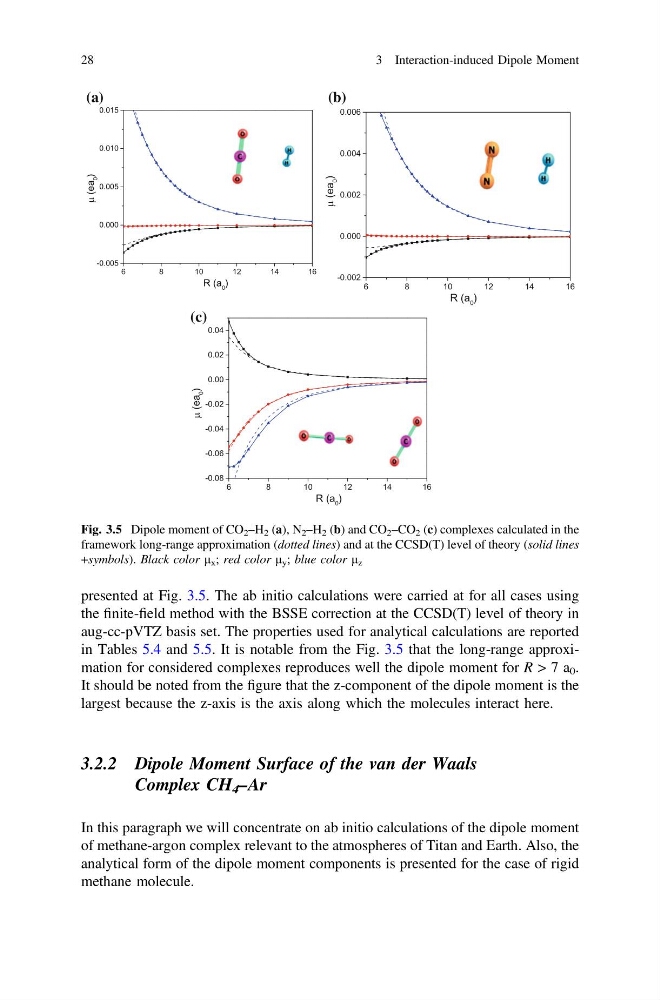
presented at Fig. 3.5. The ab initio calculations were carried at for all cases using
the finite-field method with the BSSE correction at the CCSD(T) level of theory in
aug-cc-pVTZ basis set. The properties used for analytical calculations are reported
in Tables 5.4 and 5.5. It is notable from the Fig. 3.5 that the long-range approximation for considered complexes reproduces well the dipole moment for R > 7 a 0 .
It should be noted from the figure that the z-component of the dipole moment is the
largest because the z-axis is the axis along which the molecules interact here.
3.2.2 Dipole Moment Surface of the van der Waals
Complex CH 4 –Ar
In this paragraph we will concentrate on ab initio calculations of the dipole moment
of methane-argon complex relevant to the atmospheres of Titan and Earth. Also, the
analytical form of the dipole moment components is presented for the case of rigid
methane molecule.
6
8
10
12
14
16
-0.005
0.000
0.005
0.010
0.015
R (a 0 )
(ea
0
)
6
8
10
12
14
16
-0.002
0.000
0.002
0.004
0.006
R (a 0 )
(ea
0
)
6
8
10
12
14
16
-0.08
-0.06
-0.04
-0.02
0.00
0.02
0.04
R (a 0 )
(ea
0
)
(a)
(b)
(c)
Fig. 3.5 Dipole moment of CO 2 –H 2 (a), N 2 –H 2 (b) and CO 2 –CO 2 (c) complexes calculated in the
framework long-range approximation (dotted lines) and at the CCSD(T) level of theory (solid lines
+symbols). Black color μ x ; red color μ y ; blue color μ z
28
3 Interaction-induced Dipole Moment
the finite-field method with the BSSE correction at the CCSD(T) level of theory in
aug-cc-pVTZ basis set. The properties used for analytical calculations are reported
in Tables 5.4 and 5.5. It is notable from the Fig. 3.5 that the long-range approximation for considered complexes reproduces well the dipole moment for R > 7 a 0 .
It should be noted from the figure that the z-component of the dipole moment is the
largest because the z-axis is the axis along which the molecules interact here.
3.2.2 Dipole Moment Surface of the van der Waals
Complex CH 4 –Ar
In this paragraph we will concentrate on ab initio calculations of the dipole moment
of methane-argon complex relevant to the atmospheres of Titan and Earth. Also, the
analytical form of the dipole moment components is presented for the case of rigid
methane molecule.
6
8
10
12
14
16
-0.005
0.000
0.005
0.010
0.015
R (a 0 )
(ea
0
)
6
8
10
12
14
16
-0.002
0.000
0.002
0.004
0.006
R (a 0 )
(ea
0
)
6
8
10
12
14
16
-0.08
-0.06
-0.04
-0.02
0.00
0.02
0.04
R (a 0 )
(ea
0
)
(a)
(b)
(c)
Fig. 3.5 Dipole moment of CO 2 –H 2 (a), N 2 –H 2 (b) and CO 2 –CO 2 (c) complexes calculated in the
framework long-range approximation (dotted lines) and at the CCSD(T) level of theory (solid lines
+symbols). Black color μ x ; red color μ y ; blue color μ z
28
3 Interaction-induced Dipole Moment