

l a ¼
256D a ðF
0
a ÞÀ40D a ð2F
0
a Þ þ D a ð4F
0
a Þ
180F 0
a
;
ð3:1:2Þ
where D a ðF
0
a Þ ¼ À
EðÀF
0
a ÞÀEðF
0
a Þ
2
Á
3.1.2 Long-Range Analytical Formalism. Induction
and Dispersion Contributions
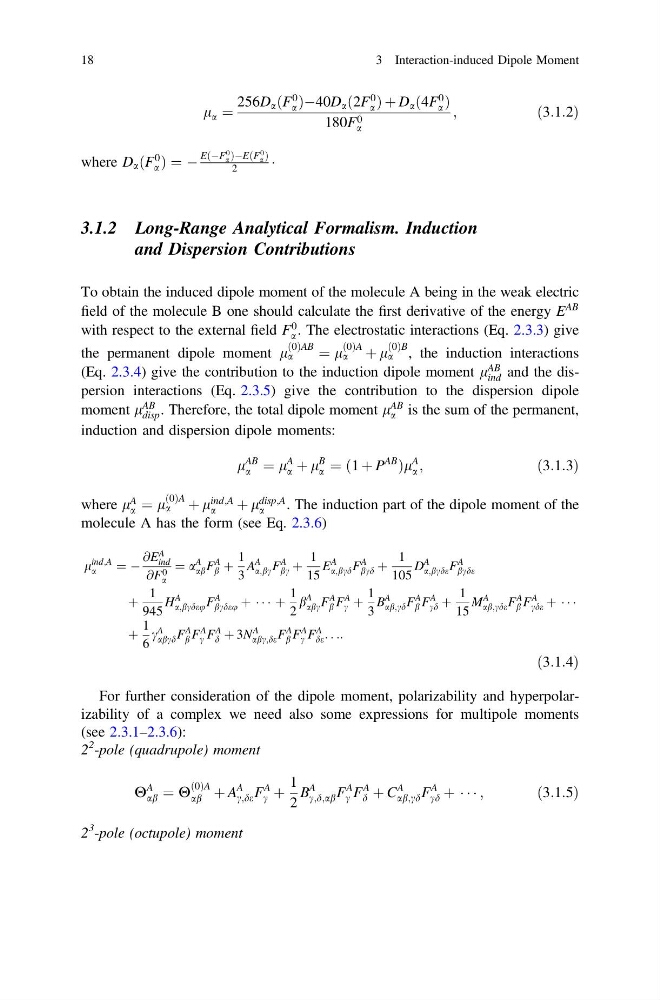
To obtain the induced dipole moment of the molecule A being in the weak electric
field of the molecule B one should calculate the first derivative of the energy E
AB
with respect to the external field F
0
a . The electrostatic interactions (Eq. 2.3.3) give
the permanent dipole moment l
0
ð ÞAB
a
¼ l
0
ð ÞA
a
þ l
0
ð ÞB
a , the induction interactions
(Eq. 2.3.4) give the contribution to the induction dipole moment l
AB
ind and the dispersion interactions (Eq. 2.3.5) give the contribution to the dispersion dipole
moment l
AB
disp . Therefore, the total dipole moment l
AB
a is the sum of the permanent,
induction and dispersion dipole moments:
l
AB
a ¼ l
A
a þ l
B
a ¼ ð1 þ P
AB
Þl
A
a ;
ð3:1:3Þ
where l
A
a ¼ l
ð0ÞA
a
þ l
ind;A
a
þ l
disp;A
a
. The induction part of the dipole moment of the
molecule A has the form (see Eq. 2.3.6)
l
ind;A
a
¼ À
@E
A
ind
@F 0
a
¼ a
A
ab F
A
b þ
1
3
A
A
a;bc F
A
bc þ
1
15
E
A
a;bcd F
A
bcd þ
1
105
D
A
a;bcde F
A
bcde
þ
1
945
H
A
a;bcdeu F
A
bcdeu þ Á Á Á þ
1
2
b
A
abc F
A
b F
A
c þ
1
3
B
A
ab;cd F
A
b F
A
cd þ
1
15
M
A
ab;cde F
A
b F
A
cde þ Á Á Á
þ
1
6
c
A
abcd F
A
b F
A
c F
A
d þ 3N
A
abc;de F
A
b F
A
c F
A
de . . .:
ð3:1:4Þ
For further consideration of the dipole moment, polarizability and hyperpolarizability of a complex we need also some expressions for multipole moments
(see 2.3.1–2.3.6):
2
2 -pole (quadrupole) moment
H
A
ab ¼ H
ð0ÞA
ab þ A
A
c;de F
A
c þ
1
2
B
A
c;d;ab F
A
c F
A
d þ C
A
ab;cd F
A
cd þ Á Á Á ;
ð3:1:5Þ
2
3 -pole (octupole) moment
18
3 Interaction-induced Dipole Moment
256D a ðF
0
a ÞÀ40D a ð2F
0
a Þ þ D a ð4F
0
a Þ
180F 0
a
;
ð3:1:2Þ
where D a ðF
0
a Þ ¼ À
EðÀF
0
a ÞÀEðF
0
a Þ
2
Á
3.1.2 Long-Range Analytical Formalism. Induction
and Dispersion Contributions
To obtain the induced dipole moment of the molecule A being in the weak electric
field of the molecule B one should calculate the first derivative of the energy E
AB
with respect to the external field F
0
a . The electrostatic interactions (Eq. 2.3.3) give
the permanent dipole moment l
0
ð ÞAB
a
¼ l
0
ð ÞA
a
þ l
0
ð ÞB
a , the induction interactions
(Eq. 2.3.4) give the contribution to the induction dipole moment l
AB
ind and the dispersion interactions (Eq. 2.3.5) give the contribution to the dispersion dipole
moment l
AB
disp . Therefore, the total dipole moment l
AB
a is the sum of the permanent,
induction and dispersion dipole moments:
l
AB
a ¼ l
A
a þ l
B
a ¼ ð1 þ P
AB
Þl
A
a ;
ð3:1:3Þ
where l
A
a ¼ l
ð0ÞA
a
þ l
ind;A
a
þ l
disp;A
a
. The induction part of the dipole moment of the
molecule A has the form (see Eq. 2.3.6)
l
ind;A
a
¼ À
@E
A
ind
@F 0
a
¼ a
A
ab F
A
b þ
1
3
A
A
a;bc F
A
bc þ
1
15
E
A
a;bcd F
A
bcd þ
1
105
D
A
a;bcde F
A
bcde
þ
1
945
H
A
a;bcdeu F
A
bcdeu þ Á Á Á þ
1
2
b
A
abc F
A
b F
A
c þ
1
3
B
A
ab;cd F
A
b F
A
cd þ
1
15
M
A
ab;cde F
A
b F
A
cde þ Á Á Á
þ
1
6
c
A
abcd F
A
b F
A
c F
A
d þ 3N
A
abc;de F
A
b F
A
c F
A
de . . .:
ð3:1:4Þ
For further consideration of the dipole moment, polarizability and hyperpolarizability of a complex we need also some expressions for multipole moments
(see 2.3.1–2.3.6):
2
2 -pole (quadrupole) moment
H
A
ab ¼ H
ð0ÞA
ab þ A
A
c;de F
A
c þ
1
2
B
A
c;d;ab F
A
c F
A
d þ C
A
ab;cd F
A
cd þ Á Á Á ;
ð3:1:5Þ
2
3 -pole (octupole) moment
18
3 Interaction-induced Dipole Moment