

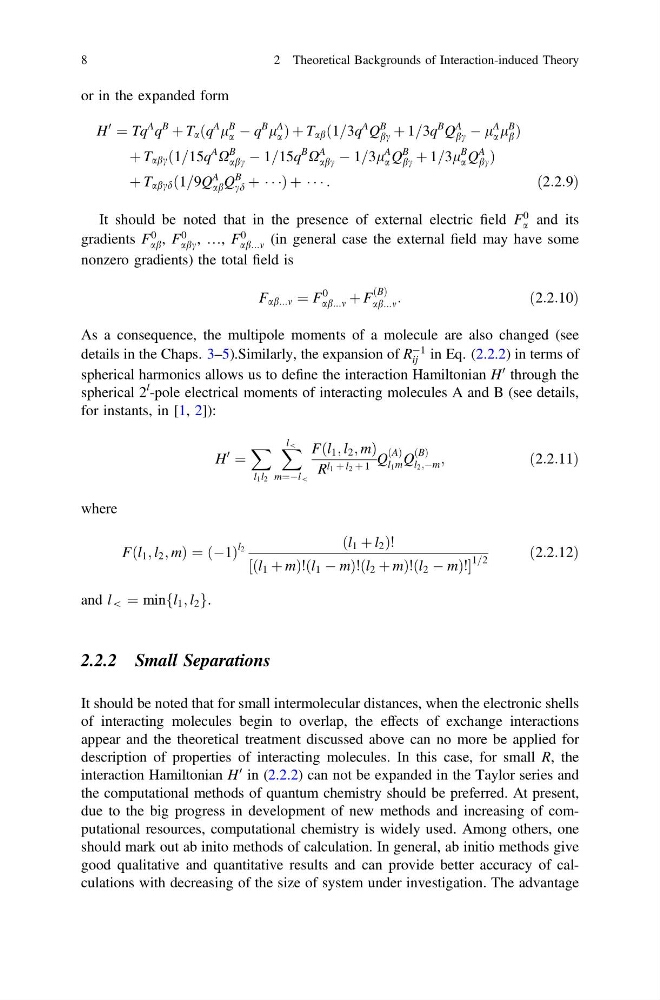
or in the expanded form
H
0
¼ Tq
A q
B
þ T a ðq
A l
B
a À q
B l
A
a Þ þ T ab ð1=3q
A Q
B
bc þ 1=3q
B Q
A
bc À l
A
a l
B
b Þ
þ T abc ð1=15q
A X
B
abc À 1=15q
B X
A
abc À 1=3l
A
a Q
B
bc þ 1=3l
B
a Q
A
bc Þ
þ T abcd ð1=9Q
A
ab Q
B
cd þ Á Á ÁÞ þ Á Á Á :
ð2:2:9Þ
It should be noted that in the presence of external electric field F
0
a and its
gradients F
0
ab , F
0
abc , …, F
0
ab...m (in general case the external field may have some
nonzero gradients) the total field is
F ab...m ¼ F
0
ab...m þ F
ðBÞ
ab...m :
ð2:2:10Þ
As a consequence, the multipole moments of a molecule are also changed (see
details in the Chaps. 3–5).Similarly, the expansion of R
À1
ij in Eq. (2.2.2) in terms of
spherical harmonics allows us to define the interaction Hamiltonian H
0 through the
spherical 2
l -pole electrical moments of interacting molecules A and B (see details,
for instants, in [1, 2]):
H
0
¼
X
l 1 l 2
X l \
m¼Àl \
Fðl 1 ; l 2 ; mÞ
R l 1 þ l 2 þ 1 Q
ðAÞ
l 1 m Q
ðBÞ
l 2 ;Àm ;
ð2:2:11Þ
where
Fðl 1 ; l 2 ; mÞ ¼ ðÀ1Þ
l 2
ðl 1 þ l 2 Þ!
ðl 1 þ mÞ!ðl 1 À mÞ!ðl 2 þ mÞ!ðl 2 À mÞ!
½
1=2
ð2:2:12Þ
and l \ ¼ minfl 1 ; l 2 g.
2.2.2 Small Separations
It should be noted that for small intermolecular distances, when the electronic shells
of interacting molecules begin to overlap, the effects of exchange interactions
appear and the theoretical treatment discussed above can no more be applied for
description of properties of interacting molecules. In this case, for small R, the
interaction Hamiltonian H
0 in (2.2.2) can not be expanded in the Taylor series and
the computational methods of quantum chemistry should be preferred. At present,
due to the big progress in development of new methods and increasing of computational resources, computational chemistry is widely used. Among others, one
should mark out ab inito methods of calculation. In general, ab initio methods give
good qualitative and quantitative results and can provide better accuracy of calculations with decreasing of the size of system under investigation. The advantage
8
2 Theoretical Backgrounds of Interaction-induced Theory
H
0
¼ Tq
A q
B
þ T a ðq
A l
B
a À q
B l
A
a Þ þ T ab ð1=3q
A Q
B
bc þ 1=3q
B Q
A
bc À l
A
a l
B
b Þ
þ T abc ð1=15q
A X
B
abc À 1=15q
B X
A
abc À 1=3l
A
a Q
B
bc þ 1=3l
B
a Q
A
bc Þ
þ T abcd ð1=9Q
A
ab Q
B
cd þ Á Á ÁÞ þ Á Á Á :
ð2:2:9Þ
It should be noted that in the presence of external electric field F
0
a and its
gradients F
0
ab , F
0
abc , …, F
0
ab...m (in general case the external field may have some
nonzero gradients) the total field is
F ab...m ¼ F
0
ab...m þ F
ðBÞ
ab...m :
ð2:2:10Þ
As a consequence, the multipole moments of a molecule are also changed (see
details in the Chaps. 3–5).Similarly, the expansion of R
À1
ij in Eq. (2.2.2) in terms of
spherical harmonics allows us to define the interaction Hamiltonian H
0 through the
spherical 2
l -pole electrical moments of interacting molecules A and B (see details,
for instants, in [1, 2]):
H
0
¼
X
l 1 l 2
X l \
m¼Àl \
Fðl 1 ; l 2 ; mÞ
R l 1 þ l 2 þ 1 Q
ðAÞ
l 1 m Q
ðBÞ
l 2 ;Àm ;
ð2:2:11Þ
where
Fðl 1 ; l 2 ; mÞ ¼ ðÀ1Þ
l 2
ðl 1 þ l 2 Þ!
ðl 1 þ mÞ!ðl 1 À mÞ!ðl 2 þ mÞ!ðl 2 À mÞ!
½
1=2
ð2:2:12Þ
and l \ ¼ minfl 1 ; l 2 g.
2.2.2 Small Separations
It should be noted that for small intermolecular distances, when the electronic shells
of interacting molecules begin to overlap, the effects of exchange interactions
appear and the theoretical treatment discussed above can no more be applied for
description of properties of interacting molecules. In this case, for small R, the
interaction Hamiltonian H
0 in (2.2.2) can not be expanded in the Taylor series and
the computational methods of quantum chemistry should be preferred. At present,
due to the big progress in development of new methods and increasing of computational resources, computational chemistry is widely used. Among others, one
should mark out ab inito methods of calculation. In general, ab initio methods give
good qualitative and quantitative results and can provide better accuracy of calculations with decreasing of the size of system under investigation. The advantage
8
2 Theoretical Backgrounds of Interaction-induced Theory