

vi
Preface for the Second Edition
For the ground-states of other electron-rich molecules, the results of valencebond calculations from different laboratories – see for example references 24-29
of Chapter 2 – also indicate also indicate that “long-bond” structures are more
important than is usually supposed, and therefore they need to be included in
qualitative valence-bond descriptions of their electronic structure. This book
describes how this can be done, and some of the resulting consequences for the
interpretation of the electronic structure, bond properties and reaction mechanisms
for various electron-rich molecules. When appropriate, molecular orbital and
valence-bond descriptions of bonding are compared, and relationships that exist
between them are derived. Considerable attention is given to the use of Pauling
“3-electron bonds” ( A···B as A · B
) for providing qualitative valence-bond
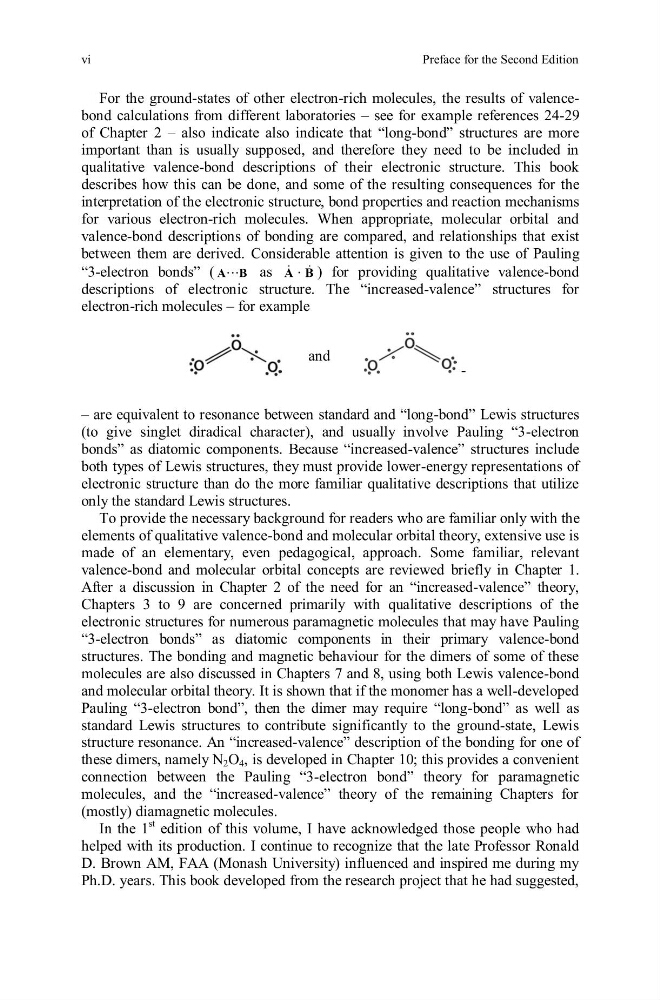
descriptions of electronic structure. The “increased-valence” structures for
electron-rich molecules – for example
and
-
– are equivalent to resonance between standard and “long-bond” Lewis structures
(to give singlet diradical character), and usually involve Pauling “3-electron
bonds” as diatomic components. Because “increased-valence” structures include
both types of Lewis structures, they must provide lower-energy representations of
electronic structure than do the more familiar qualitative descriptions that utilize
only the standard Lewis structures.
To provide the necessary background for readers who are familiar only with the
elements of qualitative valence-bond and molecular orbital theory, extensive use is
made of an elementary, even pedagogical, approach. Some familiar, relevant
valence-bond and molecular orbital concepts are reviewed briefly in Chapter 1.
After a discussion in Chapter 2 of the need for an “increased-valence” theory,
Chapters 3 to 9 are concerned primarily with qualitative descriptions of the
electronic structures for numerous paramagnetic molecules that may have Pauling
“3-electron bonds” as diatomic components in their primary valence-bond
structures. The bonding and magnetic behaviour for the dimers of some of these
molecules are also discussed in Chapters 7 and 8, using both Lewis valence-bond
and molecular orbital theory. It is shown that if the monomer has a well-developed
Pauling “3-electron bond”, then the dimer may require “long-bond” as well as
standard Lewis structures to contribute significantly to the ground-state, Lewis
structure resonance. An “increased-valence” description of the bonding for one of
these dimers, namely N 2 O 4 , is developed in Chapter 10; this provides a convenient
connection between the Pauling “3-electron bond” theory for paramagnetic
molecules, and the “increased-valence” theory of the remaining Chapters for
(mostly) diamagnetic molecules.
In the 1
st edition of this volume, I have acknowledged those people who had
helped with its production. I continue to recognize that the late Professor Ronald
D. Brown AM, FAA (Monash University) influenced and inspired me during my
Ph.D. years. This book developed from the research project that he had suggested,
Preface for the Second Edition
For the ground-states of other electron-rich molecules, the results of valencebond calculations from different laboratories – see for example references 24-29
of Chapter 2 – also indicate also indicate that “long-bond” structures are more
important than is usually supposed, and therefore they need to be included in
qualitative valence-bond descriptions of their electronic structure. This book
describes how this can be done, and some of the resulting consequences for the
interpretation of the electronic structure, bond properties and reaction mechanisms
for various electron-rich molecules. When appropriate, molecular orbital and
valence-bond descriptions of bonding are compared, and relationships that exist
between them are derived. Considerable attention is given to the use of Pauling
“3-electron bonds” ( A···B as A · B
) for providing qualitative valence-bond
descriptions of electronic structure. The “increased-valence” structures for
electron-rich molecules – for example
and
-
– are equivalent to resonance between standard and “long-bond” Lewis structures
(to give singlet diradical character), and usually involve Pauling “3-electron
bonds” as diatomic components. Because “increased-valence” structures include
both types of Lewis structures, they must provide lower-energy representations of
electronic structure than do the more familiar qualitative descriptions that utilize
only the standard Lewis structures.
To provide the necessary background for readers who are familiar only with the
elements of qualitative valence-bond and molecular orbital theory, extensive use is
made of an elementary, even pedagogical, approach. Some familiar, relevant
valence-bond and molecular orbital concepts are reviewed briefly in Chapter 1.
After a discussion in Chapter 2 of the need for an “increased-valence” theory,
Chapters 3 to 9 are concerned primarily with qualitative descriptions of the
electronic structures for numerous paramagnetic molecules that may have Pauling
“3-electron bonds” as diatomic components in their primary valence-bond
structures. The bonding and magnetic behaviour for the dimers of some of these
molecules are also discussed in Chapters 7 and 8, using both Lewis valence-bond
and molecular orbital theory. It is shown that if the monomer has a well-developed
Pauling “3-electron bond”, then the dimer may require “long-bond” as well as
standard Lewis structures to contribute significantly to the ground-state, Lewis
structure resonance. An “increased-valence” description of the bonding for one of
these dimers, namely N 2 O 4 , is developed in Chapter 10; this provides a convenient
connection between the Pauling “3-electron bond” theory for paramagnetic
molecules, and the “increased-valence” theory of the remaining Chapters for
(mostly) diamagnetic molecules.
In the 1
st edition of this volume, I have acknowledged those people who had
helped with its production. I continue to recognize that the late Professor Ronald
D. Brown AM, FAA (Monash University) influenced and inspired me during my
Ph.D. years. This book developed from the research project that he had suggested,