

Preface for the Second Edition
Both editions of this book provide qualitative molecular orbital and valence-bond
descriptions of the electronic structures for primarily electron-rich molecules.
Strong emphasis is given to the valence-bond approach.
Electron-rich molecules form a very large class of molecules, and the results of
quantum mechanical studies from different laboratories indicate that qualitative
valence-bond descriptions for many of these molecules are incomplete in so far as
they usually omit “long-bond” Lewis structures from elementary descriptions of
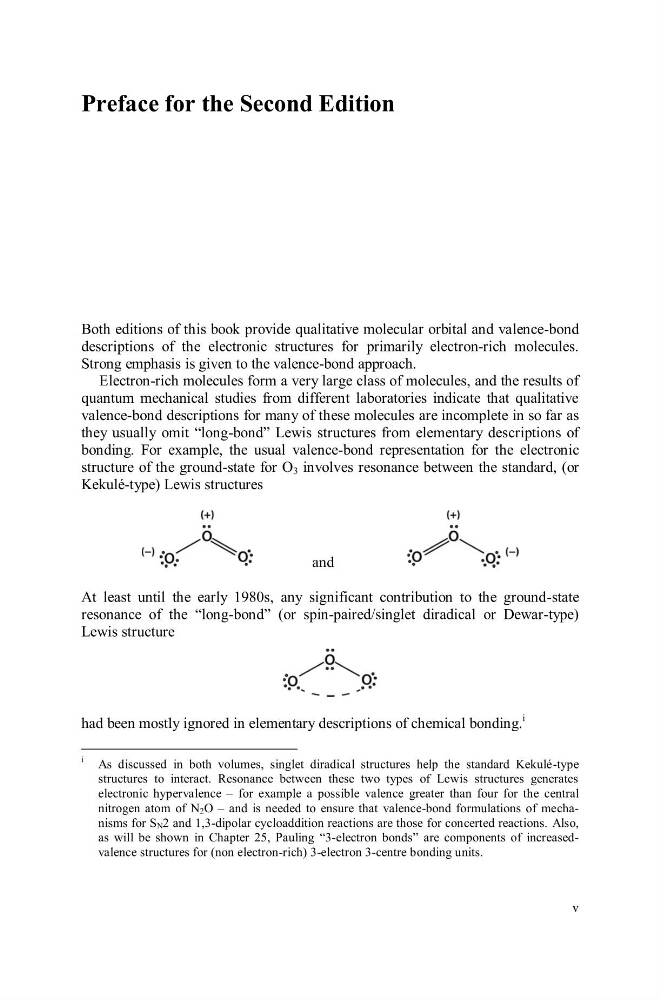
bonding. For example, the usual valence-bond representation for the electronic
structure of the ground-state for O 3 involves resonance between the standard, (or
Kekulé-type) Lewis structures
and
At least until the early 1980s, any significant contribution to the ground-state
resonance of the “long-bond” (or spin-paired/singlet diradical or Dewar-type)
Lewis structure
had been mostly ignored in elementary descriptions of chemical bonding.
i
i
As discussed in both volumes, singlet diradical structures help the standard Kekulé-type
structures to interact. Resonance between these two types of Lewis structures generates
electronic hypervalence – for example a possible valence greater than four for the central
nitrogen atom of N2O – and is needed to ensure that valence-bond formulations of mechanisms for SN2 and 1,3-dipolar cycloaddition reactions are those for concerted reactions. Also,
as will be shown in Chapter 25, Pauling “3-electron bonds” are components of increasedvalence structures for (non electron-rich) 3-electron 3-centre bonding units.
v
Both editions of this book provide qualitative molecular orbital and valence-bond
descriptions of the electronic structures for primarily electron-rich molecules.
Strong emphasis is given to the valence-bond approach.
Electron-rich molecules form a very large class of molecules, and the results of
quantum mechanical studies from different laboratories indicate that qualitative
valence-bond descriptions for many of these molecules are incomplete in so far as
they usually omit “long-bond” Lewis structures from elementary descriptions of
bonding. For example, the usual valence-bond representation for the electronic
structure of the ground-state for O 3 involves resonance between the standard, (or
Kekulé-type) Lewis structures
and
At least until the early 1980s, any significant contribution to the ground-state
resonance of the “long-bond” (or spin-paired/singlet diradical or Dewar-type)
Lewis structure
had been mostly ignored in elementary descriptions of chemical bonding.
i
i
As discussed in both volumes, singlet diradical structures help the standard Kekulé-type
structures to interact. Resonance between these two types of Lewis structures generates
electronic hypervalence – for example a possible valence greater than four for the central
nitrogen atom of N2O – and is needed to ensure that valence-bond formulations of mechanisms for SN2 and 1,3-dipolar cycloaddition reactions are those for concerted reactions. Also,
as will be shown in Chapter 25, Pauling “3-electron bonds” are components of increasedvalence structures for (non electron-rich) 3-electron 3-centre bonding units.
v