

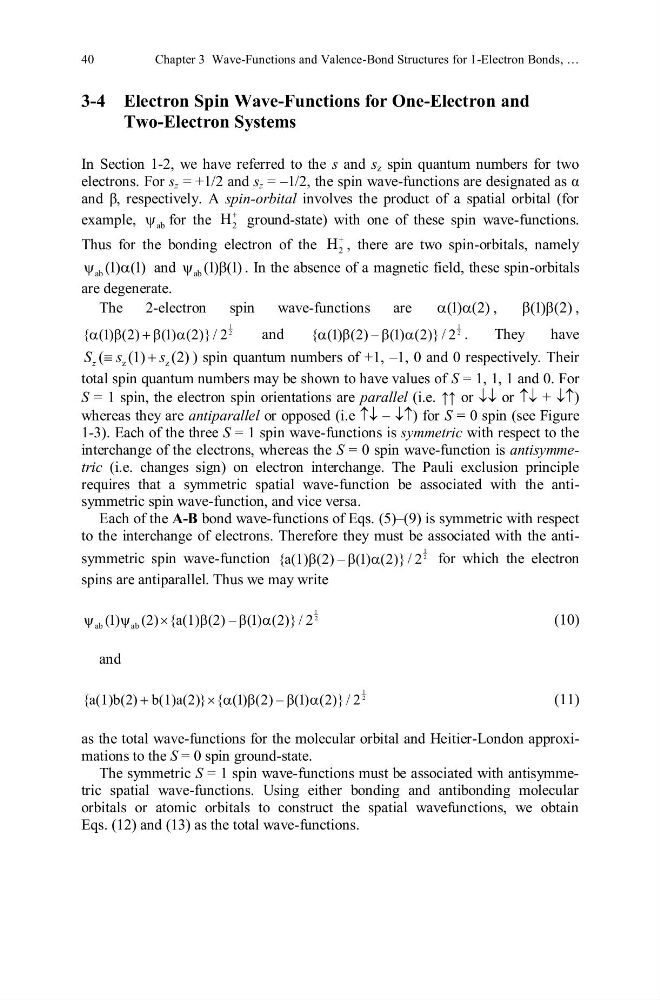
40
Chapter 3 Wave-Functions and Valence-Bond Structures for 1-Electron Bonds, …
3-4 Electron Spin Wave-Functions for One-Electron and
Two-Electron Systems
In Section 1-2, we have referred to the s and s z spin quantum numbers for two
electrons. For s z = +1/2 and s z = –1/2, the spin wave-functions are designated as α
and β, respectively. A spin-orbital involves the product of a spatial orbital (for
example, ab
for the 2
H
ground-state) with one of these spin wave-functions.
Thus for the bonding electron of the 2
H
, there are two spin-orbitals, namely
ab (1) (1)
and ab (1) (1)
. In the absence of a magnetic field, these spin-orbitals
are degenerate.
The
2-electron
spin
wave-functions
are
(1) (2)
,
(1) (2)
,
1
2
{ (1) (2) (1) (2)} / 2
and
1
2
{ (1) (2) – (1) (2)} / 2
.
They
have
z
z
(
(1)
(2)
z
S
s
s
) spin quantum numbers of +1, –1, 0 and 0 respectively. Their
total spin quantum numbers may be shown to have values of S = 1, 1, 1 and 0. For
S = 1 spin, the electron spin orientations are parallel (i.e. ↑↑ or or + )
whereas they are antiparallel or opposed (i.e – ) for S = 0 spin (see Figure
1-3). Each of the three S = 1 spin wave-functions is symmetric with respect to the
interchange of the electrons, whereas the S = 0 spin wave-function is antisymmetric (i.e. changes sign) on electron interchange. The Pauli exclusion principle
requires that a symmetric spatial wave-function be associated with the antisymmetric spin wave-function, and vice versa.
Each of the A-B bond wave-functions of Eqs. (5)–(9) is symmetric with respect
to the interchange of electrons. Therefore they must be associated with the antisymmetric spin wave-function
1
2
{a(1) (2) – (1) (2)} / 2
for which the electron
spins are antiparallel. Thus we may write
1
2
ab
ab
(1) (2) {a(1) (2) – (1) (2)} / 2
(10)
and
1
2
{a(1)b(2) b(1)a(2)} { (1) (2) – (1) (2)} / 2
(11)
as the total wave-functions for the molecular orbital and Heitier-London approximations to the S = 0 spin ground-state.
The symmetric S = 1 spin wave-functions must be associated with antisymmetric spatial wave-functions. Using either bonding and antibonding molecular
orbitals or atomic orbitals to construct the spatial wavefunctions, we obtain
Eqs. (12) and (13) as the total wave-functions.
Chapter 3 Wave-Functions and Valence-Bond Structures for 1-Electron Bonds, …
3-4 Electron Spin Wave-Functions for One-Electron and
Two-Electron Systems
In Section 1-2, we have referred to the s and s z spin quantum numbers for two
electrons. For s z = +1/2 and s z = –1/2, the spin wave-functions are designated as α
and β, respectively. A spin-orbital involves the product of a spatial orbital (for
example, ab
for the 2
H
ground-state) with one of these spin wave-functions.
Thus for the bonding electron of the 2
H
, there are two spin-orbitals, namely
ab (1) (1)
and ab (1) (1)
. In the absence of a magnetic field, these spin-orbitals
are degenerate.
The
2-electron
spin
wave-functions
are
(1) (2)
,
(1) (2)
,
1
2
{ (1) (2) (1) (2)} / 2
and
1
2
{ (1) (2) – (1) (2)} / 2
.
They
have
z
z
(
(1)
(2)
z
S
s
s
) spin quantum numbers of +1, –1, 0 and 0 respectively. Their
total spin quantum numbers may be shown to have values of S = 1, 1, 1 and 0. For
S = 1 spin, the electron spin orientations are parallel (i.e. ↑↑ or or + )
whereas they are antiparallel or opposed (i.e – ) for S = 0 spin (see Figure
1-3). Each of the three S = 1 spin wave-functions is symmetric with respect to the
interchange of the electrons, whereas the S = 0 spin wave-function is antisymmetric (i.e. changes sign) on electron interchange. The Pauli exclusion principle
requires that a symmetric spatial wave-function be associated with the antisymmetric spin wave-function, and vice versa.
Each of the A-B bond wave-functions of Eqs. (5)–(9) is symmetric with respect
to the interchange of electrons. Therefore they must be associated with the antisymmetric spin wave-function
1
2
{a(1) (2) – (1) (2)} / 2
for which the electron
spins are antiparallel. Thus we may write
1
2
ab
ab
(1) (2) {a(1) (2) – (1) (2)} / 2
(10)
and
1
2
{a(1)b(2) b(1)a(2)} { (1) (2) – (1) (2)} / 2
(11)
as the total wave-functions for the molecular orbital and Heitier-London approximations to the S = 0 spin ground-state.
The symmetric S = 1 spin wave-functions must be associated with antisymmetric spatial wave-functions. Using either bonding and antibonding molecular
orbitals or atomic orbitals to construct the spatial wavefunctions, we obtain
Eqs. (12) and (13) as the total wave-functions.