

2-5 “Long-Bond” Lewis Structures and a Need for an “Increased-Valence” Theory
27
2-5(b) The Need for “Increased-Valence” Structures
If a number of “long-bond” Lewis structures are included together with the standard Lewis structures in a qualitative resonance description of electronic structure,
the resonance description may become rather cumbersome. We may also lose
quick insight into the expected properties of the bonds. For example, if we include
the “long-bond” structures (5) and (6) together with (1), (2) and (3) to represent
the ground-state electronic structure for N 2 O, we might be led to deduce that the
contributions from structures (5) and (6) would reduce the N-N and (nearest
neighbour) N-O bond-numbers below the values of 2.67 and 1.67 obtained from
resonance between (1), (2) and (3) (with each of these latter structures contributing equally). However, this need not be the case, because this deduction ignores
the effect of resonance on bonding
i
. This suggests that we require a technique for
using all of the important Lewis octet structures (both standard and “long-bond”)
together with some indication of the effect on bonding of resonance between these
valence-bond structures. One technique involves the incorporation of 1-electron
bonds (via the Pauling “3-electron bonds”) as well as electron-pair bonds into the
valence-bond structures. In Chapters 10-14, we shall describe in some detail how
this may be done. Here, we shall only display these types of structures for N 2 O
and F 2 O 2 and make some obvious comments about them.
2-5(c)
Structures for N 2 O and F 2 O 2
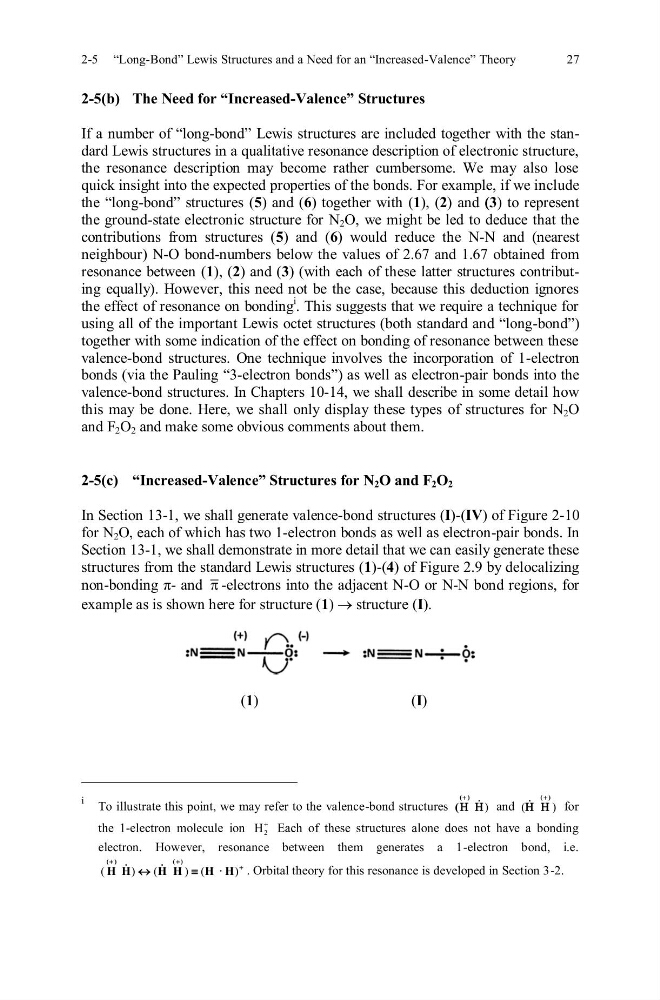
In Section 13-1, we shall generate valence-bond structures (I)-(IV) of Figure 2-10
for N 2 O, each of which has two 1-electron bonds as well as electron-pair bonds. In
Section 13-1, we shall demonstrate in more detail that we can easily generate these
structures from the standard Lewis structures (1)-(4) of Figure 2.9 by delocalizing
non-bonding π- and -electrons into the adjacent N-O or N-N bond regions, for
example as is shown here for structure (1) structure (I).
(1)
(I)
i To illustrate this point, we may refer to the valence-bond structures
)
( )
(
and (
)
( )
for
the 1-electron molecule ion
2
H
Each of these structures alone does not have a bonding
electron. However, resonance between them generates a 1-electron bond, i.e.
(
)
(
) (
)
( )
( )
H H
H H
Η · Η
. Orbital theory for this resonance is developed in Section 3-2.
“Increased-Valence”
27
2-5(b) The Need for “Increased-Valence” Structures
If a number of “long-bond” Lewis structures are included together with the standard Lewis structures in a qualitative resonance description of electronic structure,
the resonance description may become rather cumbersome. We may also lose
quick insight into the expected properties of the bonds. For example, if we include
the “long-bond” structures (5) and (6) together with (1), (2) and (3) to represent
the ground-state electronic structure for N 2 O, we might be led to deduce that the
contributions from structures (5) and (6) would reduce the N-N and (nearest
neighbour) N-O bond-numbers below the values of 2.67 and 1.67 obtained from
resonance between (1), (2) and (3) (with each of these latter structures contributing equally). However, this need not be the case, because this deduction ignores
the effect of resonance on bonding
i
. This suggests that we require a technique for
using all of the important Lewis octet structures (both standard and “long-bond”)
together with some indication of the effect on bonding of resonance between these
valence-bond structures. One technique involves the incorporation of 1-electron
bonds (via the Pauling “3-electron bonds”) as well as electron-pair bonds into the
valence-bond structures. In Chapters 10-14, we shall describe in some detail how
this may be done. Here, we shall only display these types of structures for N 2 O
and F 2 O 2 and make some obvious comments about them.
2-5(c)
Structures for N 2 O and F 2 O 2
In Section 13-1, we shall generate valence-bond structures (I)-(IV) of Figure 2-10
for N 2 O, each of which has two 1-electron bonds as well as electron-pair bonds. In
Section 13-1, we shall demonstrate in more detail that we can easily generate these
structures from the standard Lewis structures (1)-(4) of Figure 2.9 by delocalizing
non-bonding π- and -electrons into the adjacent N-O or N-N bond regions, for
example as is shown here for structure (1) structure (I).
(1)
(I)
i To illustrate this point, we may refer to the valence-bond structures
)
( )
(
and (
)
( )
for
the 1-electron molecule ion
2
H
Each of these structures alone does not have a bonding
electron. However, resonance between them generates a 1-electron bond, i.e.
(
)
(
) (
)
( )
( )
H H
H H
Η · Η
. Orbital theory for this resonance is developed in Section 3-2.
“Increased-Valence”