

20
Chapter 2 Pauling “3-Electron Bonds”, 4-Electron 3-Centre Bonding, and the Need …
The molecular orbital description of 4-electron 3-centre bonding is easy to
construct, and the molecular orbital procedure is probably the most suitable to use
to calculate the electron distributions in a polyatomic molecule. But, it has the
disadvantage that one cannot see by inspection what the properties of the individual bonds for many electron-excess molecules should be when they are compared
with those for molecules that have essentially localized 2-centre bonds. For
example, the N-N and N-O bond-lengths
i of 1.129 Å and 1.188 Å for 2
N O are
similar to the triple and double bond
7, 8 lengths of 1.098 Å and 1.214 Å for
: N Ν :
and CH 3 N = O. But inspection of the molecular orbital valence structures (4) and (5) for 2
N O does not make this similarity obvious. For 2 2
F O , the
O-O bond-length of 1.217 Å is almost identical
9 to the double-bond length of
1.207 Å for free 2
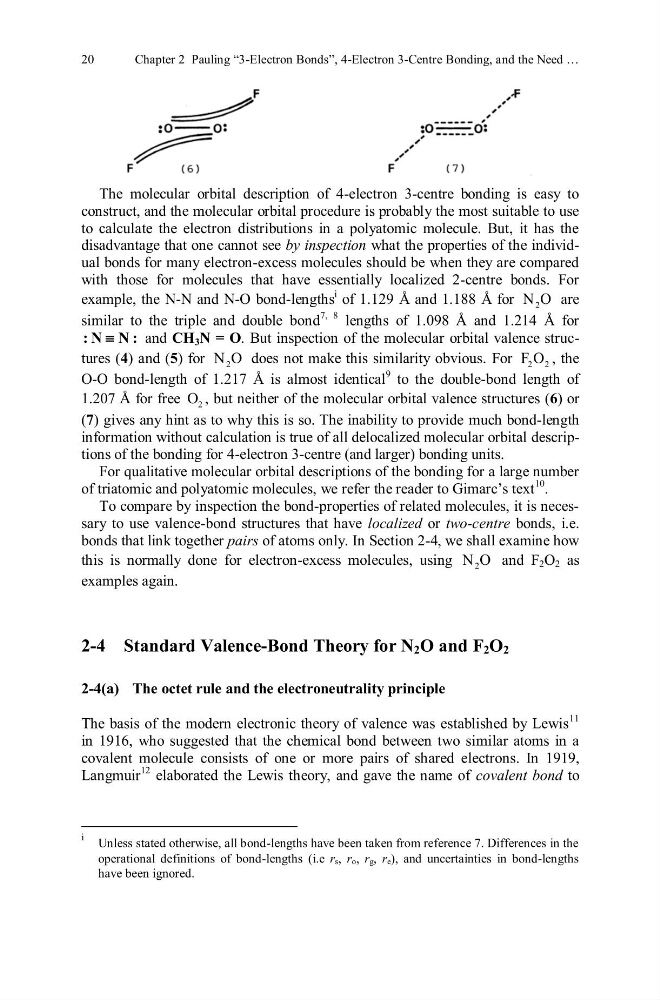
O , but neither of the molecular orbital valence structures (6) or
(7) gives any hint as to why this is so. The inability to provide much bond-length
information without calculation is true of all delocalized molecular orbital descriptions of the bonding for 4-electron 3-centre (and larger) bonding units.
For qualitative molecular orbital descriptions of the bonding for a large number
of triatomic and polyatomic molecules, we refer the reader to Gimarc’s text
10 .
To compare by inspection the bond-properties of related molecules, it is necessary to use valence-bond structures that have localized or two-centre bonds, i.e.
bonds that link together pairs of atoms only. In Section 2-4, we shall examine how
this is normally done for electron-excess molecules, using 2
N O and F 2 O 2 as
examples again.
2-4 Standard Valence-Bond Theory for N 2 O and F 2 O 2
2-4(a) The octet rule and the electroneutrality principle
The basis of the modern electronic theory of valence was established by Lewis
11
in 1916, who suggested that the chemical bond between two similar atoms in a
covalent molecule consists of one or more pairs of shared electrons. In 1919,
Langmuir
12 elaborated the Lewis theory, and gave the name of covalent bond to
i Unless stated otherwise, all bond-lengths have been taken from reference 7. Differences in the
operational definitions of bond-lengths (i.e rs, ro, rg, re), and uncertainties in bond-lengths
have been ignored.
Chapter 2 Pauling “3-Electron Bonds”, 4-Electron 3-Centre Bonding, and the Need …
The molecular orbital description of 4-electron 3-centre bonding is easy to
construct, and the molecular orbital procedure is probably the most suitable to use
to calculate the electron distributions in a polyatomic molecule. But, it has the
disadvantage that one cannot see by inspection what the properties of the individual bonds for many electron-excess molecules should be when they are compared
with those for molecules that have essentially localized 2-centre bonds. For
example, the N-N and N-O bond-lengths
i of 1.129 Å and 1.188 Å for 2
N O are
similar to the triple and double bond
7, 8 lengths of 1.098 Å and 1.214 Å for
: N Ν :
and CH 3 N = O. But inspection of the molecular orbital valence structures (4) and (5) for 2
N O does not make this similarity obvious. For 2 2
F O , the
O-O bond-length of 1.217 Å is almost identical
9 to the double-bond length of
1.207 Å for free 2
O , but neither of the molecular orbital valence structures (6) or
(7) gives any hint as to why this is so. The inability to provide much bond-length
information without calculation is true of all delocalized molecular orbital descriptions of the bonding for 4-electron 3-centre (and larger) bonding units.
For qualitative molecular orbital descriptions of the bonding for a large number
of triatomic and polyatomic molecules, we refer the reader to Gimarc’s text
10 .
To compare by inspection the bond-properties of related molecules, it is necessary to use valence-bond structures that have localized or two-centre bonds, i.e.
bonds that link together pairs of atoms only. In Section 2-4, we shall examine how
this is normally done for electron-excess molecules, using 2
N O and F 2 O 2 as
examples again.
2-4 Standard Valence-Bond Theory for N 2 O and F 2 O 2
2-4(a) The octet rule and the electroneutrality principle
The basis of the modern electronic theory of valence was established by Lewis
11
in 1916, who suggested that the chemical bond between two similar atoms in a
covalent molecule consists of one or more pairs of shared electrons. In 1919,
Langmuir
12 elaborated the Lewis theory, and gave the name of covalent bond to
i Unless stated otherwise, all bond-lengths have been taken from reference 7. Differences in the
operational definitions of bond-lengths (i.e rs, ro, rg, re), and uncertainties in bond-lengths
have been ignored.