

2-3 Delocalized Molecular Orbital Theory for 4-Electron 3-Centre Bonding Units
19
Approximate contours for these molecular orbitals are displayed in Figure 2-7
and examination of them shows that 1
, 2
and 3
are respectively bonding,
non-bonding and antibonding with respect to each pair of adjacent hydrogen
atoms.
The lowest-energy molecular orbital configuration for the 4-electron 3-centre
bonding unit is therefore
2
2
1
2
( ) ( )
, with the antibonding 3
molecular orbital
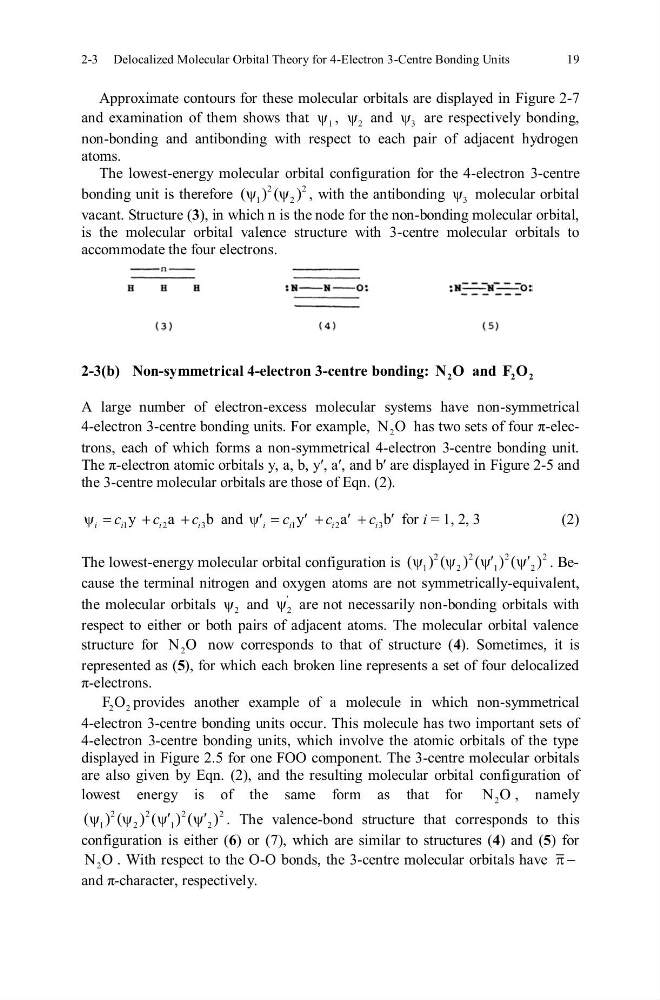
vacant. Structure (3), in which n is the node for the non-bonding molecular orbital,
is the molecular orbital valence structure with 3-centre molecular orbitals to
accommodate the four electrons.
2-3(b) Non-symmetrical 4-electron 3-centre bonding: 2
N O and 2 2
F O
A large number of electron-excess molecular systems have non-symmetrical
4-electron 3-centre bonding units. For example, 2
N O has two sets of four π-electrons, each of which forms a non-symmetrical 4-electron 3-centre bonding unit.
The π-electron atomic orbitals y, a, b, y′, a′, and b′ are displayed in Figure 2-5 and
the 3-centre molecular orbitals are those of Eqn. (2).
1
2
3
y
a
b
i
i
i
i
c
c
c
and
1
2
3
y
a
b
i
i
i
i
c
c
c
for i = 1, 2, 3
(2)
The lowest-energy molecular orbital configuration is
2
2
2
2
1
2
1
2
( ) ( ) ( ) ( )
. Because the terminal nitrogen and oxygen atoms are not symmetrically-equivalent,
the molecular orbitals 2
and 2
are not necessarily non-bonding orbitals with
respect to either or both pairs of adjacent atoms. The molecular orbital valence
structure for
2
N O now corresponds to that of structure (4). Sometimes, it is
represented as (5), for which each broken line represents a set of four delocalized
π-electrons.
2 2
F O provides another example of a molecule in which non-symmetrical
4-electron 3-centre bonding units occur. This molecule has two important sets of
4-electron 3-centre bonding units, which involve the atomic orbitals of the type
displayed in Figure 2.5 for one FOO component. The 3-centre molecular orbitals
are also given by Eqn. (2), and the resulting molecular orbital configuration of
lowest energy is of the same form as that for
2
N O , namely
2
2
2
2
1
2
1
2
( ) ( ) ( ) ( )
. The valence-bond structure that corresponds to this
configuration is either (6) or (7), which are similar to structures (4) and (5) for
2
N O . With respect to the O-O bonds, the 3-centre molecular orbitals have
and π-character, respectively.
19
Approximate contours for these molecular orbitals are displayed in Figure 2-7
and examination of them shows that 1
, 2
and 3
are respectively bonding,
non-bonding and antibonding with respect to each pair of adjacent hydrogen
atoms.
The lowest-energy molecular orbital configuration for the 4-electron 3-centre
bonding unit is therefore
2
2
1
2
( ) ( )
, with the antibonding 3
molecular orbital
vacant. Structure (3), in which n is the node for the non-bonding molecular orbital,
is the molecular orbital valence structure with 3-centre molecular orbitals to
accommodate the four electrons.
2-3(b) Non-symmetrical 4-electron 3-centre bonding: 2
N O and 2 2
F O
A large number of electron-excess molecular systems have non-symmetrical
4-electron 3-centre bonding units. For example, 2
N O has two sets of four π-electrons, each of which forms a non-symmetrical 4-electron 3-centre bonding unit.
The π-electron atomic orbitals y, a, b, y′, a′, and b′ are displayed in Figure 2-5 and
the 3-centre molecular orbitals are those of Eqn. (2).
1
2
3
y
a
b
i
i
i
i
c
c
c
and
1
2
3
y
a
b
i
i
i
i
c
c
c
for i = 1, 2, 3
(2)
The lowest-energy molecular orbital configuration is
2
2
2
2
1
2
1
2
( ) ( ) ( ) ( )
. Because the terminal nitrogen and oxygen atoms are not symmetrically-equivalent,
the molecular orbitals 2
and 2
are not necessarily non-bonding orbitals with
respect to either or both pairs of adjacent atoms. The molecular orbital valence
structure for
2
N O now corresponds to that of structure (4). Sometimes, it is
represented as (5), for which each broken line represents a set of four delocalized
π-electrons.
2 2
F O provides another example of a molecule in which non-symmetrical
4-electron 3-centre bonding units occur. This molecule has two important sets of
4-electron 3-centre bonding units, which involve the atomic orbitals of the type
displayed in Figure 2.5 for one FOO component. The 3-centre molecular orbitals
are also given by Eqn. (2), and the resulting molecular orbital configuration of
lowest energy is of the same form as that for
2
N O , namely
2
2
2
2
1
2
1
2
( ) ( ) ( ) ( )
. The valence-bond structure that corresponds to this
configuration is either (6) or (7), which are similar to structures (4) and (5) for
2
N O . With respect to the O-O bonds, the 3-centre molecular orbitals have
and π-character, respectively.