

2-2 Electron Deficient and Electron Excess Bonding Units
17
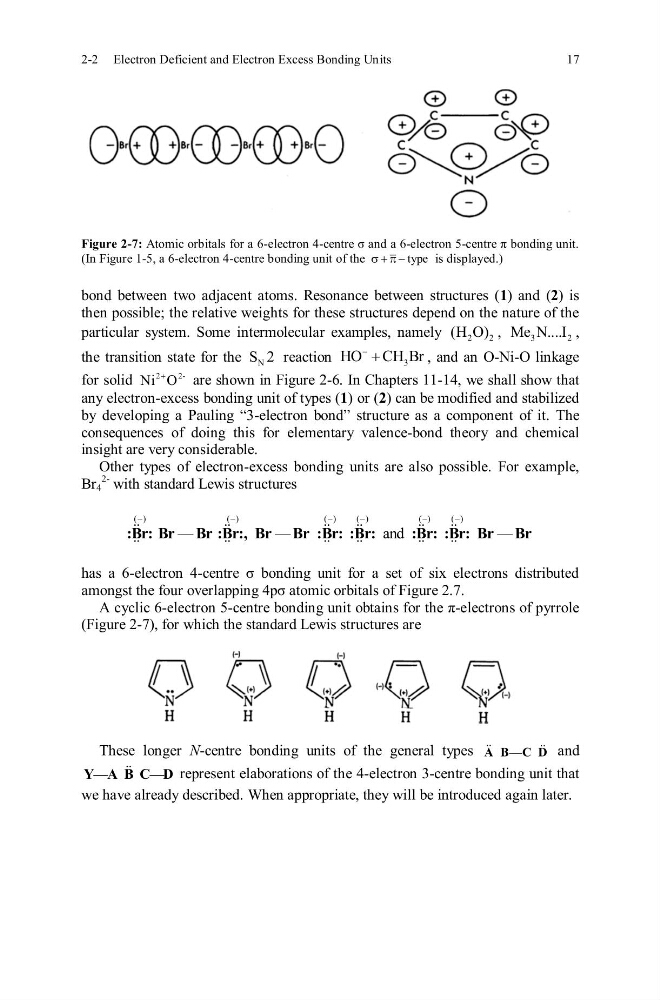
Figure 2-7: Atomic orbitals for a 6-electron 4-centre σ and a 6-electron 5-centre π bonding unit.
(In Figure 1-5, a 6-electron 4-centre bonding unit of the
type
is displayed.)
bond between two adjacent atoms. Resonance between structures (1) and (2) is
then possible; the relative weights for these structures depend on the nature of the
particular system. Some intermolecular examples, namely
2
2
(H O) ,
3
2
Me N....I ,
the transition state for the N
S 2 reaction
3
HO CH Br
, and an O-Ni-O linkage
for solid
2
2Ni O
are shown in Figure 2-6. In Chapters 11-14, we shall show that
any electron-excess bonding unit of types (1) or (2) can be modified and stabilized
by developing a Pauling “3-electron bond” structure as a component of it. The
consequences of doing this for elementary valence-bond theory and chemical
insight are very considerable.
Other types of electron-excess bonding units are also possible. For example,
Br 4
2- with standard Lewis structures
( )
( )
( )
( )
( )
( )
—
—
and
—
:Br: Br Br :Br:, Br Br :Br: :Br:
:Br: :Br: Br Br
has a 6-electron 4-centre σ bonding unit for a set of six electrons distributed
amongst the four overlapping 4pσ atomic orbitals of Figure 2.7.
A cyclic 6-electron 5-centre bonding unit obtains for the π-electrons of pyrrole
(Figure 2-7), for which the standard Lewis structures are
These longer N-centre bonding units of the general types A B—C D
and
Y—A B C—D
represent elaborations of the 4-electron 3-centre bonding unit that
we have already described. When appropriate, they will be introduced again later.
17
Figure 2-7: Atomic orbitals for a 6-electron 4-centre σ and a 6-electron 5-centre π bonding unit.
(In Figure 1-5, a 6-electron 4-centre bonding unit of the
type
is displayed.)
bond between two adjacent atoms. Resonance between structures (1) and (2) is
then possible; the relative weights for these structures depend on the nature of the
particular system. Some intermolecular examples, namely
2
2
(H O) ,
3
2
Me N....I ,
the transition state for the N
S 2 reaction
3
HO CH Br
, and an O-Ni-O linkage
for solid
2
2Ni O
are shown in Figure 2-6. In Chapters 11-14, we shall show that
any electron-excess bonding unit of types (1) or (2) can be modified and stabilized
by developing a Pauling “3-electron bond” structure as a component of it. The
consequences of doing this for elementary valence-bond theory and chemical
insight are very considerable.
Other types of electron-excess bonding units are also possible. For example,
Br 4
2- with standard Lewis structures
( )
( )
( )
( )
( )
( )
—
—
and
—
:Br: Br Br :Br:, Br Br :Br: :Br:
:Br: :Br: Br Br
has a 6-electron 4-centre σ bonding unit for a set of six electrons distributed
amongst the four overlapping 4pσ atomic orbitals of Figure 2.7.
A cyclic 6-electron 5-centre bonding unit obtains for the π-electrons of pyrrole
(Figure 2-7), for which the standard Lewis structures are
These longer N-centre bonding units of the general types A B—C D
and
Y—A B C—D
represent elaborations of the 4-electron 3-centre bonding unit that
we have already described. When appropriate, they will be introduced again later.