

16
Chapter 2 Pauling “3-Electron Bonds”, 4-Electron 3-Centre Bonding, and the Need …
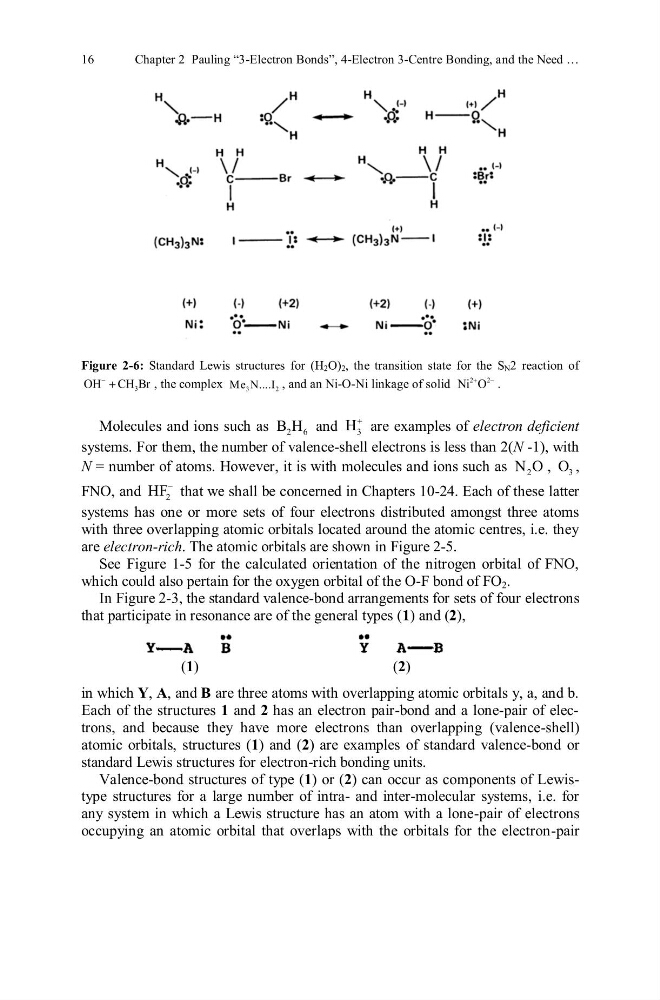
Figure 2-6: Standard Lewis structures for (H2O)2, the transition state for the SN2 reaction of
3
OH CH Br
, the complex
3
2
Me N....I , and an Ni-O-Ni linkage of solid
2
2
Ni O
.
Molecules and ions such as 2 6
B H and 3
H
are examples of electron deficient
systems. For them, the number of valence-shell electrons is less than 2(N -1), with
Ν = number of atoms. However, it is with molecules and ions such as 2
N O , 3
O ,
FNO, and
2
HF
that we shall be concerned in Chapters 10-24. Each of these latter
systems has one or more sets of four electrons distributed amongst three atoms
with three overlapping atomic orbitals located around the atomic centres, i.e. they
are electron-rich. The atomic orbitals are shown in Figure 2-5.
See Figure 1-5 for the calculated orientation of the nitrogen orbital of FNO,
which could also pertain for the oxygen orbital of the O-F bond of FO 2 .
In Figure 2-3, the standard valence-bond arrangements for sets of four electrons
that participate in resonance are of the general types (1) and (2),
(1)
(2)
in which Y, A, and Β are three atoms with overlapping atomic orbitals y, a, and b.
Each of the structures 1 and 2 has an electron pair-bond and a lone-pair of electrons, and because they have more electrons than overlapping (valence-shell)
atomic orbitals, structures (1) and (2) are examples of standard valence-bond or
standard Lewis structures for electron-rich bonding units.
Valence-bond structures of type (1) or (2) can occur as components of Lewistype structures for a large number of intra- and inter-molecular systems, i.e. for
any system in which a Lewis structure has an atom with a lone-pair of electrons
occupying an atomic orbital that overlaps with the orbitals for the electron-pair
Chapter 2 Pauling “3-Electron Bonds”, 4-Electron 3-Centre Bonding, and the Need …
Figure 2-6: Standard Lewis structures for (H2O)2, the transition state for the SN2 reaction of
3
OH CH Br
, the complex
3
2
Me N....I , and an Ni-O-Ni linkage of solid
2
2
Ni O
.
Molecules and ions such as 2 6
B H and 3
H
are examples of electron deficient
systems. For them, the number of valence-shell electrons is less than 2(N -1), with
Ν = number of atoms. However, it is with molecules and ions such as 2
N O , 3
O ,
FNO, and
2
HF
that we shall be concerned in Chapters 10-24. Each of these latter
systems has one or more sets of four electrons distributed amongst three atoms
with three overlapping atomic orbitals located around the atomic centres, i.e. they
are electron-rich. The atomic orbitals are shown in Figure 2-5.
See Figure 1-5 for the calculated orientation of the nitrogen orbital of FNO,
which could also pertain for the oxygen orbital of the O-F bond of FO 2 .
In Figure 2-3, the standard valence-bond arrangements for sets of four electrons
that participate in resonance are of the general types (1) and (2),
(1)
(2)
in which Y, A, and Β are three atoms with overlapping atomic orbitals y, a, and b.
Each of the structures 1 and 2 has an electron pair-bond and a lone-pair of electrons, and because they have more electrons than overlapping (valence-shell)
atomic orbitals, structures (1) and (2) are examples of standard valence-bond or
standard Lewis structures for electron-rich bonding units.
Valence-bond structures of type (1) or (2) can occur as components of Lewistype structures for a large number of intra- and inter-molecular systems, i.e. for
any system in which a Lewis structure has an atom with a lone-pair of electrons
occupying an atomic orbital that overlaps with the orbitals for the electron-pair