

288
Chapter 22 Free-Radical and Spin-Paired Diradical Reactions
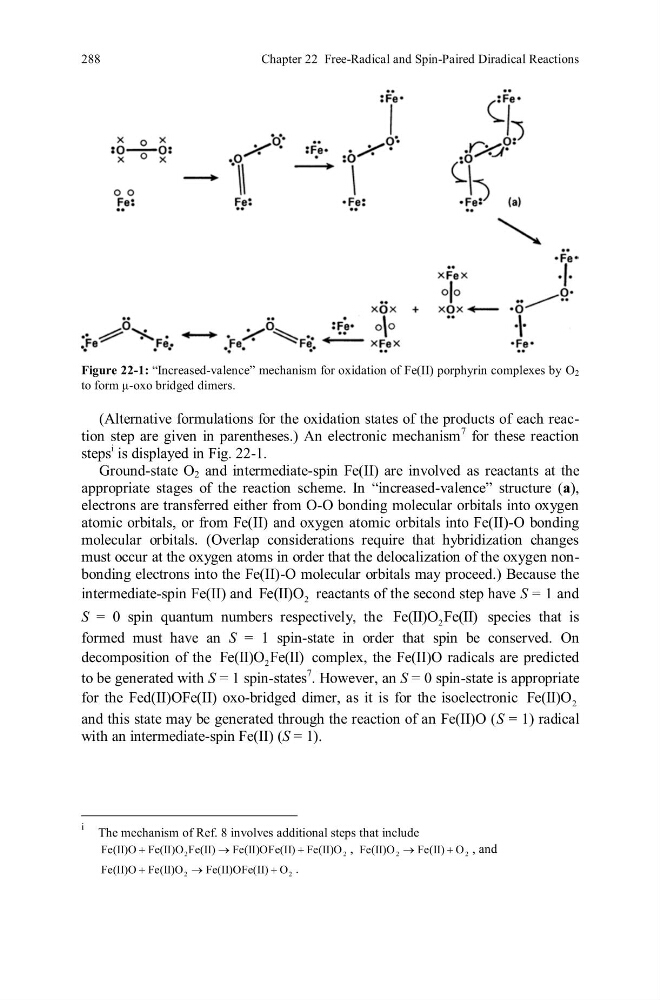
Figure 22-1: “Increased-valence” mechanism for oxidation of Fe(II) porphyrin complexes by O2
to form μ-oxo bridged dimers.
(Alternative formulations for the oxidation states of the products of each reaction step are given in parentheses.) An electronic mechanism
7 for these reaction
steps
i is displayed in Fig. 22-1.
Ground-state O 2 and intermediate-spin Fe(II) are involved as reactants at the
appropriate stages of the reaction scheme. In “increased-valence” structure (a),
electrons are transferred either from O-O bonding molecular orbitals into oxygen
atomic orbitals, or from Fe(II) and oxygen atomic orbitals into Fe(II)-O bonding
molecular orbitals. (Overlap considerations require that hybridization changes
must occur at the oxygen atoms in order that the delocalization of the oxygen nonbonding electrons into the Fe(II)-O molecular orbitals may proceed.) Because the
intermediate-spin Fe(II) and
2
Fe(II)O reactants of the second step have S = 1 and
S = 0 spin quantum numbers respectively, the
2
Fe(II)O Fe(II) species that is
formed must have an S = 1 spin-state in order that spin be conserved. On
decomposition of the
2
Fe(II)O Fe(II) complex, the Fe(II)O radicals are predicted
to be generated with S = 1 spin-states
7
. However, an S = 0 spin-state is appropriate
for the Fed(II)OFe(II) oxo-bridged dimer, as it is for the isoelectronic
2
Fe(II)O
and this state may be generated through the reaction of an Fe(II)O (S = 1) radical
with an intermediate-spin Fe(II) (S = 1).
i The mechanism of Ref. 8 involves additional steps that include
2
2
Fe(II)O Fe(II)O Fe(II) Fe(II)OFe(II) Fe(II)O
,
2
2
Fe(II)O
Fe(II) O
, and
2
2
Fe(II)O Fe(II)O
Fe(II)OFe(II) O
.
Chapter 22 Free-Radical and Spin-Paired Diradical Reactions
Figure 22-1: “Increased-valence” mechanism for oxidation of Fe(II) porphyrin complexes by O2
to form μ-oxo bridged dimers.
(Alternative formulations for the oxidation states of the products of each reaction step are given in parentheses.) An electronic mechanism
7 for these reaction
steps
i is displayed in Fig. 22-1.
Ground-state O 2 and intermediate-spin Fe(II) are involved as reactants at the
appropriate stages of the reaction scheme. In “increased-valence” structure (a),
electrons are transferred either from O-O bonding molecular orbitals into oxygen
atomic orbitals, or from Fe(II) and oxygen atomic orbitals into Fe(II)-O bonding
molecular orbitals. (Overlap considerations require that hybridization changes
must occur at the oxygen atoms in order that the delocalization of the oxygen nonbonding electrons into the Fe(II)-O molecular orbitals may proceed.) Because the
intermediate-spin Fe(II) and
2
Fe(II)O reactants of the second step have S = 1 and
S = 0 spin quantum numbers respectively, the
2
Fe(II)O Fe(II) species that is
formed must have an S = 1 spin-state in order that spin be conserved. On
decomposition of the
2
Fe(II)O Fe(II) complex, the Fe(II)O radicals are predicted
to be generated with S = 1 spin-states
7
. However, an S = 0 spin-state is appropriate
for the Fed(II)OFe(II) oxo-bridged dimer, as it is for the isoelectronic
2
Fe(II)O
and this state may be generated through the reaction of an Fe(II)O (S = 1) radical
with an intermediate-spin Fe(II) (S = 1).
i The mechanism of Ref. 8 involves additional steps that include
2
2
Fe(II)O Fe(II)O Fe(II) Fe(II)OFe(II) Fe(II)O
,
2
2
Fe(II)O
Fe(II) O
, and
2
2
Fe(II)O Fe(II)O
Fe(II)OFe(II) O
.