

286
Chapter 22 Free-Radical and Spin-Paired Diradical Reactions
(c) “Increased-valence” may be restored by delocalizing oxygen lone-pair electrons into the vacant O-O bonding π-orbitals, as is done in structure (6). The
resulting “increased-valence” structure (7) has a weakened O-O bond between
the H-O and O-O linkages.
(d) The weak O-O bond of structure (7) can now break to release the HO and O 2
products.
Although the reaction proceeds by means of a concerted mechanism, it is
convenient to display a series of steps in the valence-bond representation of the
electronic reorganization.
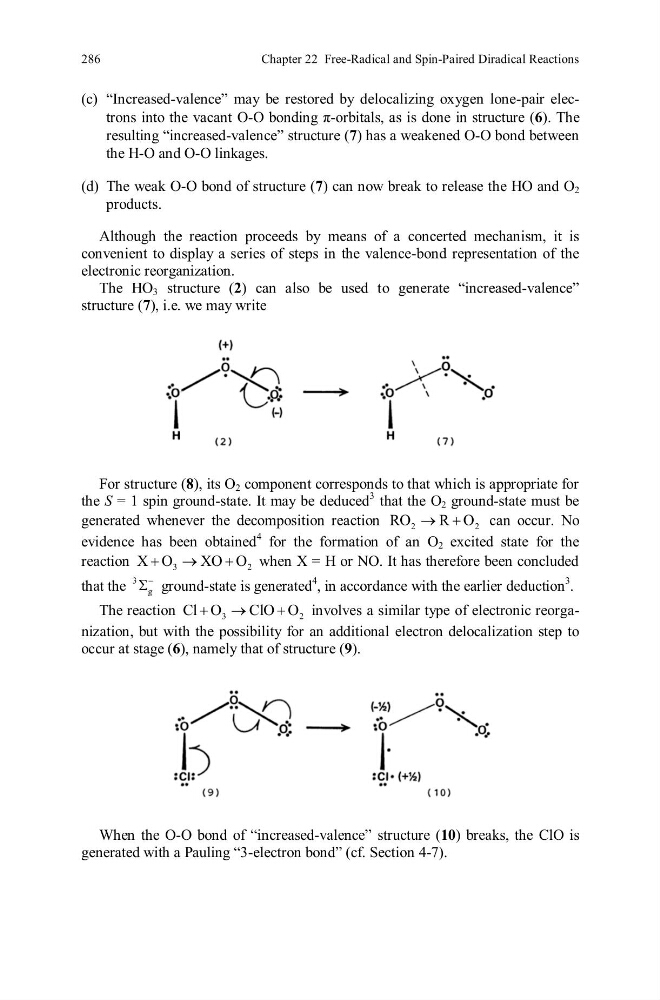
The HO 3 structure (2) can also be used to generate “increased-valence”
structure (7), i.e. we may write
For structure (8), its O 2 component corresponds to that which is appropriate for
the S = 1 spin ground-state. It may be deduced
3 that the O 2 ground-state must be
generated whenever the decomposition reaction
2
2
RO
R O
can occur. No
evidence has been obtained
4 for the formation of an O 2 excited state for the
reaction
3
2
X O
XO O
when X = H or NO. It has therefore been concluded
that the
3
g
ground-state is generated
4
, in accordance with the earlier deduction
3
.
The reaction
3
2
Cl O
ClO O
involves a similar type of electronic reorganization, but with the possibility for an additional electron delocalization step to
occur at stage (6), namely that of structure (9).
When the O-O bond of “increased-valence” structure (10) breaks, the ClO is
generated with a Pauling “3-electron bond” (cf. Section 4-7).
Chapter 22 Free-Radical and Spin-Paired Diradical Reactions
(c) “Increased-valence” may be restored by delocalizing oxygen lone-pair electrons into the vacant O-O bonding π-orbitals, as is done in structure (6). The
resulting “increased-valence” structure (7) has a weakened O-O bond between
the H-O and O-O linkages.
(d) The weak O-O bond of structure (7) can now break to release the HO and O 2
products.
Although the reaction proceeds by means of a concerted mechanism, it is
convenient to display a series of steps in the valence-bond representation of the
electronic reorganization.
The HO 3 structure (2) can also be used to generate “increased-valence”
structure (7), i.e. we may write
For structure (8), its O 2 component corresponds to that which is appropriate for
the S = 1 spin ground-state. It may be deduced
3 that the O 2 ground-state must be
generated whenever the decomposition reaction
2
2
RO
R O
can occur. No
evidence has been obtained
4 for the formation of an O 2 excited state for the
reaction
3
2
X O
XO O
when X = H or NO. It has therefore been concluded
that the
3
g
ground-state is generated
4
, in accordance with the earlier deduction
3
.
The reaction
3
2
Cl O
ClO O
involves a similar type of electronic reorganization, but with the possibility for an additional electron delocalization step to
occur at stage (6), namely that of structure (9).
When the O-O bond of “increased-valence” structure (10) breaks, the ClO is
generated with a Pauling “3-electron bond” (cf. Section 4-7).