

22-2
R + O3 RO + O2, with R = H, Cl, and NO
285
The electronic reorganization displayed in structures (1)-(3) does not make
clear why the HO-O bond of structure (2) should break homolytically, and retains
formal charge separation on the two oxygen atoms in structure (3).
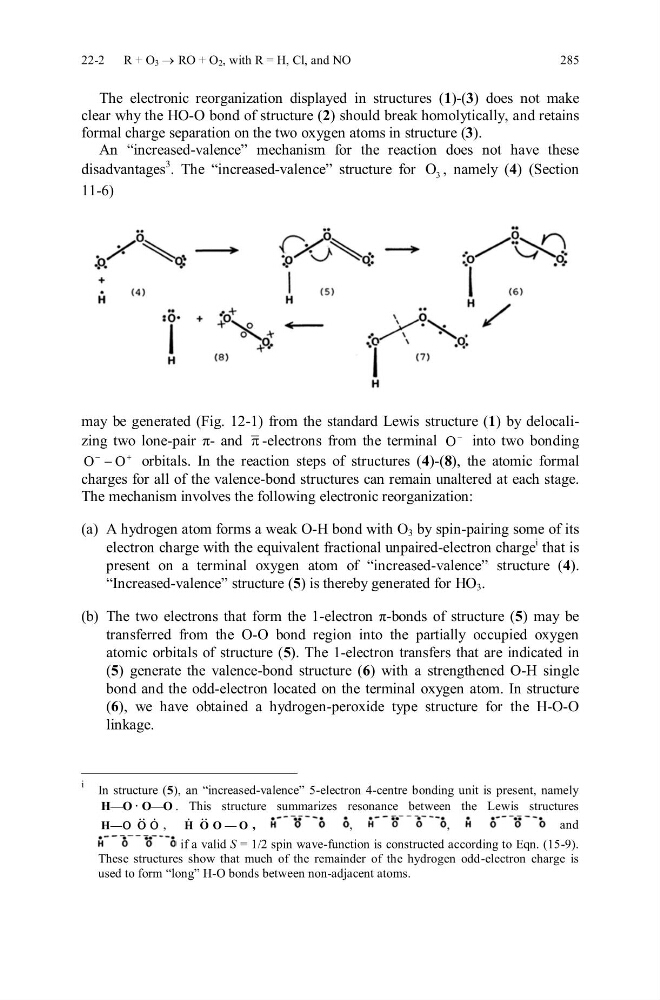
An “increased-valence” mechanism for the reaction does not have these
disadvantages
3 . The “increased-valence” structure for 3
O , namely (4) (Section
11-6)
may be generated (Fig. 12-1) from the standard Lewis structure (1) by delocalizing two lone-pair π- and -electrons from the terminal O
into two bonding
O O
orbitals. In the reaction steps of structures (4)-(8), the atomic formal
charges for all of the valence-bond structures can remain unaltered at each stage.
The mechanism involves the following electronic reorganization:
(a) A hydrogen atom forms a weak O-H bond with O 3 by spin-pairing some of its
electron charge with the equivalent fractional unpaired-electron charge
i that is
present on a terminal oxygen atom of “increased-valence” structure (4).
“Increased-valence” structure (5) is thereby generated for HO 3 .
(b) The two electrons that form the 1-electron π-bonds of structure (5) may be
transferred from the O-O bond region into the partially occupied oxygen
atomic orbitals of structure (5). The 1-electron transfers that are indicated in
(5) generate the valence-bond structure (6) with a strengthened O-H single
bond and the odd-electron located on the terminal oxygen atom. In structure
(6), we have obtained a hydrogen-peroxide type structure for the H-O-O
linkage.
i In structure (5), an “increased-valence” 5-electron 4-centre bonding unit is present, namely
H—O · O—O . This structure summarizes resonance between the Lewis structures
H—
, H Ο Ο — Ο
,
,
,
and
if a valid S = 1/2 spin wave-function is constructed according to Eqn. (15-9).
These structures show that much of the remainder of the hydrogen odd-electron charge is
used to form “long” H-O bonds between non-adjacent atoms.
R + O3 RO + O2, with R = H, Cl, and NO
285
The electronic reorganization displayed in structures (1)-(3) does not make
clear why the HO-O bond of structure (2) should break homolytically, and retains
formal charge separation on the two oxygen atoms in structure (3).
An “increased-valence” mechanism for the reaction does not have these
disadvantages
3 . The “increased-valence” structure for 3
O , namely (4) (Section
11-6)
may be generated (Fig. 12-1) from the standard Lewis structure (1) by delocalizing two lone-pair π- and -electrons from the terminal O
into two bonding
O O
orbitals. In the reaction steps of structures (4)-(8), the atomic formal
charges for all of the valence-bond structures can remain unaltered at each stage.
The mechanism involves the following electronic reorganization:
(a) A hydrogen atom forms a weak O-H bond with O 3 by spin-pairing some of its
electron charge with the equivalent fractional unpaired-electron charge
i that is
present on a terminal oxygen atom of “increased-valence” structure (4).
“Increased-valence” structure (5) is thereby generated for HO 3 .
(b) The two electrons that form the 1-electron π-bonds of structure (5) may be
transferred from the O-O bond region into the partially occupied oxygen
atomic orbitals of structure (5). The 1-electron transfers that are indicated in
(5) generate the valence-bond structure (6) with a strengthened O-H single
bond and the odd-electron located on the terminal oxygen atom. In structure
(6), we have obtained a hydrogen-peroxide type structure for the H-O-O
linkage.
i In structure (5), an “increased-valence” 5-electron 4-centre bonding unit is present, namely
H—O · O—O . This structure summarizes resonance between the Lewis structures
H—
, H Ο Ο — Ο
,
,
,
and
if a valid S = 1/2 spin wave-function is constructed according to Eqn. (15-9).
These structures show that much of the remainder of the hydrogen odd-electron charge is
used to form “long” H-O bonds between non-adjacent atoms.