

252
Chapter 19 Some Electron-Excess σ Bonded Systems
The lengths of their I-I bonds are longer than the I-I single bond length of
2.67 Å for free 2
I . We can account for these observations by inspection of the
“increased-valence” structures (30), (32) and (34), which we may derive from the
Lewis or non-paired spatial orbital structures (29), (31) and (33). For the latter
three structures, we have subdivided the ions into 2
2
I I I
, 2 3 2
I I I
, and
2
2
2
I I I I I
components, and used the non-paired spatial orbital structure
(8) for 3
I
. All of the bonds are σ-bonds.
19-3 Xe 2 F 3
+
and H 2 F 3
–
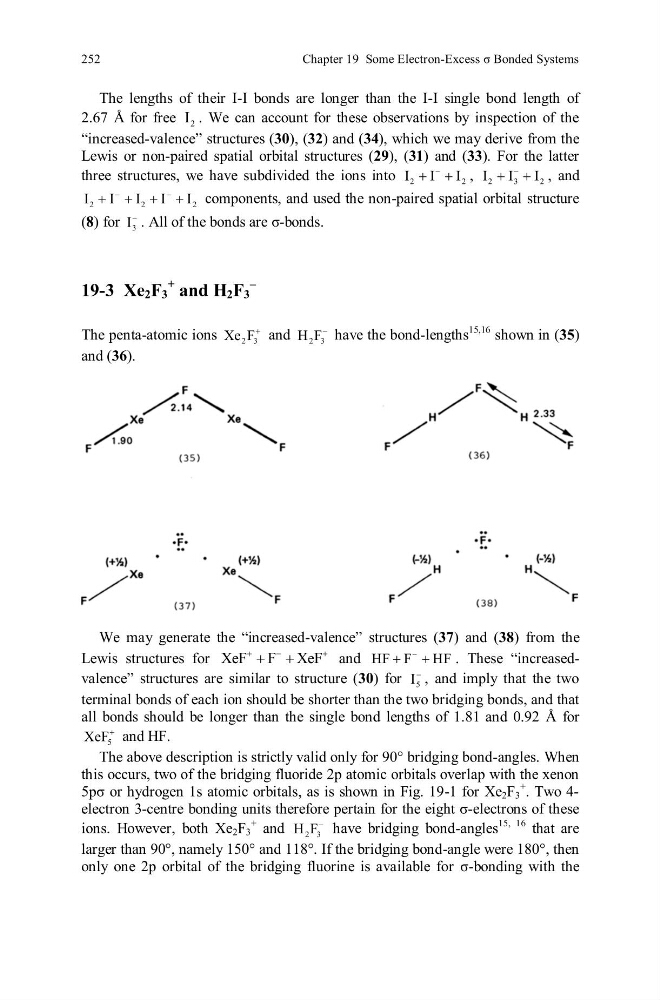
The penta-atomic ions
2 3
Xe F
and 2 3
H F
have the bond-lengths
15,16 shown in (35)
and (36).
We may generate the “increased-valence” structures (37) and (38) from the
Lewis structures for XeF F XeF
and HF F HF
. These “increasedvalence” structures are similar to structure (30) for 5
I
, and imply that the two
terminal bonds of each ion should be shorter than the two bridging bonds, and that
all bonds should be longer than the single bond lengths of 1.81 and 0.92 Å for
5
XeF
and HF.
The above description is strictly valid only for 90° bridging bond-angles. When
this occurs, two of the bridging fluoride 2p atomic orbitals overlap with the xenon
5pσ or hydrogen 1s atomic orbitals, as is shown in Fig. 19-1 for Xe 2 F 3
+
. Two 4electron 3-centre bonding units therefore pertain for the eight σ-electrons of these
ions. However, both Xe 2 F 3
+ and 2 3
H F
have bridging bond-angles
15, 16 that are
larger than 90°, namely 150° and 118°. If the bridging bond-angle were 180°, then
only one 2p orbital of the bridging fluorine is available for σ-bonding with the
Chapter 19 Some Electron-Excess σ Bonded Systems
The lengths of their I-I bonds are longer than the I-I single bond length of
2.67 Å for free 2
I . We can account for these observations by inspection of the
“increased-valence” structures (30), (32) and (34), which we may derive from the
Lewis or non-paired spatial orbital structures (29), (31) and (33). For the latter
three structures, we have subdivided the ions into 2
2
I I I
, 2 3 2
I I I
, and
2
2
2
I I I I I
components, and used the non-paired spatial orbital structure
(8) for 3
I
. All of the bonds are σ-bonds.
19-3 Xe 2 F 3
+
and H 2 F 3
–
The penta-atomic ions
2 3
Xe F
and 2 3
H F
have the bond-lengths
15,16 shown in (35)
and (36).
We may generate the “increased-valence” structures (37) and (38) from the
Lewis structures for XeF F XeF
and HF F HF
. These “increasedvalence” structures are similar to structure (30) for 5
I
, and imply that the two
terminal bonds of each ion should be shorter than the two bridging bonds, and that
all bonds should be longer than the single bond lengths of 1.81 and 0.92 Å for
5
XeF
and HF.
The above description is strictly valid only for 90° bridging bond-angles. When
this occurs, two of the bridging fluoride 2p atomic orbitals overlap with the xenon
5pσ or hydrogen 1s atomic orbitals, as is shown in Fig. 19-1 for Xe 2 F 3
+
. Two 4electron 3-centre bonding units therefore pertain for the eight σ-electrons of these
ions. However, both Xe 2 F 3
+ and 2 3
H F
have bridging bond-angles
15, 16 that are
larger than 90°, namely 150° and 118°. If the bridging bond-angle were 180°, then
only one 2p orbital of the bridging fluorine is available for σ-bonding with the