

19-1
Trihalide Anions and some Related Molecules
249
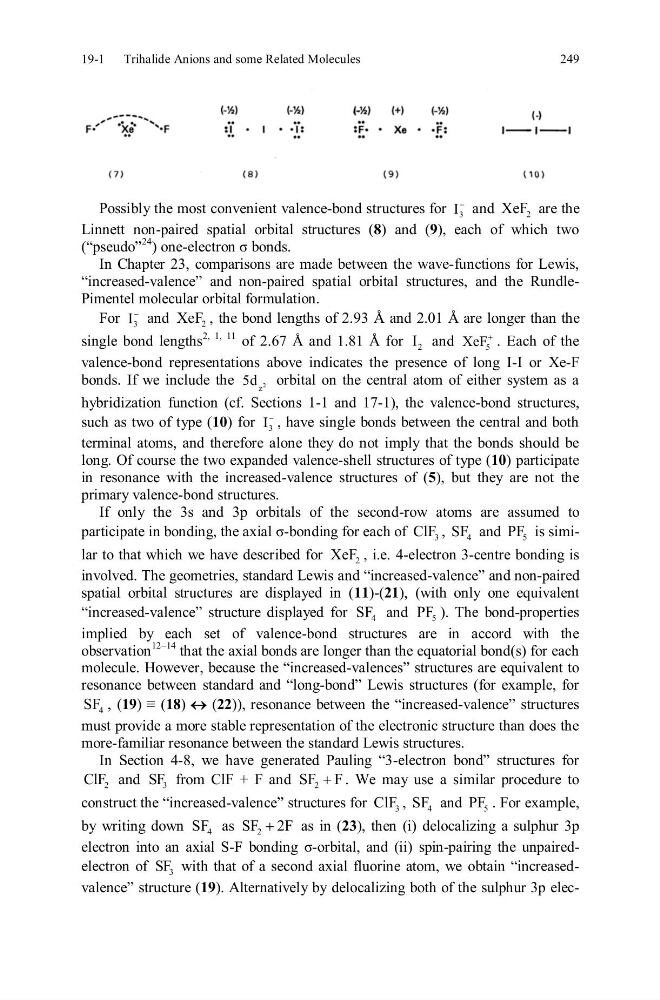
Possibly the most convenient valence-bond structures for 3
I
and
2
XeF are the
Linnett non-paired spatial orbital structures (8) and (9), each of which two
(“pseudo”
24 ) one-electron σ bonds.
In Chapter 23, comparisons are made between the wave-functions for Lewis,
“increased-valence” and non-paired spatial orbital structures, and the RundlePimentel molecular orbital formulation.
For 3
I
and
2
XeF , the bond lengths of 2.93 Å and 2.01 Å are longer than the
single bond lengths
2, 1, 11 of 2.67 Å and 1.81 Å for 2
I and
5
XeF
. Each of the
valence-bond representations above indicates the presence of long I-I or Xe-F
bonds. If we include the
2
z
5d orbital on the central atom of either system as a
hybridization function (cf. Sections 1-1 and 17-1), the valence-bond structures,
such as two of type (10) for 3
I
, have single bonds between the central and both
terminal atoms, and therefore alone they do not imply that the bonds should be
long. Of course the two expanded valence-shell structures of type (10) participate
in resonance with the increased-valence structures of (5), but they are not the
primary valence-bond structures.
If only the 3s and 3p orbitals of the second-row atoms are assumed to
participate in bonding, the axial σ-bonding for each of
3
ClF , 4
SF and 5
PF is similar to that which we have described for
2
XeF , i.e. 4-electron 3-centre bonding is
involved. The geometries, standard Lewis and “increased-valence” and non-paired
spatial orbital structures are displayed in (11)-(21), (with only one equivalent
“increased-valence” structure displayed for
4
SF and
5
PF ). The bond-properties
implied by each set of valence-bond structures are in accord with the
observation
12–14 that the axial bonds are longer than the equatorial bond(s) for each
molecule. However, because the “increased-valences” structures are equivalent to
resonance between standard and “long-bond” Lewis structures (for example, for
4
SF , (19) ≡ (18) (22)), resonance between the “increased-valence” structures
must provide a more stable representation of the electronic structure than does the
more-familiar resonance between the standard Lewis structures.
In Section 4-8, we have generated Pauling “3-electron bond” structures for
2
ClF and 3
SF from ClF + F and
2
SF F
. We may use a similar procedure to
construct the “increased-valence” structures for
3
ClF , 4
SF and 5
PF . For example,
by writing down
4
SF as 2
SF 2F
as in (23), then (i) delocalizing a sulphur 3p
electron into an axial S-F bonding σ-orbital, and (ii) spin-pairing the unpairedelectron of 3
SF with that of a second axial fluorine atom, we obtain “increasedvalence” structure (19). Alternatively by delocalizing both of the sulphur 3p elec-
Trihalide Anions and some Related Molecules
249
Possibly the most convenient valence-bond structures for 3
I
and
2
XeF are the
Linnett non-paired spatial orbital structures (8) and (9), each of which two
(“pseudo”
24 ) one-electron σ bonds.
In Chapter 23, comparisons are made between the wave-functions for Lewis,
“increased-valence” and non-paired spatial orbital structures, and the RundlePimentel molecular orbital formulation.
For 3
I
and
2
XeF , the bond lengths of 2.93 Å and 2.01 Å are longer than the
single bond lengths
2, 1, 11 of 2.67 Å and 1.81 Å for 2
I and
5
XeF
. Each of the
valence-bond representations above indicates the presence of long I-I or Xe-F
bonds. If we include the
2
z
5d orbital on the central atom of either system as a
hybridization function (cf. Sections 1-1 and 17-1), the valence-bond structures,
such as two of type (10) for 3
I
, have single bonds between the central and both
terminal atoms, and therefore alone they do not imply that the bonds should be
long. Of course the two expanded valence-shell structures of type (10) participate
in resonance with the increased-valence structures of (5), but they are not the
primary valence-bond structures.
If only the 3s and 3p orbitals of the second-row atoms are assumed to
participate in bonding, the axial σ-bonding for each of
3
ClF , 4
SF and 5
PF is similar to that which we have described for
2
XeF , i.e. 4-electron 3-centre bonding is
involved. The geometries, standard Lewis and “increased-valence” and non-paired
spatial orbital structures are displayed in (11)-(21), (with only one equivalent
“increased-valence” structure displayed for
4
SF and
5
PF ). The bond-properties
implied by each set of valence-bond structures are in accord with the
observation
12–14 that the axial bonds are longer than the equatorial bond(s) for each
molecule. However, because the “increased-valences” structures are equivalent to
resonance between standard and “long-bond” Lewis structures (for example, for
4
SF , (19) ≡ (18) (22)), resonance between the “increased-valence” structures
must provide a more stable representation of the electronic structure than does the
more-familiar resonance between the standard Lewis structures.
In Section 4-8, we have generated Pauling “3-electron bond” structures for
2
ClF and 3
SF from ClF + F and
2
SF F
. We may use a similar procedure to
construct the “increased-valence” structures for
3
ClF , 4
SF and 5
PF . For example,
by writing down
4
SF as 2
SF 2F
as in (23), then (i) delocalizing a sulphur 3p
electron into an axial S-F bonding σ-orbital, and (ii) spin-pairing the unpairedelectron of 3
SF with that of a second axial fluorine atom, we obtain “increasedvalence” structure (19). Alternatively by delocalizing both of the sulphur 3p elec-