

248
Chapter 19 Some Electron-Excess σ Bonded Systems
Y —
Y—A B
can occur for four σ-electrons. Therefore, the bonding schemes for this chapter do
not differ from those of the previous chapters, except in so far as we shall be
dealing only with σ-bonding. It is well-known that geometrical hypervalence is an
extremely widespread phenomenon.
The delocalized molecular orbital theory for hypervalent molecules involves
3-centre molecular orbitals, and we have given an account of it in Section 2-3(a),
for the simplest hypervalent system 3
H
. This molecular orbital theory was first
proposed in 1951 by Pimentel
4
, and Hach and Rundle
5 , and has been used subsequently by many workers
2, 6–9 to describe 4-electron 3-centre σ-bonding. Of
course, it is also appropriate for π bonding, as we have indicated in earlier
chapters.
For linear, symmetrical 3
I
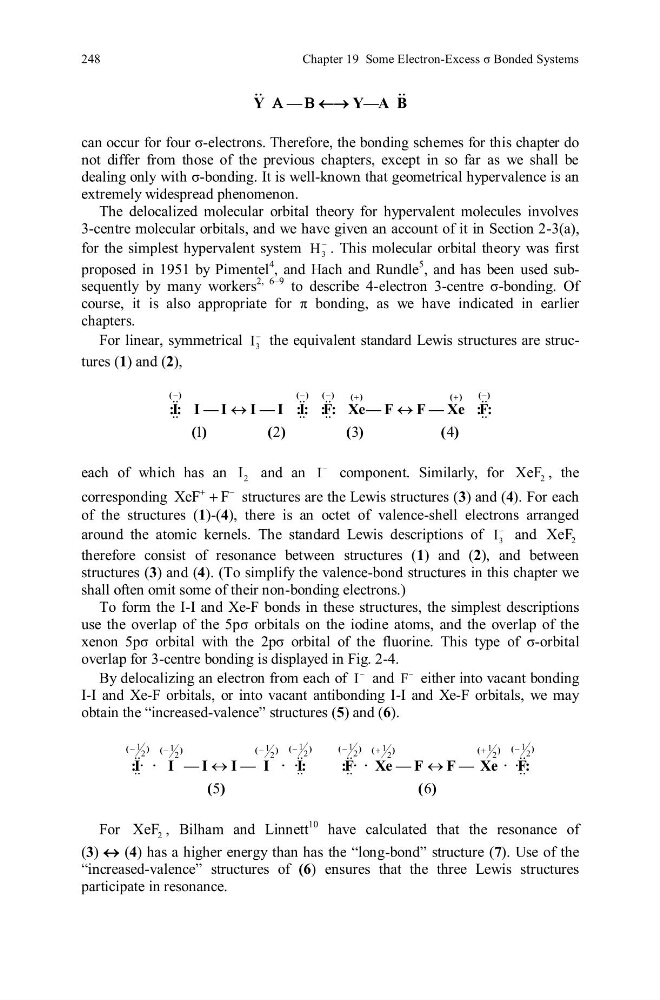
the equivalent standard Lewis structures are structures (1) and (2),
1
2
3
4
( )
( )
( )
( )
( )
( )
:I: I — I
I — I :I: :F: Xe— F
F — Xe :F:
( )
( )
( )
( )
each of which has an 2
I and an I
component. Similarly, for
2
XeF , the
corresponding XeF F
structures are the Lewis structures (3) and (4). For each
of the structures (1)-(4), there is an octet of valence-shell electrons arranged
around the atomic kernels. The standard Lewis descriptions of 3
I
and
2
XeF
therefore consist of resonance between structures (1) and (2), and between
structures (3) and (4). (To simplify the valence-bond structures in this chapter we
shall often omit some of their non-bonding electrons.)
To form the I-I and Xe-F bonds in these structures, the simplest descriptions
use the overlap of the 5pσ orbitals on the iodine atoms, and the overlap of the
xenon 5pσ orbital with the 2pσ orbital of the fluorine. This type of σ-orbital
overlap for 3-centre bonding is displayed in Fig. 2-4.
By delocalizing an electron from each of I
and F
either into vacant bonding
I-I and Xe-F orbitals, or into vacant antibonding I-I and Xe-F orbitals, we may
obtain the “increased-valence” structures (5) and (6).
1
1
1
1
1
1
1
1
2
2
2
2
2
2
2
2
5
6
(
)
(
)
(
)
(
)
(
)
(
)
(
)
(
)
:I· · I — I
I — I · ·I:
:F· · Xe — F
F — Xe · ·F:
( )
( )
For
2
XeF , Bilham and Linnett
10 have calculated that the resonance of
(3) (4) has a higher energy than has the “long-bond” structure (7). Use of the
“increased-valence” structures of (6) ensures that the three Lewis structures
participate in resonance.
Chapter 19 Some Electron-Excess σ Bonded Systems
Y —
Y—A B
can occur for four σ-electrons. Therefore, the bonding schemes for this chapter do
not differ from those of the previous chapters, except in so far as we shall be
dealing only with σ-bonding. It is well-known that geometrical hypervalence is an
extremely widespread phenomenon.
The delocalized molecular orbital theory for hypervalent molecules involves
3-centre molecular orbitals, and we have given an account of it in Section 2-3(a),
for the simplest hypervalent system 3
H
. This molecular orbital theory was first
proposed in 1951 by Pimentel
4
, and Hach and Rundle
5 , and has been used subsequently by many workers
2, 6–9 to describe 4-electron 3-centre σ-bonding. Of
course, it is also appropriate for π bonding, as we have indicated in earlier
chapters.
For linear, symmetrical 3
I
the equivalent standard Lewis structures are structures (1) and (2),
1
2
3
4
( )
( )
( )
( )
( )
( )
:I: I — I
I — I :I: :F: Xe— F
F — Xe :F:
( )
( )
( )
( )
each of which has an 2
I and an I
component. Similarly, for
2
XeF , the
corresponding XeF F
structures are the Lewis structures (3) and (4). For each
of the structures (1)-(4), there is an octet of valence-shell electrons arranged
around the atomic kernels. The standard Lewis descriptions of 3
I
and
2
XeF
therefore consist of resonance between structures (1) and (2), and between
structures (3) and (4). (To simplify the valence-bond structures in this chapter we
shall often omit some of their non-bonding electrons.)
To form the I-I and Xe-F bonds in these structures, the simplest descriptions
use the overlap of the 5pσ orbitals on the iodine atoms, and the overlap of the
xenon 5pσ orbital with the 2pσ orbital of the fluorine. This type of σ-orbital
overlap for 3-centre bonding is displayed in Fig. 2-4.
By delocalizing an electron from each of I
and F
either into vacant bonding
I-I and Xe-F orbitals, or into vacant antibonding I-I and Xe-F orbitals, we may
obtain the “increased-valence” structures (5) and (6).
1
1
1
1
1
1
1
1
2
2
2
2
2
2
2
2
5
6
(
)
(
)
(
)
(
)
(
)
(
)
(
)
(
)
:I· · I — I
I — I · ·I:
:F· · Xe — F
F — Xe · ·F:
( )
( )
For
2
XeF , Bilham and Linnett
10 have calculated that the resonance of
(3) (4) has a higher energy than has the “long-bond” structure (7). Use of the
“increased-valence” structures of (6) ensures that the three Lewis structures
participate in resonance.