

232
Chapter 18 Transition Metal Complexes with CO, N2, NO and O2 Ligands
18-1 Carbonyl Complexes
In the standard Lewis structures (4), (5) and (6), we have used a lone-pair of
carbon or nitrogen electrons to form a σ-single bond with the metal M.
Carbonyl, dinitrogen and cyanide complexes of transition metals are generally
not stable unless the metal has lone-pair electrons occupying atomic orbitals that
overlap with ligand π orbitals. In structures (4)-(6), we have indicated two sets of
lone-pair electrons. If we assume that these electrons occupy metal xz
d and yz
d
atomic orbitals, then they can overlap with the atomic orbitals that form the x
and y
bonds of the ligands. For a M-CO linkage, we show the overlap of these
orbitals in Fig. 2-4. These are the types of π-orbital overlaps that pertain for
trigonal bipyramidal and octahedral carbonyl compounds, such as
5
Fe(CO) and
6
Cr(CO) . For tetrahedral compounds such as
4
Ni(CO) , the metal-carbon π
overlaps are similar to those described in Section 5-5 with the 2
z
d and 2 2
x y
d
metal orbitals forming strong σ-bonds, and the xy
d , yz
d and xz
d orbitals forming
weak π-bonds.
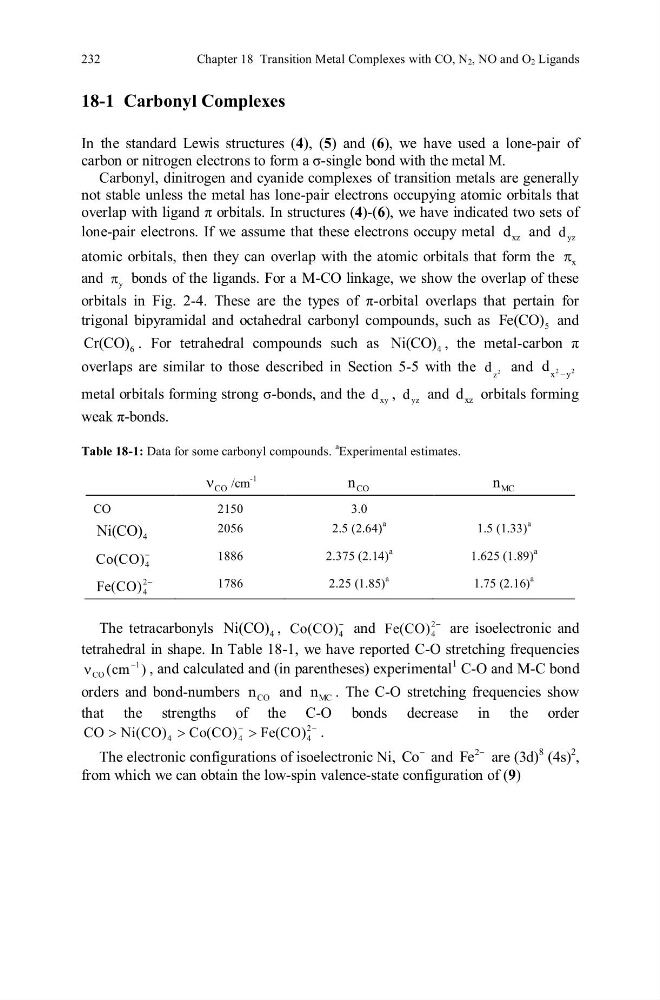
Table 18-1: Data for some carbonyl compounds.
a
Experimental estimates.
CO
/cm
-1
CO
n
MC
n
CO
2150
3.0
4
Ni(CO)
2056
2.5 (2.64)
a
1.5 (1.33)
a
4
Co(CO)
1886
2.375 (2.14)
a
1.625 (1.89)
a
2
4
Fe(CO)
1786
2.25 (1.85)
a
1.75 (2.16)
a
The tetracarbonyls
4
Ni(CO) ,
4
Co(CO)
and
2
4
Fe(CO)
are isoelectronic and
tetrahedral in shape. In Table 18-1, we have reported C-O stretching frequencies
1
CO (cm )
, and calculated and (in parentheses) experimental
1 C-O and M-C bond
orders and bond-numbers CO
n
and MC
n . The C-O stretching frequencies show
that the strengths of the C-O bonds decrease in the order
2
4
4
4
CO Ni(CO)
Co(CO)
Fe(CO)
.
The electronic configurations of isoelectronic Ni, Co
and
2
Fe
are (3d)
8 (4s)
2
,
from which we can obtain the low-spin valence-state configuration of (9)
Chapter 18 Transition Metal Complexes with CO, N2, NO and O2 Ligands
18-1 Carbonyl Complexes
In the standard Lewis structures (4), (5) and (6), we have used a lone-pair of
carbon or nitrogen electrons to form a σ-single bond with the metal M.
Carbonyl, dinitrogen and cyanide complexes of transition metals are generally
not stable unless the metal has lone-pair electrons occupying atomic orbitals that
overlap with ligand π orbitals. In structures (4)-(6), we have indicated two sets of
lone-pair electrons. If we assume that these electrons occupy metal xz
d and yz
d
atomic orbitals, then they can overlap with the atomic orbitals that form the x
and y
bonds of the ligands. For a M-CO linkage, we show the overlap of these
orbitals in Fig. 2-4. These are the types of π-orbital overlaps that pertain for
trigonal bipyramidal and octahedral carbonyl compounds, such as
5
Fe(CO) and
6
Cr(CO) . For tetrahedral compounds such as
4
Ni(CO) , the metal-carbon π
overlaps are similar to those described in Section 5-5 with the 2
z
d and 2 2
x y
d
metal orbitals forming strong σ-bonds, and the xy
d , yz
d and xz
d orbitals forming
weak π-bonds.
Table 18-1: Data for some carbonyl compounds.
a
Experimental estimates.
CO
/cm
-1
CO
n
MC
n
CO
2150
3.0
4
Ni(CO)
2056
2.5 (2.64)
a
1.5 (1.33)
a
4
Co(CO)
1886
2.375 (2.14)
a
1.625 (1.89)
a
2
4
Fe(CO)
1786
2.25 (1.85)
a
1.75 (2.16)
a
The tetracarbonyls
4
Ni(CO) ,
4
Co(CO)
and
2
4
Fe(CO)
are isoelectronic and
tetrahedral in shape. In Table 18-1, we have reported C-O stretching frequencies
1
CO (cm )
, and calculated and (in parentheses) experimental
1 C-O and M-C bond
orders and bond-numbers CO
n
and MC
n . The C-O stretching frequencies show
that the strengths of the C-O bonds decrease in the order
2
4
4
4
CO Ni(CO)
Co(CO)
Fe(CO)
.
The electronic configurations of isoelectronic Ni, Co
and
2
Fe
are (3d)
8 (4s)
2
,
from which we can obtain the low-spin valence-state configuration of (9)