

Chapter 18 Transition Metal Complexes with
CO, N 2 , NO and O 2 Ligands
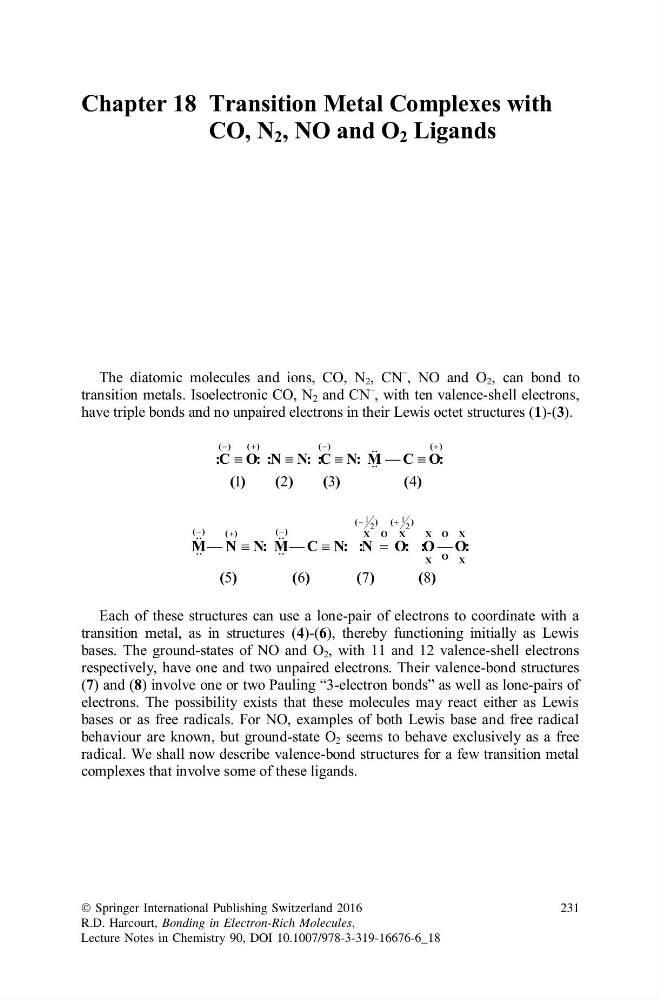
The diatomic molecules and ions, CO, N 2 , CN
–
, NO and O 2 , can bond to
transition metals. Isoelectronic CO, N 2 and CN
–
, with ten valence-shell electrons,
have triple bonds and no unpaired electrons in their Lewis octet structures (1)-(3).
1
2
3
4
( )
( )
( )
( )
:C O: :N N: :C N: M — C O:
( )
( )
( )
( )
1
1
2
2
5
6
7
8
(
) (
)
( )
( )
( )
X O X
X O X
O
X
X
M— N N: M— C N: :N O: :O — O:
( )
( )
( )
( )
Each of these structures can use a lone-pair of electrons to coordinate with a
transition metal, as in structures (4)-(6), thereby functioning initially as Lewis
bases. The ground-states of NO and O 2 , with 11 and 12 valence-shell electrons
respectively, have one and two unpaired electrons. Their valence-bond structures
(7) and (8) involve one or two Pauling “3-electron bonds” as well as lone-pairs of
electrons. The possibility exists that these molecules may react either as Lewis
bases or as free radicals. For NO, examples of both Lewis base and free radical
behaviour are known, but ground-state O 2 seems to behave exclusively as a free
radical. We shall now describe valence-bond structures for a few transition metal
complexes that involve some of these ligands.
Ó Springer International Publishing Switzerland 2016
R.D. Harcourt, Bonding in Electron-Rich Molecules,
Lecture Notes in Chemistry 90, DOI 10.1007/978-3-319-16676-6_18
231
CO, N 2 , NO and O 2 Ligands
The diatomic molecules and ions, CO, N 2 , CN
–
, NO and O 2 , can bond to
transition metals. Isoelectronic CO, N 2 and CN
–
, with ten valence-shell electrons,
have triple bonds and no unpaired electrons in their Lewis octet structures (1)-(3).
1
2
3
4
( )
( )
( )
( )
:C O: :N N: :C N: M — C O:
( )
( )
( )
( )
1
1
2
2
5
6
7
8
(
) (
)
( )
( )
( )
X O X
X O X
O
X
X
M— N N: M— C N: :N O: :O — O:
( )
( )
( )
( )
Each of these structures can use a lone-pair of electrons to coordinate with a
transition metal, as in structures (4)-(6), thereby functioning initially as Lewis
bases. The ground-states of NO and O 2 , with 11 and 12 valence-shell electrons
respectively, have one and two unpaired electrons. Their valence-bond structures
(7) and (8) involve one or two Pauling “3-electron bonds” as well as lone-pairs of
electrons. The possibility exists that these molecules may react either as Lewis
bases or as free radicals. For NO, examples of both Lewis base and free radical
behaviour are known, but ground-state O 2 seems to behave exclusively as a free
radical. We shall now describe valence-bond structures for a few transition metal
complexes that involve some of these ligands.
Ó Springer International Publishing Switzerland 2016
R.D. Harcourt, Bonding in Electron-Rich Molecules,
Lecture Notes in Chemistry 90, DOI 10.1007/978-3-319-16676-6_18
231