

228
Chapter 17 Some Tetrahedral Molecules
The P-F bond-lengths
15 of 1.523 Å for F 3 PO are shorter than the 1.561 A
16 for
3
PF (with formal single-bonds), and this suggests that the expanded valence-shell
structure is more appropriate than the “increased-valence” structure. Should this
be the case, it is probable that the expanded valence-shell structure of type (39)
(with P replacing N) is of greater significance than “increased-valence” structures
of type (40) for
3
4
PO
, whose P-O bond-lengths
17, 18 of 1.54 Å are longer than the
1.437 Å for 3
F PO but much shorter than the estimate of 1.73 Å for a P-O single
bond
18 .
17-6
2
2 n
S O
(n = 3, 4, 5, 6)
The thio anions
2
2
S O n
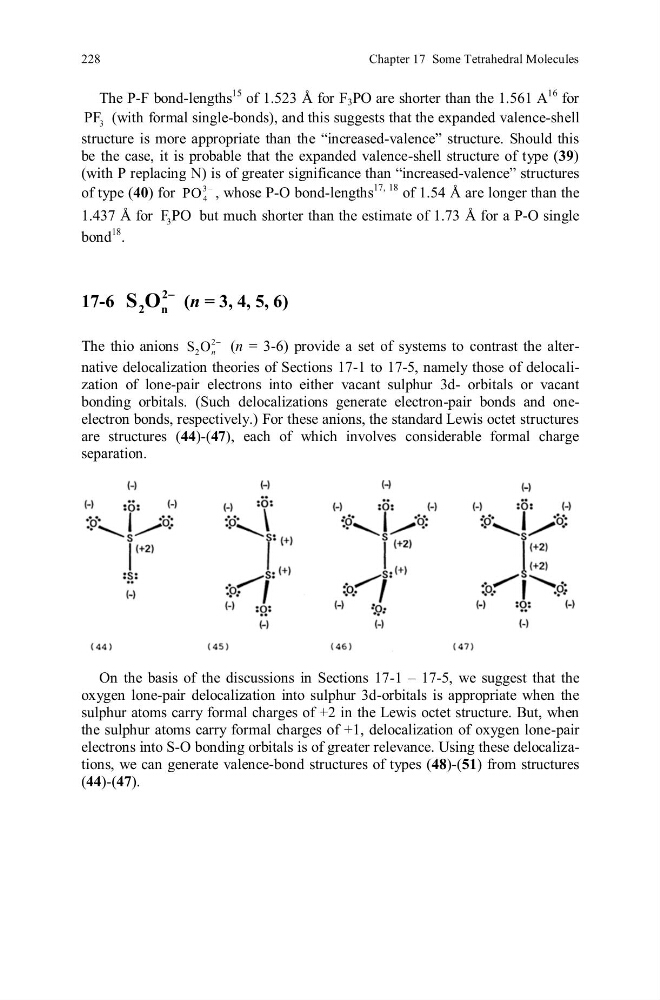
(n = 3-6) provide a set of systems to contrast the alternative delocalization theories of Sections 17-1 to 17-5, namely those of delocalization of lone-pair electrons into either vacant sulphur 3d- orbitals or vacant
bonding orbitals. (Such delocalizations generate electron-pair bonds and oneelectron bonds, respectively.) For these anions, the standard Lewis octet structures
are structures (44)-(47), each of which involves considerable formal charge
separation.
On the basis of the discussions in Sections 17-1 – 17-5, we suggest that the
oxygen lone-pair delocalization into sulphur 3d-orbitals is appropriate when the
sulphur atoms carry formal charges of +2 in the Lewis octet structure. But, when
the sulphur atoms carry formal charges of +1, delocalization of oxygen lone-pair
electrons into S-O bonding orbitals is of greater relevance. Using these delocalizations, we can generate valence-bond structures of types (48)-(51) from structures
(44)-(47).
Chapter 17 Some Tetrahedral Molecules
The P-F bond-lengths
15 of 1.523 Å for F 3 PO are shorter than the 1.561 A
16 for
3
PF (with formal single-bonds), and this suggests that the expanded valence-shell
structure is more appropriate than the “increased-valence” structure. Should this
be the case, it is probable that the expanded valence-shell structure of type (39)
(with P replacing N) is of greater significance than “increased-valence” structures
of type (40) for
3
4
PO
, whose P-O bond-lengths
17, 18 of 1.54 Å are longer than the
1.437 Å for 3
F PO but much shorter than the estimate of 1.73 Å for a P-O single
bond
18 .
17-6
2
2 n
S O
(n = 3, 4, 5, 6)
The thio anions
2
2
S O n
(n = 3-6) provide a set of systems to contrast the alternative delocalization theories of Sections 17-1 to 17-5, namely those of delocalization of lone-pair electrons into either vacant sulphur 3d- orbitals or vacant
bonding orbitals. (Such delocalizations generate electron-pair bonds and oneelectron bonds, respectively.) For these anions, the standard Lewis octet structures
are structures (44)-(47), each of which involves considerable formal charge
separation.
On the basis of the discussions in Sections 17-1 – 17-5, we suggest that the
oxygen lone-pair delocalization into sulphur 3d-orbitals is appropriate when the
sulphur atoms carry formal charges of +2 in the Lewis octet structure. But, when
the sulphur atoms carry formal charges of +1, delocalization of oxygen lone-pair
electrons into S-O bonding orbitals is of greater relevance. Using these delocalizations, we can generate valence-bond structures of types (48)-(51) from structures
(44)-(47).