

17-5
3
4
NO ,
3
4
PO and F3PO
227
delocalizing non-bonding π- or -electrons from the O
into bonding S-O orbitals to afford the more-stable valence-bond structures of type (37). Because the
sulphur atom of structure (5) is already neutral, these delocalizations are not
expected to be appreciable but must occur to some extent (cf.
2
2 4
C O
of Section
13-2).
17-5
3
4
NO ,
3
4
PO and F 3 PO
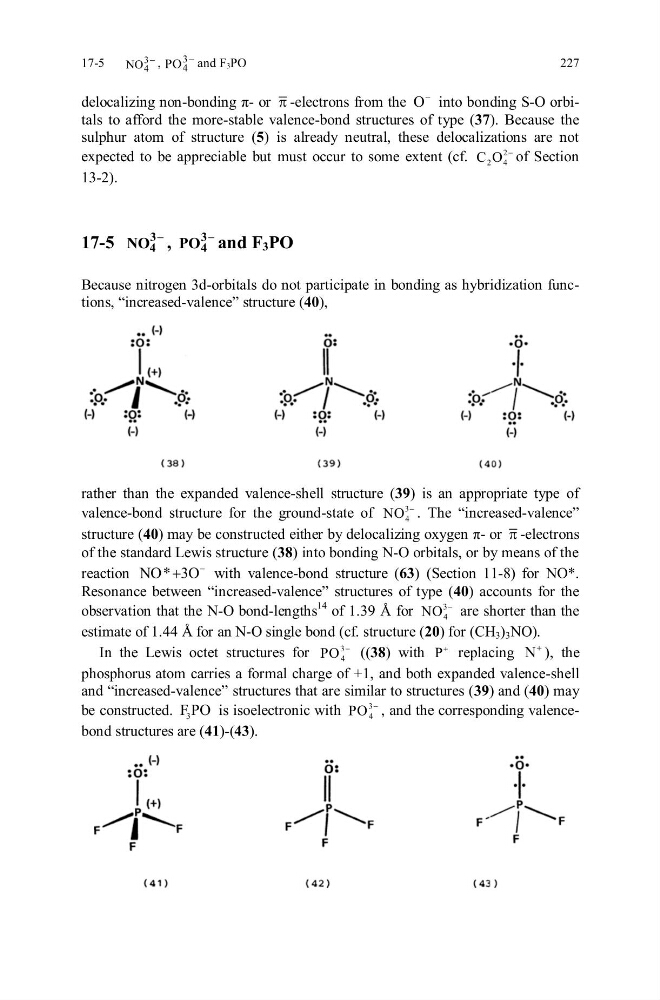
Because nitrogen 3d-orbitals do not participate in bonding as hybridization functions, “increased-valence” structure (40),
rather than the expanded valence-shell structure (39) is an appropriate type of
valence-bond structure for the ground-state of
3
4
NO
. The “increased-valence”
structure (40) may be constructed either by delocalizing oxygen π- or -electrons
of the standard Lewis structure (38) into bonding N-O orbitals, or by means of the
reaction NO* 3O
with valence-bond structure (63) (Section 11-8) for NO*.
Resonance between “increased-valence” structures of type (40) accounts for the
observation that the N-O bond-lengths
14 of 1.39 Å for
3
4
NO
are shorter than the
estimate of 1.44 Å for an N-O single bond (cf. structure (20) for (CH 3 ) 3 NO).
In the Lewis octet structures for
3
4
PO
((38) with P
replacing N
), the
phosphorus atom carries a formal charge of +1, and both expanded valence-shell
and “increased-valence” structures that are similar to structures (39) and (40) may
be constructed. 3
F PO is isoelectronic with
3
4
PO
, and the corresponding valencebond structures are (41)-(43).
3
4
NO ,
3
4
PO and F3PO
227
delocalizing non-bonding π- or -electrons from the O
into bonding S-O orbitals to afford the more-stable valence-bond structures of type (37). Because the
sulphur atom of structure (5) is already neutral, these delocalizations are not
expected to be appreciable but must occur to some extent (cf.
2
2 4
C O
of Section
13-2).
17-5
3
4
NO ,
3
4
PO and F 3 PO
Because nitrogen 3d-orbitals do not participate in bonding as hybridization functions, “increased-valence” structure (40),
rather than the expanded valence-shell structure (39) is an appropriate type of
valence-bond structure for the ground-state of
3
4
NO
. The “increased-valence”
structure (40) may be constructed either by delocalizing oxygen π- or -electrons
of the standard Lewis structure (38) into bonding N-O orbitals, or by means of the
reaction NO* 3O
with valence-bond structure (63) (Section 11-8) for NO*.
Resonance between “increased-valence” structures of type (40) accounts for the
observation that the N-O bond-lengths
14 of 1.39 Å for
3
4
NO
are shorter than the
estimate of 1.44 Å for an N-O single bond (cf. structure (20) for (CH 3 ) 3 NO).
In the Lewis octet structures for
3
4
PO
((38) with P
replacing N
), the
phosphorus atom carries a formal charge of +1, and both expanded valence-shell
and “increased-valence” structures that are similar to structures (39) and (40) may
be constructed. 3
F PO is isoelectronic with
3
4
PO
, and the corresponding valencebond structures are (41)-(43).