

Chapter 17 Some Tetrahedral Molecules and
d π – p π Bonding for some Sulphur
Compounds
17-1 d-Orbitals as Polarization and Hybridization Functions
In Chapters 11 and 13, we have constructed valence-bond structures for several
molecules that involve sulphur atoms. For them, it was assumed that only the
valence-shell 3s and 3p orbitals need participate in bonding. Of course, atoms of
the second-row of the periodic table may also utilize one or more 3d-orbitals as
hybridization functions for bonding, i.e. such atoms may expand their valence
shells. When this occurs, the associated Lewis-type valence-bond structures
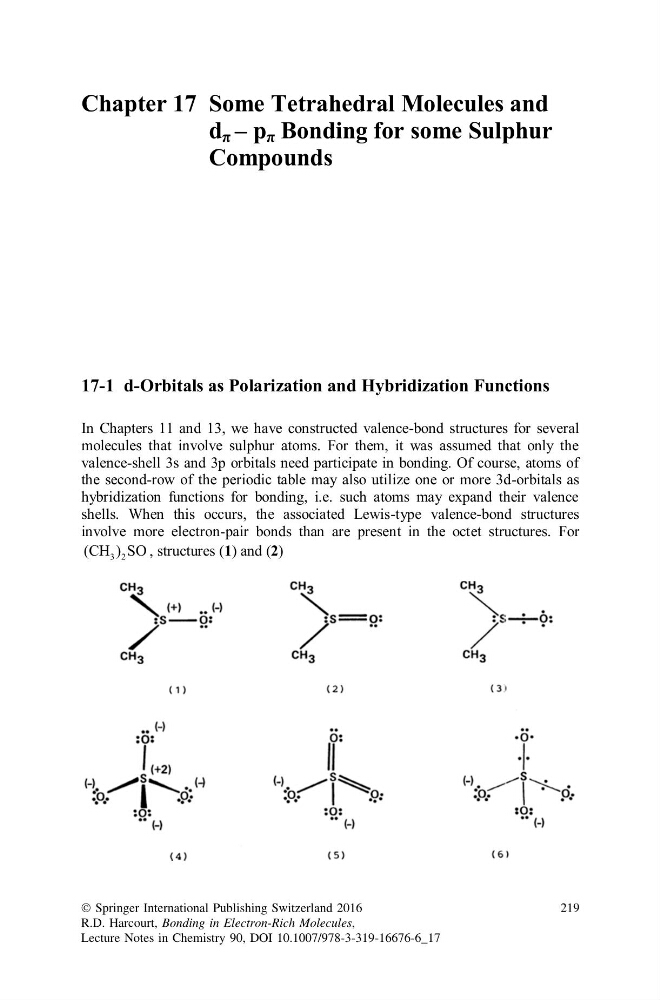
involve more electron-pair bonds than are present in the octet structures. For
3 2
(CH ) SO , structures (1) and (2)
Ó Springer International Publishing Switzerland 2016
R.D. Harcourt, Bonding in Electron-Rich Molecules,
Lecture Notes in Chemistry 90, DOI 10.1007/978-3-319-16676-6_17
219
d π – p π Bonding for some Sulphur
Compounds
17-1 d-Orbitals as Polarization and Hybridization Functions
In Chapters 11 and 13, we have constructed valence-bond structures for several
molecules that involve sulphur atoms. For them, it was assumed that only the
valence-shell 3s and 3p orbitals need participate in bonding. Of course, atoms of
the second-row of the periodic table may also utilize one or more 3d-orbitals as
hybridization functions for bonding, i.e. such atoms may expand their valence
shells. When this occurs, the associated Lewis-type valence-bond structures
involve more electron-pair bonds than are present in the octet structures. For
3 2
(CH ) SO , structures (1) and (2)
Ó Springer International Publishing Switzerland 2016
R.D. Harcourt, Bonding in Electron-Rich Molecules,
Lecture Notes in Chemistry 90, DOI 10.1007/978-3-319-16676-6_17
219