

218
Chapter 16 Classical Valence-Bond Structures and Quinquevalent Nitrogen Atoms
bitals and two S = 0 spin wavefunctions. For some of the molecules that have been
studied
28 – for example CH 2 NN and O 3 - the resulting SCVB structures have an
apparent valence of five, as in H 2 C N N for the central nitrogen and either four
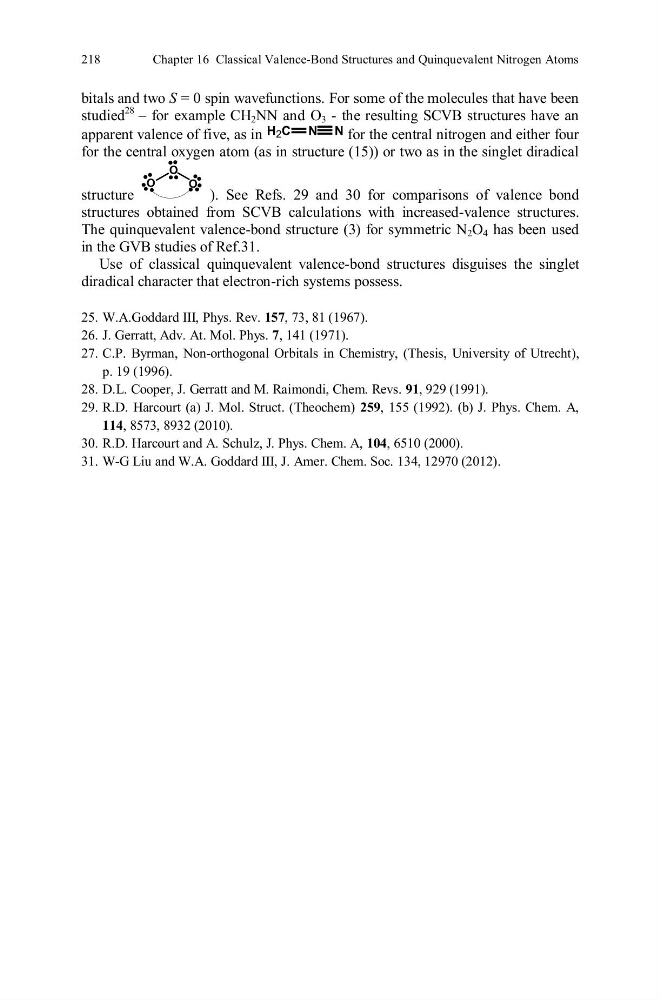
for the central oxygen atom (as in structure (15)) or two as in the singlet diradical
structure
O
O
O ). See Refs. 29 and 30 for comparisons of valence bond
structures obtained from SCVB calculations with increased-valence structures.
The quinquevalent valence-bond structure (3) for symmetric N 2 O 4 has been used
in the GVB studies of Ref.31.
Use of classical quinquevalent valence-bond structures disguises the singlet
diradical character that electron-rich systems possess.
25. W.A.Goddard III, Phys. Rev. 157, 73, 81 (1967).
26. J. Gerratt, Adv. At. Mol. Phys. 7, 141 (1971).
27. C.P. Byrman, Non-orthogonal Orbitals in Chemistry, (Thesis, University of Utrecht),
p. 19 (1996).
28. D.L. Cooper, J. Gerratt and M. Raimondi, Chem. Revs. 91, 929 (1991).
29. R.D. Harcourt (a) J. Mol. Struct. (Theochem) 259, 155 (1992). (b) J. Phys. Chem. A,
114, 8573, 8932 (2010).
30. R.D. Harcourt and A. Schulz, J. Phys. Chem. A, 104, 6510 (2000).
31. W-G Liu and W.A. Goddard III, J. Amer. Chem. Soc. 134, 12970 (2012).
Chapter 16 Classical Valence-Bond Structures and Quinquevalent Nitrogen Atoms
bitals and two S = 0 spin wavefunctions. For some of the molecules that have been
studied
28 – for example CH 2 NN and O 3 - the resulting SCVB structures have an
apparent valence of five, as in H 2 C N N for the central nitrogen and either four
for the central oxygen atom (as in structure (15)) or two as in the singlet diradical
structure
O
O
O ). See Refs. 29 and 30 for comparisons of valence bond
structures obtained from SCVB calculations with increased-valence structures.
The quinquevalent valence-bond structure (3) for symmetric N 2 O 4 has been used
in the GVB studies of Ref.31.
Use of classical quinquevalent valence-bond structures disguises the singlet
diradical character that electron-rich systems possess.
25. W.A.Goddard III, Phys. Rev. 157, 73, 81 (1967).
26. J. Gerratt, Adv. At. Mol. Phys. 7, 141 (1971).
27. C.P. Byrman, Non-orthogonal Orbitals in Chemistry, (Thesis, University of Utrecht),
p. 19 (1996).
28. D.L. Cooper, J. Gerratt and M. Raimondi, Chem. Revs. 91, 929 (1991).
29. R.D. Harcourt (a) J. Mol. Struct. (Theochem) 259, 155 (1992). (b) J. Phys. Chem. A,
114, 8573, 8932 (2010).
30. R.D. Harcourt and A. Schulz, J. Phys. Chem. A, 104, 6510 (2000).
31. W-G Liu and W.A. Goddard III, J. Amer. Chem. Soc. 134, 12970 (2012).