

15-2
Spin Degeneracy and Wave-Functions for “Increased-Valence” Structures
209
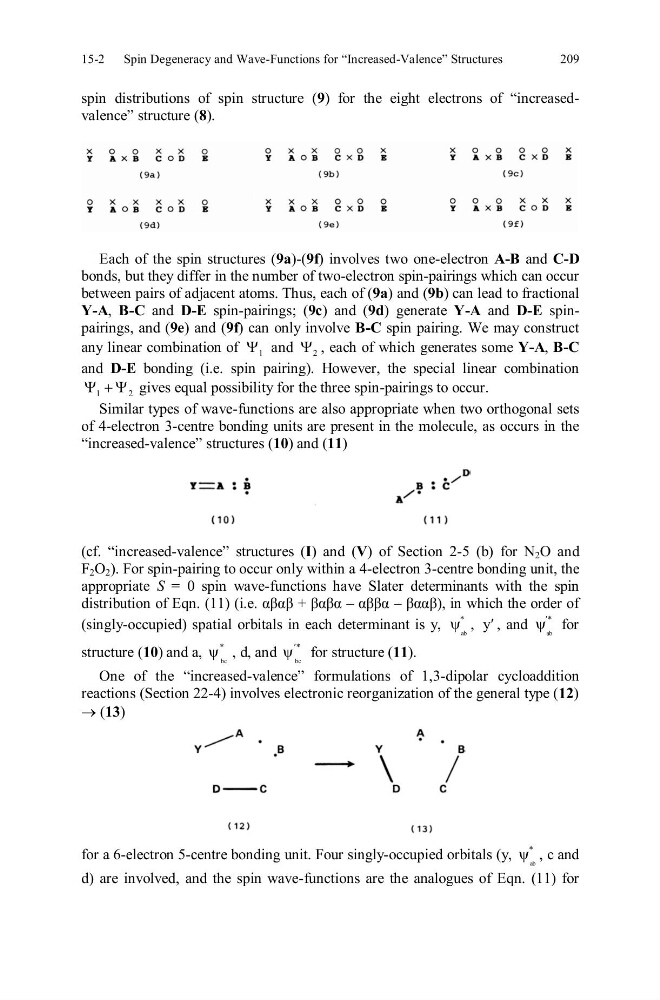
spin distributions of spin structure (9) for the eight electrons of “increasedvalence” structure (8).
Each of the spin structures (9a)-(9f) involves two one-electron A-B and C-D
bonds, but they differ in the number of two-electron spin-pairings which can occur
between pairs of adjacent atoms. Thus, each of (9a) and (9b) can lead to fractional
Y-A, B-C and D-E spin-pairings; (9c) and (9d) generate Y-A and D-E spinpairings, and (9e) and (9f) can only involve B-C spin pairing. We may construct
any linear combination of 1
and 2
, each of which generates some Y-A, B-C
and D-E bonding (i.e. spin pairing). However, the special linear combination
1
2
gives equal possibility for the three spin-pairings to occur.
Similar types of wave-functions are also appropriate when two orthogonal sets
of 4-electron 3-centre bonding units are present in the molecule, as occurs in the
“increased-valence” structures (10) and (11)
(cf. “increased-valence” structures (I) and (V) of Section 2-5 (b) for N 2 O and
F 2 O 2 ). For spin-pairing to occur only within a 4-electron 3-centre bonding unit, the
appropriate S = 0 spin wave-functions have Slater determinants with the spin
distribution of Eqn. (11) (i.e. αβαβ + βαβα – αββα – βααβ), in which the order of
(singly-occupied) spatial orbitals in each determinant is y,
ab
*
, y , and
ab
*
for
structure (10) and a,
bc
*
, d, and
bc
*
for structure (11).
One of the “increased-valence” formulations of 1,3-dipolar cycloaddition
reactions (Section 22-4) involves electronic reorganization of the general type (12)
(13)
for a 6-electron 5-centre bonding unit. Four singly-occupied orbitals (y,
ab
*
, c and
d) are involved, and the spin wave-functions are the analogues of Eqn. (11) for
Spin Degeneracy and Wave-Functions for “Increased-Valence” Structures
209
spin distributions of spin structure (9) for the eight electrons of “increasedvalence” structure (8).
Each of the spin structures (9a)-(9f) involves two one-electron A-B and C-D
bonds, but they differ in the number of two-electron spin-pairings which can occur
between pairs of adjacent atoms. Thus, each of (9a) and (9b) can lead to fractional
Y-A, B-C and D-E spin-pairings; (9c) and (9d) generate Y-A and D-E spinpairings, and (9e) and (9f) can only involve B-C spin pairing. We may construct
any linear combination of 1
and 2
, each of which generates some Y-A, B-C
and D-E bonding (i.e. spin pairing). However, the special linear combination
1
2
gives equal possibility for the three spin-pairings to occur.
Similar types of wave-functions are also appropriate when two orthogonal sets
of 4-electron 3-centre bonding units are present in the molecule, as occurs in the
“increased-valence” structures (10) and (11)
(cf. “increased-valence” structures (I) and (V) of Section 2-5 (b) for N 2 O and
F 2 O 2 ). For spin-pairing to occur only within a 4-electron 3-centre bonding unit, the
appropriate S = 0 spin wave-functions have Slater determinants with the spin
distribution of Eqn. (11) (i.e. αβαβ + βαβα – αββα – βααβ), in which the order of
(singly-occupied) spatial orbitals in each determinant is y,
ab
*
, y , and
ab
*
for
structure (10) and a,
bc
*
, d, and
bc
*
for structure (11).
One of the “increased-valence” formulations of 1,3-dipolar cycloaddition
reactions (Section 22-4) involves electronic reorganization of the general type (12)
(13)
for a 6-electron 5-centre bonding unit. Four singly-occupied orbitals (y,
ab
*
, c and
d) are involved, and the spin wave-functions are the analogues of Eqn. (11) for