

208
Chapter 15 Slater Determinants and Wave-Functions for “Increased-Valence” Structures
15-2 Spin Degeneracy and Wave-Functions for
“Increased-Valence” Structures
Except for 4-electron 3-centre and 6-electron 4-centre “increased-valence” structures, all other “increased-valence” structures involve the spin-pairing of three or
more odd electrons, i.e. in the “increased-valence” wave-function, three or more
orbitals must be singly-occupied. This may be seen by examination of the
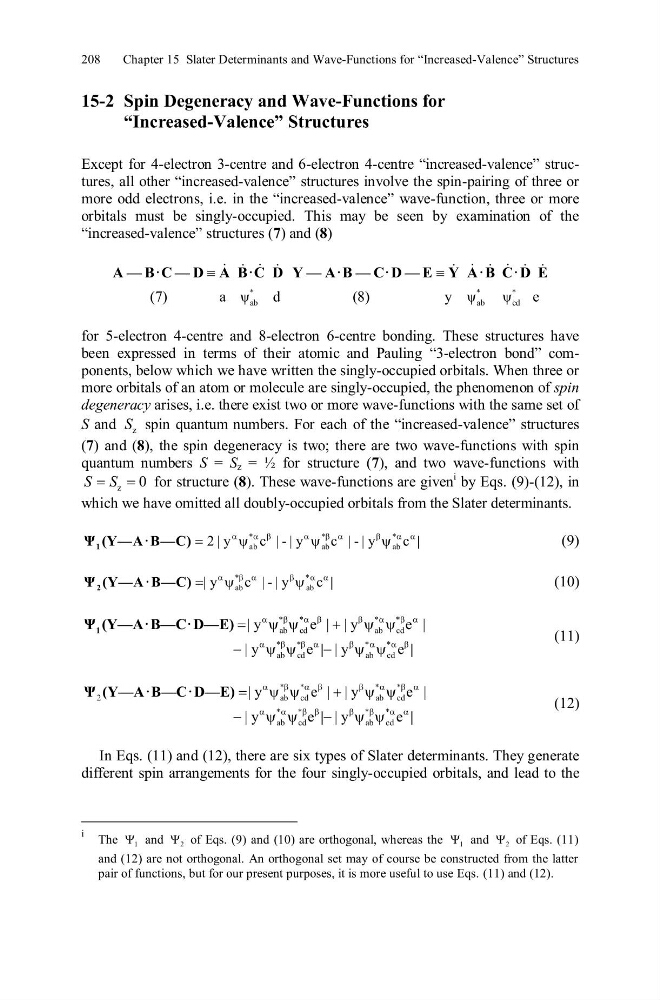
“increased-valence” structures (7) and (8)
*
ab
(7)
a ψ
d
A — B·C — D A B·C D
*
*
ab
cd
(8)
y ψ
ψ e
Y — A·B — C·D — E Y A·B C· D E
for 5-electron 4-centre and 8-electron 6-centre bonding. These structures have
been expressed in terms of their atomic and Pauling “3-electron bond” components, below which we have written the singly-occupied orbitals. When three or
more orbitals of an atom or molecule are singly-occupied, the phenomenon of spin
degeneracy arises, i.e. there exist two or more wave-functions with the same set of
S and z
S spin quantum numbers. For each of the “increased-valence” structures
(7) and (8), the spin degeneracy is two; there are two wave-functions with spin
quantum numbers S = S z = ½ for structure (7), and two wave-functions with
z
0
S S
for structure (8). These wave-functions are given
i by Eqs. (9)-(12), in
which we have omitted all doubly-occupied orbitals from the Slater determinants.
*
*
*
ab
ab
ab
2 | y
c | - | y
c | - | y
c
1
Ψ (Y—A·B—C)
|
(9)
*
*
ab
ab
| y
c | - | y
c
2
Ψ (Y—A ·B—C)
|
(10)
*
*
*
*
ab cd
ab
cd
*
*
*
*
ab cd
ab
cd
| y
e | | y
e |
| y
e | y
e
1
Ψ (Y—A·B—C·D—E)
|
|
(11)
*
*
*
*
2
ab cd
ab
cd
*
*
*
*
ab
cd
ab cd
| y
e | | y
e |
| y
e | y
e
Ψ (Y—A·B—C·D—E)
|
|
(12)
In Eqs. (11) and (12), there are six types of Slater determinants. They generate
different spin arrangements for the four singly-occupied orbitals, and lead to the
i The 1
and 2
of Eqs. (9) and (10) are orthogonal, whereas the 1
and 2
of Eqs. (11)
and (12) are not orthogonal. An orthogonal set may of course be constructed from the latter
pair of functions, but for our present purposes, it is more useful to use Eqs. (11) and (12).
Chapter 15 Slater Determinants and Wave-Functions for “Increased-Valence” Structures
15-2 Spin Degeneracy and Wave-Functions for
“Increased-Valence” Structures
Except for 4-electron 3-centre and 6-electron 4-centre “increased-valence” structures, all other “increased-valence” structures involve the spin-pairing of three or
more odd electrons, i.e. in the “increased-valence” wave-function, three or more
orbitals must be singly-occupied. This may be seen by examination of the
“increased-valence” structures (7) and (8)
*
ab
(7)
a ψ
d
A — B·C — D A B·C D
*
*
ab
cd
(8)
y ψ
ψ e
Y — A·B — C·D — E Y A·B C· D E
for 5-electron 4-centre and 8-electron 6-centre bonding. These structures have
been expressed in terms of their atomic and Pauling “3-electron bond” components, below which we have written the singly-occupied orbitals. When three or
more orbitals of an atom or molecule are singly-occupied, the phenomenon of spin
degeneracy arises, i.e. there exist two or more wave-functions with the same set of
S and z
S spin quantum numbers. For each of the “increased-valence” structures
(7) and (8), the spin degeneracy is two; there are two wave-functions with spin
quantum numbers S = S z = ½ for structure (7), and two wave-functions with
z
0
S S
for structure (8). These wave-functions are given
i by Eqs. (9)-(12), in
which we have omitted all doubly-occupied orbitals from the Slater determinants.
*
*
*
ab
ab
ab
2 | y
c | - | y
c | - | y
c
1
Ψ (Y—A·B—C)
|
(9)
*
*
ab
ab
| y
c | - | y
c
2
Ψ (Y—A ·B—C)
|
(10)
*
*
*
*
ab cd
ab
cd
*
*
*
*
ab cd
ab
cd
| y
e | | y
e |
| y
e | y
e
1
Ψ (Y—A·B—C·D—E)
|
|
(11)
*
*
*
*
2
ab cd
ab
cd
*
*
*
*
ab
cd
ab cd
| y
e | | y
e |
| y
e | y
e
Ψ (Y—A·B—C·D—E)
|
|
(12)
In Eqs. (11) and (12), there are six types of Slater determinants. They generate
different spin arrangements for the four singly-occupied orbitals, and lead to the
i The 1
and 2
of Eqs. (9) and (10) are orthogonal, whereas the 1
and 2
of Eqs. (11)
and (12) are not orthogonal. An orthogonal set may of course be constructed from the latter
pair of functions, but for our present purposes, it is more useful to use Eqs. (11) and (12).