

13-2
N2O4,
22 4
C O and (RNO)2 , with 6-Electron 4-Centre Bonding Units
169
we may deduce that the a
b
N N
and C-N bonds should be longer than triple
bonds, and that the b
c
N N
and N-O bond-lengths should be similar to those of
double bonds. With the possible exception of the C-N bond for HCNO, the bondlengths reported in Table 13-1 are in accord with these deductions.
The symmetrical triatomic species 3
N
,
2
NO
and CO 2 are also isoelectronic
with N 2 O. Their standard Lewis and “increased-valence” structures are displayed
in Fig. 13-1. For each of these systems, resonance between the four “increasedvalence” structures indicates more clearly than does resonance between the
standard Lewis structures that the N-N, N-O and C-O bond-lengths of 1.18 Å,
1.15 Å and 1.16 Å are shorter than those of double-bonds (see Table 13-1). The
smaller formal charges for “increased-valence” structures (II) and (III) suggest
that these are the most important of the four “increased-valence” structures, and
inspection of them alone makes clear why the bond-lengths are shorter than
double-bonds. Similar types of “increased-valence” structures should also be the
primary structures for HNCO. Inspection of them in Fig. 13-1 leads to the conclusion that the C-N and C-O bonds are both shorter than double bonds, and the
bond-lengths reported in Table 13-1 support this conclusion.
13-2 N 2 O 4 ,
2
2 4
C O
and (RNO) 2 , with 6-Electron 4-Centre
Bonding Units
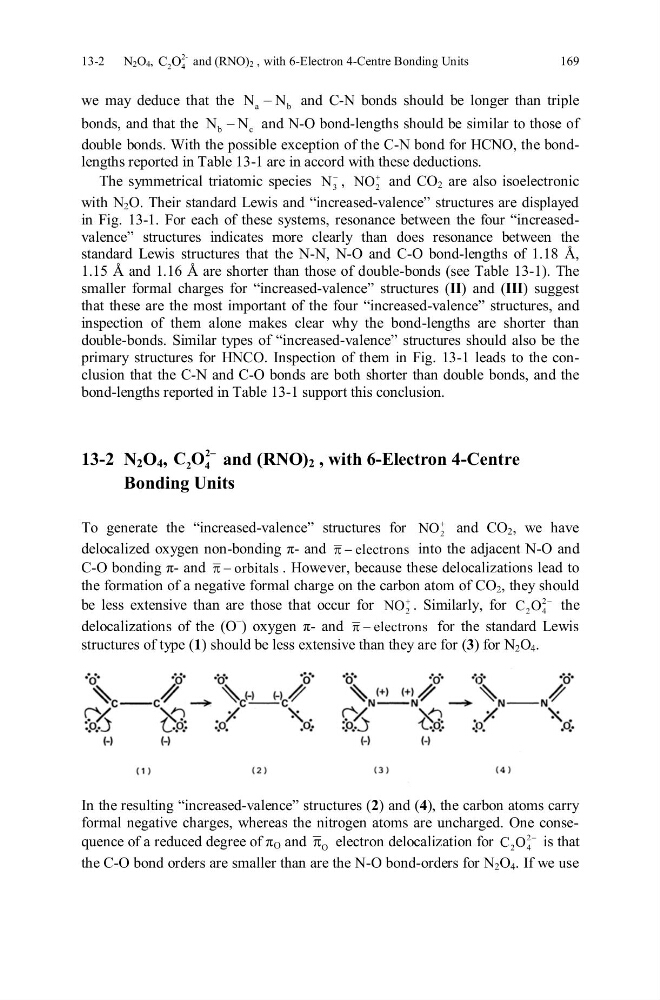
To generate the “increased-valence” structures for
2
NO
and CO 2 , we have
delocalized oxygen non-bonding π- and
electrons
into the adjacent N-O and
C-O bonding π- and
orbitals
. However, because these delocalizations lead to
the formation of a negative formal charge on the carbon atom of CO 2 , they should
be less extensive than are those that occur for
2
NO
. Similarly, for
2
2 4
C O
the
delocalizations of the (O
– ) oxygen π- and
electrons
for the standard Lewis
structures of type (1) should be less extensive than they are for (3) for N 2 O 4 .
In the resulting “increased-valence” structures (2) and (4), the carbon atoms carry
formal negative charges, whereas the nitrogen atoms are uncharged. One consequence of a reduced degree of π O and O
electron delocalization for
2
2 4
C O
is that
the C-O bond orders are smaller than are the N-O bond-orders for N 2 O 4 . If we use
N2O4,
22 4
C O and (RNO)2 , with 6-Electron 4-Centre Bonding Units
169
we may deduce that the a
b
N N
and C-N bonds should be longer than triple
bonds, and that the b
c
N N
and N-O bond-lengths should be similar to those of
double bonds. With the possible exception of the C-N bond for HCNO, the bondlengths reported in Table 13-1 are in accord with these deductions.
The symmetrical triatomic species 3
N
,
2
NO
and CO 2 are also isoelectronic
with N 2 O. Their standard Lewis and “increased-valence” structures are displayed
in Fig. 13-1. For each of these systems, resonance between the four “increasedvalence” structures indicates more clearly than does resonance between the
standard Lewis structures that the N-N, N-O and C-O bond-lengths of 1.18 Å,
1.15 Å and 1.16 Å are shorter than those of double-bonds (see Table 13-1). The
smaller formal charges for “increased-valence” structures (II) and (III) suggest
that these are the most important of the four “increased-valence” structures, and
inspection of them alone makes clear why the bond-lengths are shorter than
double-bonds. Similar types of “increased-valence” structures should also be the
primary structures for HNCO. Inspection of them in Fig. 13-1 leads to the conclusion that the C-N and C-O bonds are both shorter than double bonds, and the
bond-lengths reported in Table 13-1 support this conclusion.
13-2 N 2 O 4 ,
2
2 4
C O
and (RNO) 2 , with 6-Electron 4-Centre
Bonding Units
To generate the “increased-valence” structures for
2
NO
and CO 2 , we have
delocalized oxygen non-bonding π- and
electrons
into the adjacent N-O and
C-O bonding π- and
orbitals
. However, because these delocalizations lead to
the formation of a negative formal charge on the carbon atom of CO 2 , they should
be less extensive than are those that occur for
2
NO
. Similarly, for
2
2 4
C O
the
delocalizations of the (O
– ) oxygen π- and
electrons
for the standard Lewis
structures of type (1) should be less extensive than they are for (3) for N 2 O 4 .
In the resulting “increased-valence” structures (2) and (4), the carbon atoms carry
formal negative charges, whereas the nitrogen atoms are uncharged. One consequence of a reduced degree of π O and O
electron delocalization for
2
2 4
C O
is that
the C-O bond orders are smaller than are the N-O bond-orders for N 2 O 4 . If we use