

164
Chapter 12
Constructed from Lewis Structures
X OX
A B and
O XO
A B
and then delocalizing an
1
z
2
(x)
s
or
1
z
2
(o)
s
electron of B into an A-B
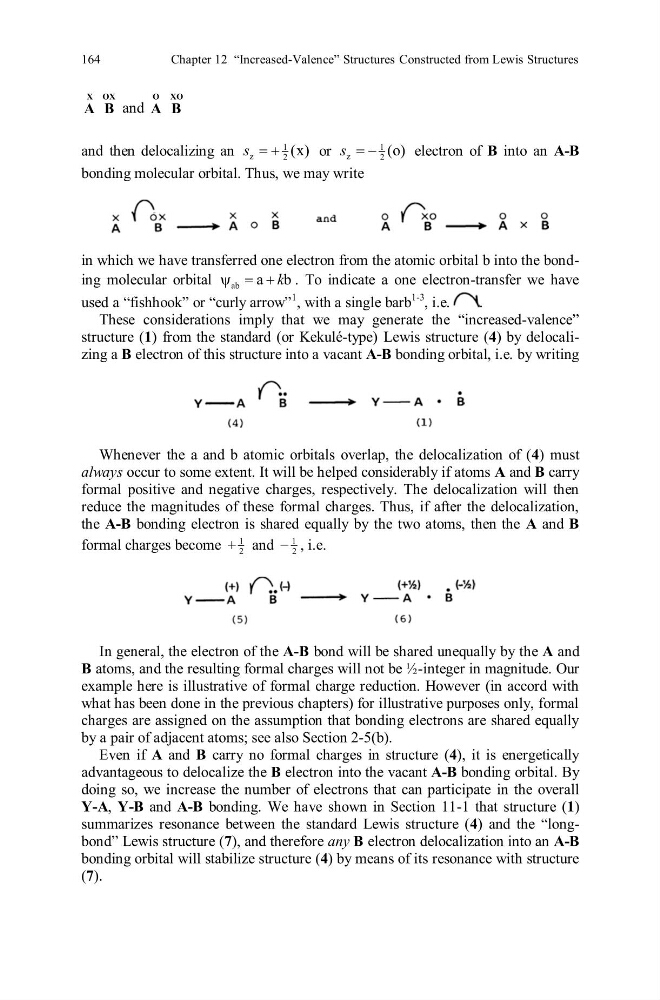
bonding molecular orbital. Thus, we may write
in which we have transferred one electron from the atomic orbital b into the bonding molecular orbital ab a b
k
. To indicate a one electron-transfer we have
used a “fishhook” or “curly arrow”
1 , with a single barb
1-3
, i.e.
.
These considerations imply that we may generate the “increased-valence”
structure (1) from the standard (or Kekulé-type) Lewis structure (4) by delocalizing a B electron of this structure into a vacant A-B bonding orbital, i.e. by writing
Whenever the a and b atomic orbitals overlap, the delocalization of (4) must
always occur to some extent. It will be helped considerably if atoms A and B carry
formal positive and negative charges, respectively. The delocalization will then
reduce the magnitudes of these formal charges. Thus, if after the delocalization,
the A-B bonding electron is shared equally by the two atoms, then the A and B
formal charges become
1
2
and
1
2
, i.e.
In general, the electron of the A-B bond will be shared unequally by the A and
B atoms, and the resulting formal charges will not be ½-integer in magnitude. Our
example here is illustrative of formal charge reduction. However (in accord with
what has been done in the previous chapters) for illustrative purposes only, formal
charges are assigned on the assumption that bonding electrons are shared equally
by a pair of adjacent atoms; see also Section 2-5(b).
Even if A and B carry no formal charges in structure (4), it is energetically
advantageous to delocalize the B electron into the vacant A-B bonding orbital. By
doing so, we increase the number of electrons that can participate in the overall
Y-A, Y-B and A-B bonding. We have shown in Section 11-1 that structure (1)
summarizes resonance between the standard Lewis structure (4) and the “longbond” Lewis structure (7), and therefore any B electron delocalization into an A-B
bonding orbital will stabilize structure (4) by means of its resonance with structure
(7).
“Increased-Valence” Structures
Chapter 12
Constructed from Lewis Structures
X OX
A B and
O XO
A B
and then delocalizing an
1
z
2
(x)
s
or
1
z
2
(o)
s
electron of B into an A-B
bonding molecular orbital. Thus, we may write
in which we have transferred one electron from the atomic orbital b into the bonding molecular orbital ab a b
k
. To indicate a one electron-transfer we have
used a “fishhook” or “curly arrow”
1 , with a single barb
1-3
, i.e.
.
These considerations imply that we may generate the “increased-valence”
structure (1) from the standard (or Kekulé-type) Lewis structure (4) by delocalizing a B electron of this structure into a vacant A-B bonding orbital, i.e. by writing
Whenever the a and b atomic orbitals overlap, the delocalization of (4) must
always occur to some extent. It will be helped considerably if atoms A and B carry
formal positive and negative charges, respectively. The delocalization will then
reduce the magnitudes of these formal charges. Thus, if after the delocalization,
the A-B bonding electron is shared equally by the two atoms, then the A and B
formal charges become
1
2
and
1
2
, i.e.
In general, the electron of the A-B bond will be shared unequally by the A and
B atoms, and the resulting formal charges will not be ½-integer in magnitude. Our
example here is illustrative of formal charge reduction. However (in accord with
what has been done in the previous chapters) for illustrative purposes only, formal
charges are assigned on the assumption that bonding electrons are shared equally
by a pair of adjacent atoms; see also Section 2-5(b).
Even if A and B carry no formal charges in structure (4), it is energetically
advantageous to delocalize the B electron into the vacant A-B bonding orbital. By
doing so, we increase the number of electrons that can participate in the overall
Y-A, Y-B and A-B bonding. We have shown in Section 11-1 that structure (1)
summarizes resonance between the standard Lewis structure (4) and the “longbond” Lewis structure (7), and therefore any B electron delocalization into an A-B
bonding orbital will stabilize structure (4) by means of its resonance with structure
(7).
“Increased-Valence” Structures