

Chapter 12
Constructed from Lewis Structures:
Delocalization of a Lone-Pair
Electron into a Vacant Bonding
Orbital
For diamagnetic polyatomic molecules, it is easy to write down standard Lewis
structures that have electron-pair bonds and lone-pairs of electrons. It is then also
easy to generate “increased-valence” structures from them. To do this, we must
delocalize one or more lone-pair electrons into either two-centre bonding orbitals
or two-centre antibonding orbitals, both types of orbitals being vacant in the standard Lewis structures. In this chapter, we shall describe these delocalizations into
bonding orbitals.
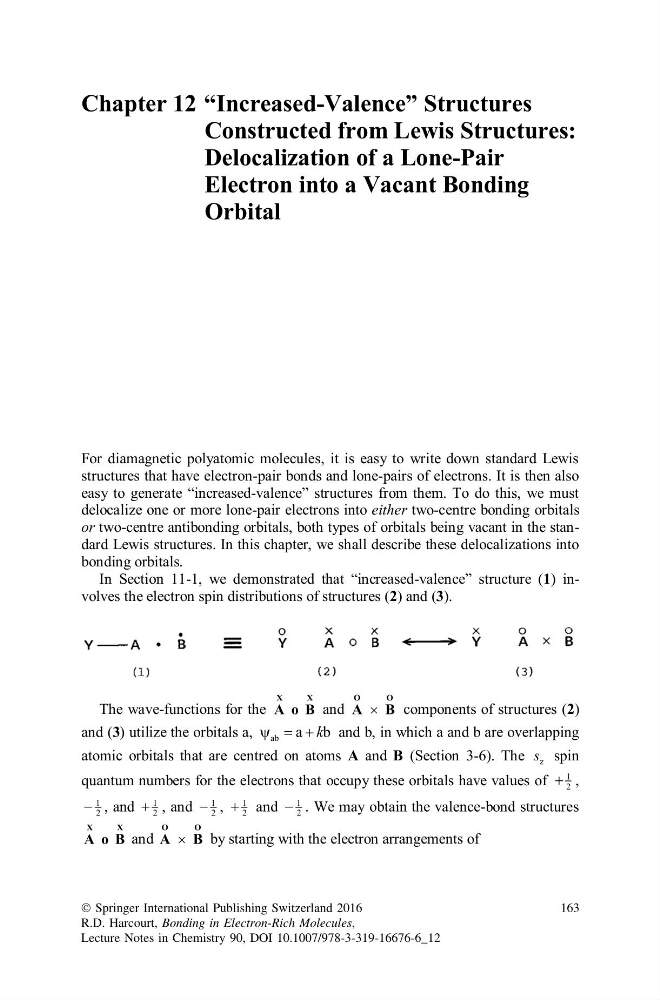
In Section 11-1, we demonstrated that “increased-valence” structure (1) involves the electron spin distributions of structures (2) and (3).
The wave-functions for the
X
X
A o B and
O
O
A
B components of structures (2)
and (3) utilize the orbitals a, ab a b
k and b, in which a and b are overlapping
atomic orbitals that are centred on atoms A and B (Section 3-6). The z
s spin
quantum numbers for the electrons that occupy these orbitals have values of
1
2
,
1
2
, and
1
2
, and
1
2
,
1
2
and
1
2
. We may obtain the valence-bond structures
X
X
A o B and
O
O
A
B by starting with the electron arrangements of
Ó Springer International Publishing Switzerland 2016
R.D. Harcourt, Bonding in Electron-Rich Molecules,
Lecture Notes in Chemistry 90, DOI 10.1007/978-3-319-16676-6_12
163
“Increased-Valence” Structures
Constructed from Lewis Structures:
Delocalization of a Lone-Pair
Electron into a Vacant Bonding
Orbital
For diamagnetic polyatomic molecules, it is easy to write down standard Lewis
structures that have electron-pair bonds and lone-pairs of electrons. It is then also
easy to generate “increased-valence” structures from them. To do this, we must
delocalize one or more lone-pair electrons into either two-centre bonding orbitals
or two-centre antibonding orbitals, both types of orbitals being vacant in the standard Lewis structures. In this chapter, we shall describe these delocalizations into
bonding orbitals.
In Section 11-1, we demonstrated that “increased-valence” structure (1) involves the electron spin distributions of structures (2) and (3).
The wave-functions for the
X
X
A o B and
O
O
A
B components of structures (2)
and (3) utilize the orbitals a, ab a b
k and b, in which a and b are overlapping
atomic orbitals that are centred on atoms A and B (Section 3-6). The z
s spin
quantum numbers for the electrons that occupy these orbitals have values of
1
2
,
1
2
, and
1
2
, and
1
2
,
1
2
and
1
2
. We may obtain the valence-bond structures
X
X
A o B and
O
O
A
B by starting with the electron arrangements of
Ó Springer International Publishing Switzerland 2016
R.D. Harcourt, Bonding in Electron-Rich Molecules,
Lecture Notes in Chemistry 90, DOI 10.1007/978-3-319-16676-6_12
163
“Increased-Valence” Structures