

160
Chapter 11 Pauling “3-Electron Bonds” and “Increased-Valence” Structures
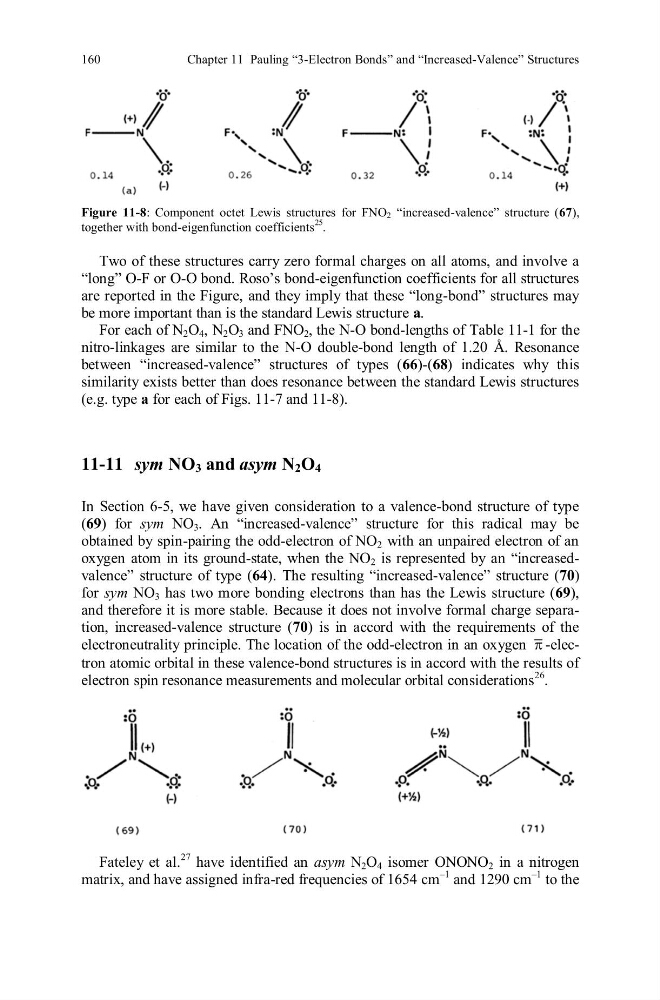
Figure 11-8: Component octet Lewis structures for FNO2 “increased-valence” structure (67),
together with bond-eigenfunction coefficients
25
.
Two of these structures carry zero formal charges on all atoms, and involve a
“long” O-F or O-O bond. Roso’s bond-eigenfunction coefficients for all structures
are reported in the Figure, and they imply that these “long-bond” structures may
be more important than is the standard Lewis structure a.
For each of N 2 O 4 , N 2 O 3 and FNO 2 , the N-O bond-lengths of Table 11-1 for the
nitro-linkages are similar to the N-O double-bond length of 1.20 Å. Resonance
between “increased-valence” structures of types (66)-(68) indicates why this
similarity exists better than does resonance between the standard Lewis structures
(e.g. type a for each of Figs. 11-7 and 11-8).
11-11 sym NO 3 and asym N 2 O 4
In Section 6-5, we have given consideration to a valence-bond structure of type
(69) for sym NO 3 . An “increased-valence” structure for this radical may be
obtained by spin-pairing the odd-electron of NO 2 with an unpaired electron of an
oxygen atom in its ground-state, when the NO 2 is represented by an “increasedvalence” structure of type (64). The resulting “increased-valence” structure (70)
for sym NO 3 has two more bonding electrons than has the Lewis structure (69),
and therefore it is more stable. Because it does not involve formal charge separation, increased-valence structure (70) is in accord with the requirements of the
electroneutrality principle. The location of the odd-electron in an oxygen -electron atomic orbital in these valence-bond structures is in accord with the results of
electron spin resonance measurements and molecular orbital considerations
26
.
Fateley et al.
27 have identified an asym N 2 O 4 isomer ONONO 2 in a nitrogen
matrix, and have assigned infra-red frequencies of 1654 cm
–1 and 1290 cm
–1 to the
Chapter 11 Pauling “3-Electron Bonds” and “Increased-Valence” Structures
Figure 11-8: Component octet Lewis structures for FNO2 “increased-valence” structure (67),
together with bond-eigenfunction coefficients
25
.
Two of these structures carry zero formal charges on all atoms, and involve a
“long” O-F or O-O bond. Roso’s bond-eigenfunction coefficients for all structures
are reported in the Figure, and they imply that these “long-bond” structures may
be more important than is the standard Lewis structure a.
For each of N 2 O 4 , N 2 O 3 and FNO 2 , the N-O bond-lengths of Table 11-1 for the
nitro-linkages are similar to the N-O double-bond length of 1.20 Å. Resonance
between “increased-valence” structures of types (66)-(68) indicates why this
similarity exists better than does resonance between the standard Lewis structures
(e.g. type a for each of Figs. 11-7 and 11-8).
11-11 sym NO 3 and asym N 2 O 4
In Section 6-5, we have given consideration to a valence-bond structure of type
(69) for sym NO 3 . An “increased-valence” structure for this radical may be
obtained by spin-pairing the odd-electron of NO 2 with an unpaired electron of an
oxygen atom in its ground-state, when the NO 2 is represented by an “increasedvalence” structure of type (64). The resulting “increased-valence” structure (70)
for sym NO 3 has two more bonding electrons than has the Lewis structure (69),
and therefore it is more stable. Because it does not involve formal charge separation, increased-valence structure (70) is in accord with the requirements of the
electroneutrality principle. The location of the odd-electron in an oxygen -electron atomic orbital in these valence-bond structures is in accord with the results of
electron spin resonance measurements and molecular orbital considerations
26
.
Fateley et al.
27 have identified an asym N 2 O 4 isomer ONONO 2 in a nitrogen
matrix, and have assigned infra-red frequencies of 1654 cm
–1 and 1290 cm
–1 to the