

11-10 N2O4, N2O3 and FNO2
159
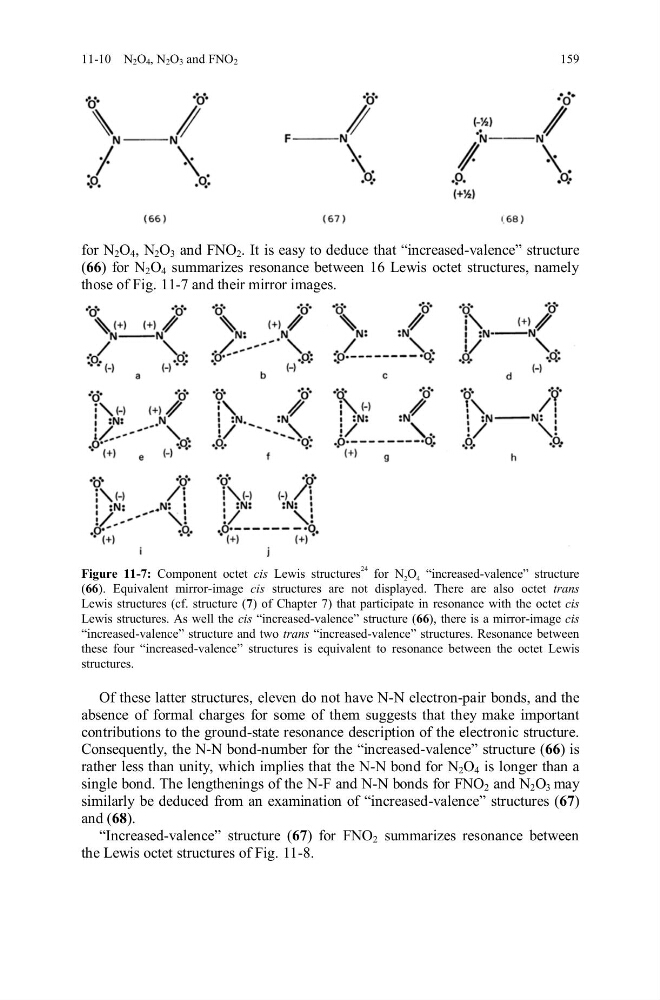
for N 2 O 4 , N 2 O 3 and FNO 2 . It is easy to deduce that “increased-valence” structure
(66) for N 2 O 4 summarizes resonance between 16 Lewis octet structures, namely
those of Fig. 11-7 and their mirror images.
Of these latter structures, eleven do not have N-N electron-pair bonds, and the
absence of formal charges for some of them suggests that they make important
contributions to the ground-state resonance description of the electronic structure.
Consequently, the N-N bond-number for the “increased-valence” structure (66) is
rather less than unity, which implies that the N-N bond for N 2 O 4 is longer than a
single bond. The lengthenings of the N-F and N-N bonds for FNO 2 and N 2 O 3 may
similarly be deduced from an examination of “increased-valence” structures (67)
and (68).
“Increased-valence” structure (67) for FNO 2 summarizes resonance between
the Lewis octet structures of Fig. 11-8.
Figure 11-7: Component octet cis Lewis structures
24 for N 2 O 4 “increased-valence” structure
(66). Equivalent mirror-image cis structures are not displayed. There are also octet trans
Lewis structures (cf. structure (7) of Chapter 7) that participate in resonance with the octet cis
Lewis structures. As well the cis “increased-valence” structure (66), there is a mirror-image cis
“increased-valence” structure and two trans “increased-valence” structures. Resonance between
these four “increased-valence” structures is equivalent to resonance between the octet Lewis
structures.
159
for N 2 O 4 , N 2 O 3 and FNO 2 . It is easy to deduce that “increased-valence” structure
(66) for N 2 O 4 summarizes resonance between 16 Lewis octet structures, namely
those of Fig. 11-7 and their mirror images.
Of these latter structures, eleven do not have N-N electron-pair bonds, and the
absence of formal charges for some of them suggests that they make important
contributions to the ground-state resonance description of the electronic structure.
Consequently, the N-N bond-number for the “increased-valence” structure (66) is
rather less than unity, which implies that the N-N bond for N 2 O 4 is longer than a
single bond. The lengthenings of the N-F and N-N bonds for FNO 2 and N 2 O 3 may
similarly be deduced from an examination of “increased-valence” structures (67)
and (68).
“Increased-valence” structure (67) for FNO 2 summarizes resonance between
the Lewis octet structures of Fig. 11-8.
Figure 11-7: Component octet cis Lewis structures
24 for N 2 O 4 “increased-valence” structure
(66). Equivalent mirror-image cis structures are not displayed. There are also octet trans
Lewis structures (cf. structure (7) of Chapter 7) that participate in resonance with the octet cis
Lewis structures. As well the cis “increased-valence” structure (66), there is a mirror-image cis
“increased-valence” structure and two trans “increased-valence” structures. Resonance between
these four “increased-valence” structures is equivalent to resonance between the octet Lewis
structures.