

7-1 The Long, Weak N-N Bond of N2O4: Lewis Valence-Bond Theory
89
which is a trans analogue of structure 6)
i
, may be used to describe the electronic
structure of N 2 O 4 when charge-transfer between the NO 2 moieties is not
considered. Therefore, the N-N bond number for N 2 O 4 (i.e. the number of pairs of
electrons that form the N-N bond) must be smaller than the bond-number of unity
that pertains for the N-N single-bond of 2 4
N H (as in
··
2
2
··
H N — N H ). A less-thanunity bond-number implies that the N-N bond is longer than a single bond.
Estimates of the N-N bond-number are 0.34 from the bond-length and 0.24 from
the photo-electron spectrum
7c
.
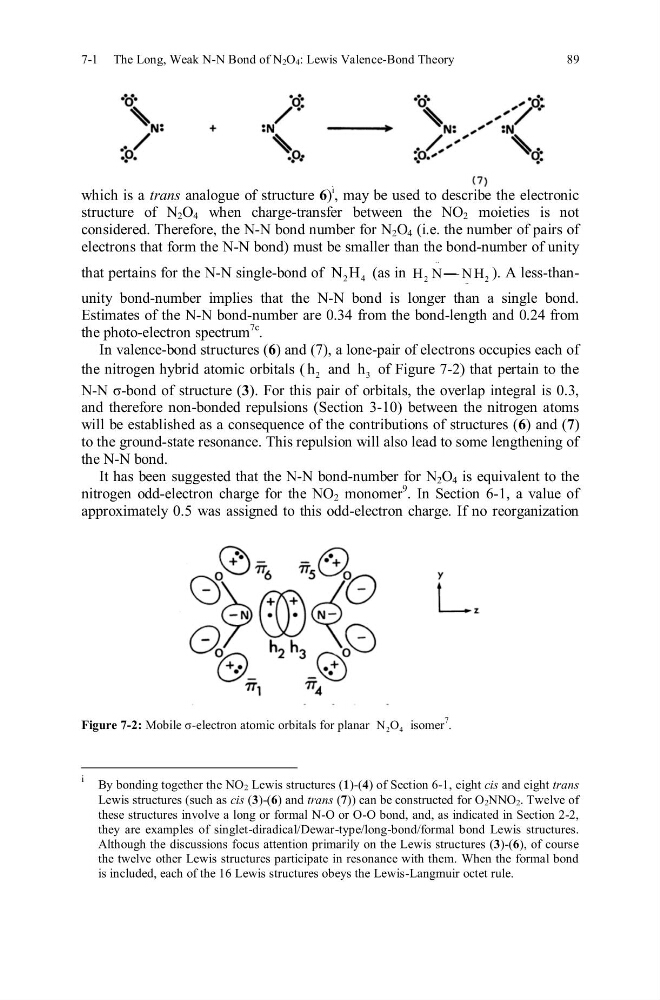
In valence-bond structures (6) and (7), a lone-pair of electrons occupies each of
the nitrogen hybrid atomic orbitals ( 2
h and 3
h of Figure 7-2) that pertain to the
N-N σ-bond of structure (3). For this pair of orbitals, the overlap integral is 0.3,
and therefore non-bonded repulsions (Section 3-10) between the nitrogen atoms
will be established as a consequence of the contributions of structures (6) and (7)
to the ground-state resonance. This repulsion will also lead to some lengthening of
the N-N bond.
It has been suggested that the N-N bond-number for N 2 O 4 is equivalent to the
nitrogen odd-electron charge for the NO 2 monomer
9 . In Section 6-1, a value of
approximately 0.5 was assigned to this odd-electron charge. If no reorganization
Figure 7-2: Mobile σ-electron atomic orbitals for planar 2 4
N O isomer
7
.
i By bonding together the NO2 Lewis structures (1)-(4) of Section 6-1, eight cis and eight trans
Lewis structures (such as cis (3)-(6) and trans (7)) can be constructed for O2NNO2. Twelve of
these structures involve a long or formal N-O or O-O bond, and, as indicated in Section 2-2,
they are examples of singlet-diradical/Dewar-type/long-bond/formal bond Lewis structures.
Although the discussions focus attention primarily on the Lewis structures (3)-(6), of course
the twelve other Lewis structures participate in resonance with them. When the formal bond
is included, each of the 16 Lewis structures obeys the Lewis-Langmuir octet rule.
89
which is a trans analogue of structure 6)
i
, may be used to describe the electronic
structure of N 2 O 4 when charge-transfer between the NO 2 moieties is not
considered. Therefore, the N-N bond number for N 2 O 4 (i.e. the number of pairs of
electrons that form the N-N bond) must be smaller than the bond-number of unity
that pertains for the N-N single-bond of 2 4
N H (as in
··
2
2
··
H N — N H ). A less-thanunity bond-number implies that the N-N bond is longer than a single bond.
Estimates of the N-N bond-number are 0.34 from the bond-length and 0.24 from
the photo-electron spectrum
7c
.
In valence-bond structures (6) and (7), a lone-pair of electrons occupies each of
the nitrogen hybrid atomic orbitals ( 2
h and 3
h of Figure 7-2) that pertain to the
N-N σ-bond of structure (3). For this pair of orbitals, the overlap integral is 0.3,
and therefore non-bonded repulsions (Section 3-10) between the nitrogen atoms
will be established as a consequence of the contributions of structures (6) and (7)
to the ground-state resonance. This repulsion will also lead to some lengthening of
the N-N bond.
It has been suggested that the N-N bond-number for N 2 O 4 is equivalent to the
nitrogen odd-electron charge for the NO 2 monomer
9 . In Section 6-1, a value of
approximately 0.5 was assigned to this odd-electron charge. If no reorganization
Figure 7-2: Mobile σ-electron atomic orbitals for planar 2 4
N O isomer
7
.
i By bonding together the NO2 Lewis structures (1)-(4) of Section 6-1, eight cis and eight trans
Lewis structures (such as cis (3)-(6) and trans (7)) can be constructed for O2NNO2. Twelve of
these structures involve a long or formal N-O or O-O bond, and, as indicated in Section 2-2,
they are examples of singlet-diradical/Dewar-type/long-bond/formal bond Lewis structures.
Although the discussions focus attention primarily on the Lewis structures (3)-(6), of course
the twelve other Lewis structures participate in resonance with them. When the formal bond
is included, each of the 16 Lewis structures obeys the Lewis-Langmuir octet rule.