

88
Chapter 7 Some Dimers of Triatomic Radicals with 17 and 19 Valence-Shell Electrons
bond theory may be used to explain why the N-N bond is long and weak. The
Lewis-type valence-bond explanation follows immediately from the valence-bond
description of the electronic structure of
2
NO (Section 6-1).
We shall assume here that the electronic structure of the ground-state for NO 2
may be described by invoking resonance between the valence-bond structures (1)(4) of Section 6-1. (For convenience only, we shall initially restrict our attention to
structures (1) and (2), but is to be understood that these valence-bond structures
participate in resonance with the symmetrically-equivalent structures (3) and (4).)
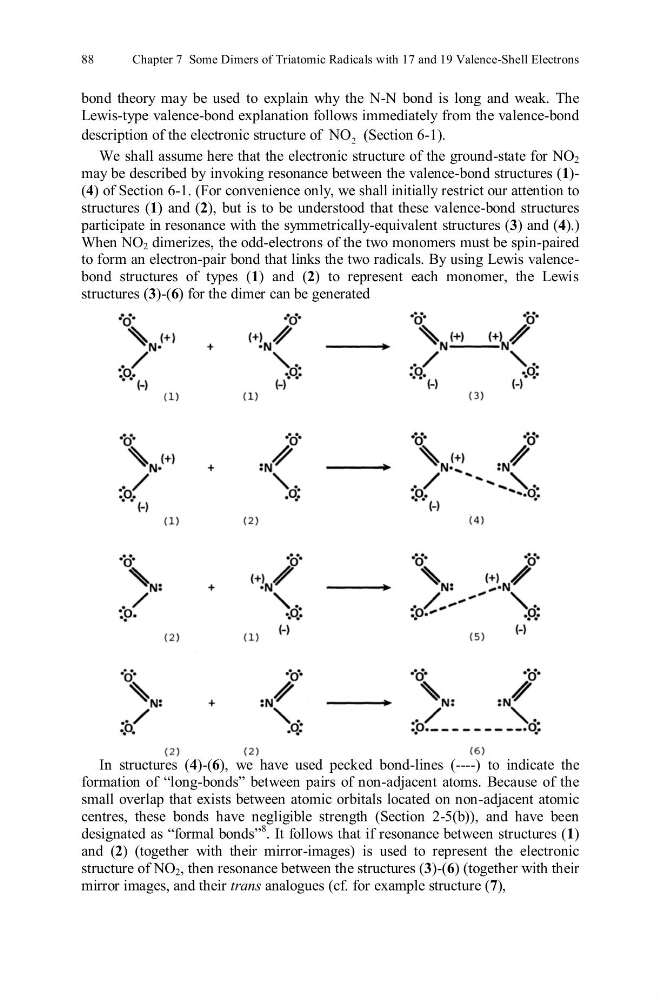
When NO 2 dimerizes, the odd-electrons of the two monomers must be spin-paired
to form an electron-pair bond that links the two radicals. By using Lewis valencebond structures of types (1) and (2) to represent each monomer, the Lewis
structures (3)-(6) for the dimer can be generated
In structures (4)-(6), we have used pecked bond-lines (----) to indicate the
formation of “long-bonds” between pairs of non-adjacent atoms. Because of the
small overlap that exists between atomic orbitals located on non-adjacent atomic
centres, these bonds have negligible strength (Section 2-5(b)), and have been
designated as “formal bonds”
8
. It follows that if resonance between structures (1)
and (2) (together with their mirror-images) is used to represent the electronic
structure of NO 2 , then resonance between the structures (3)-(6) (together with their
mirror images, and their trans analogues (cf. for example structure (7),
Chapter 7 Some Dimers of Triatomic Radicals with 17 and 19 Valence-Shell Electrons
bond theory may be used to explain why the N-N bond is long and weak. The
Lewis-type valence-bond explanation follows immediately from the valence-bond
description of the electronic structure of
2
NO (Section 6-1).
We shall assume here that the electronic structure of the ground-state for NO 2
may be described by invoking resonance between the valence-bond structures (1)(4) of Section 6-1. (For convenience only, we shall initially restrict our attention to
structures (1) and (2), but is to be understood that these valence-bond structures
participate in resonance with the symmetrically-equivalent structures (3) and (4).)
When NO 2 dimerizes, the odd-electrons of the two monomers must be spin-paired
to form an electron-pair bond that links the two radicals. By using Lewis valencebond structures of types (1) and (2) to represent each monomer, the Lewis
structures (3)-(6) for the dimer can be generated
In structures (4)-(6), we have used pecked bond-lines (----) to indicate the
formation of “long-bonds” between pairs of non-adjacent atoms. Because of the
small overlap that exists between atomic orbitals located on non-adjacent atomic
centres, these bonds have negligible strength (Section 2-5(b)), and have been
designated as “formal bonds”
8
. It follows that if resonance between structures (1)
and (2) (together with their mirror-images) is used to represent the electronic
structure of NO 2 , then resonance between the structures (3)-(6) (together with their
mirror images, and their trans analogues (cf. for example structure (7),