

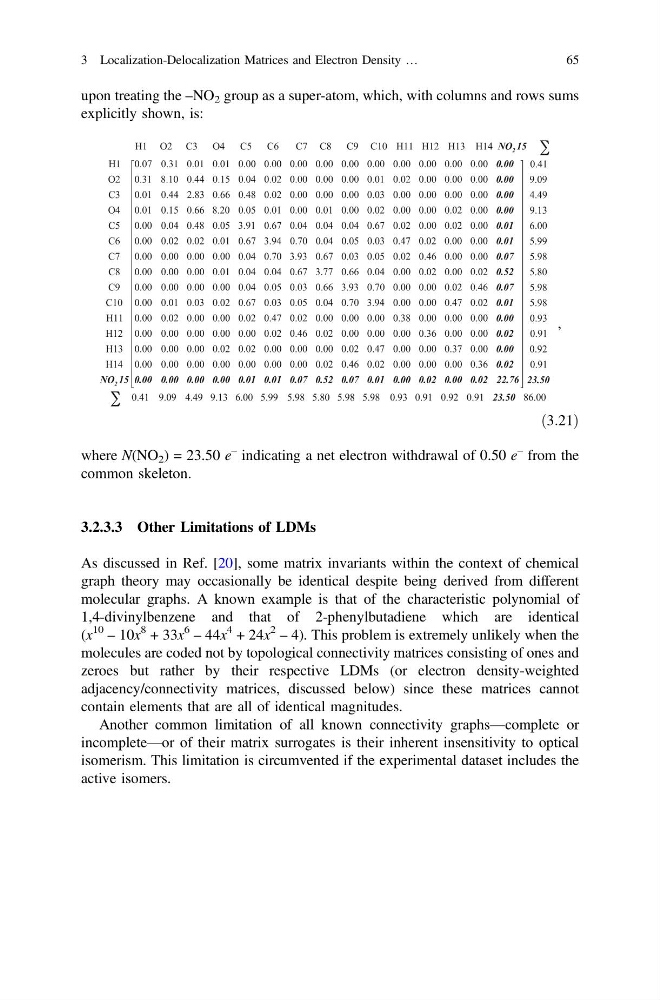
upon treating the –NO 2 group as a super-atom, which, with columns and rows sums
explicitly shown, is:
ð3:21Þ
where N(NO 2 ) = 23.50 e
– indicating a net electron withdrawal of 0.50 e
– from the
common skeleton.
3.2.3.3 Other Limitations of LDMs
As discussed in Ref. [20], some matrix invariants within the context of chemical
graph theory may occasionally be identical despite being derived from different
molecular graphs. A known example is that of the characteristic polynomial of
1,4-divinylbenzene and that of 2-phenylbutadiene which are identical
(x
10
– 10x
8 + 33x
6
– 44x
4 + 24x
2
– 4). This problem is extremely unlikely when the
molecules are coded not by topological connectivity matrices consisting of ones and
zeroes but rather by their respective LDMs (or electron density-weighted
adjacency/connectivity matrices, discussed below) since these matrices cannot
contain elements that are all of identical magnitudes.
Another common limitation of all known connectivity graphs—complete or
incomplete—or of their matrix surrogates is their inherent insensitivity to optical
isomerism. This limitation is circumvented if the experimental dataset includes the
active isomers.
3 Localization-Delocalization Matrices and Electron Density …
65
explicitly shown, is:
ð3:21Þ
where N(NO 2 ) = 23.50 e
– indicating a net electron withdrawal of 0.50 e
– from the
common skeleton.
3.2.3.3 Other Limitations of LDMs
As discussed in Ref. [20], some matrix invariants within the context of chemical
graph theory may occasionally be identical despite being derived from different
molecular graphs. A known example is that of the characteristic polynomial of
1,4-divinylbenzene and that of 2-phenylbutadiene which are identical
(x
10
– 10x
8 + 33x
6
– 44x
4 + 24x
2
– 4). This problem is extremely unlikely when the
molecules are coded not by topological connectivity matrices consisting of ones and
zeroes but rather by their respective LDMs (or electron density-weighted
adjacency/connectivity matrices, discussed below) since these matrices cannot
contain elements that are all of identical magnitudes.
Another common limitation of all known connectivity graphs—complete or
incomplete—or of their matrix surrogates is their inherent insensitivity to optical
isomerism. This limitation is circumvented if the experimental dataset includes the
active isomers.
3 Localization-Delocalization Matrices and Electron Density …
65